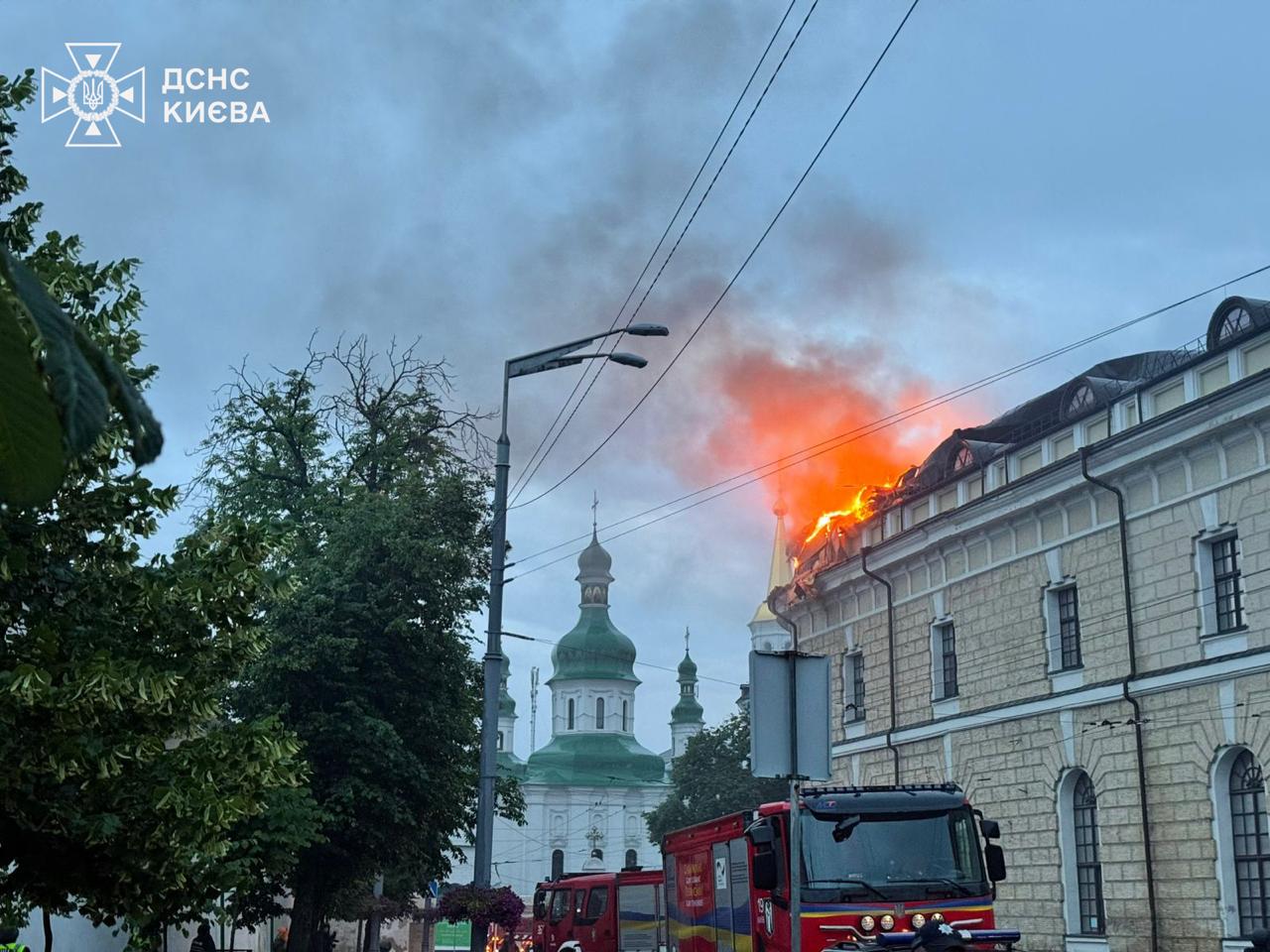
On the night of June 10, 2025, Russia delivered one of the largest airstrikes throughout the full-scale war — approximately 500 drones and over 10 missiles of various types. The primary target was Kyiv. Among the damaged objects was the Assumption Cathedral of the Kyiv-Pechersk Lavra, dating back to the 11th century. The building's roof caught fire, with the blaze covering approximately 800 square meters.
According to Reuters and Kyiv's State Emergency Service, firefighters and monastery personnel managed to localize the fire. Bishop Avramiy reported that an urgent evacuation of sacred relics and liturgical items began that same night.
"Forever inscribed his name on the list of the worst barbarians"
Foreign Minister Andrii Sybiha responded sharply and without diplomatic euphemisms. According to him, Putin, by striking one of Christianity's greatest shrines, "has forever inscribed his name on the list of the worst barbarians in history."
"From the Horde in the 13th century to the Nazis and Bolsheviks in the 20th — Kyiv's holy places survived barbarians. Now we are dealing with Russian terrorists who have already surpassed ISIS in their crimes against cultural heritage."
Andrii Sybiha, Ukraine's Foreign Minister
Sybiha announced the urgent initiation of all relevant procedures within UNESCO and other international mechanisms, adding a specific demand: "No vague words, silence, or weak steps."
The Lavra as an object of international law
The Lavra complex was inscribed on UNESCO's World Heritage List in 1990. In September 2023, it was added to the List of World Heritage in Danger and also received international status of enhanced protection of cultural property. Despite three levels of protection, no enforcement mechanism exists that could stop a strike or automatically provide for sanctions.
UNESCO responded with a statement on June 11, expressing "deep concern" and directly naming the Russian Federation as responsible. However, the organization limited itself to words about the "gravity of the situation" without concrete tools of influence.
What Europe and the USA are saying
Estonian Foreign Minister Margus Tsahkna wrote on social network X: "Russia loves to present itself as a defender of Christian civilization. By striking the Lavra, it once again demonstrated its barbarism and contempt for humanity's shared heritage."
Latvia's Foreign Ministry, led by Baiba Braže, called for preventing the "normalization" of this war and appealed to the Venice Biennale and UNESCO with a demand to review Russia's participation in international cultural events.
Primate of the Orthodox Church of Ukraine Metropolitan Epifaniy called the strike "a crime against humanity, against history, against Christianity" and called for international prayers and protection.
From the USA — so far restrained. American pastor Mark Burns, considered close to Donald Trump, wrote on X that his "heart is with the people of Ukraine" and called for prayer. Former U.S. Ambassador to Ukraine Bridget Brink reminded that Trump promised to end this war "on day one."
A precedent without consequences?
This is the second strike on the Lavra since the beginning of the full-scale war and only the third since World War II. The first was delivered by Russia itself in 1941, when it blew up the Assumption Cathedral, which was then rebuilt over decades.
The reaction of international institutions so far fits the familiar algorithm: statements — without a mechanism of accountability. If UNESCO does not introduce specific legal consequences for a country that strikes an object under enhanced protection, the strike on the Lavra will remain another precedent without unprecedented consequences — and a signal that three levels of international protection protect nothing.





