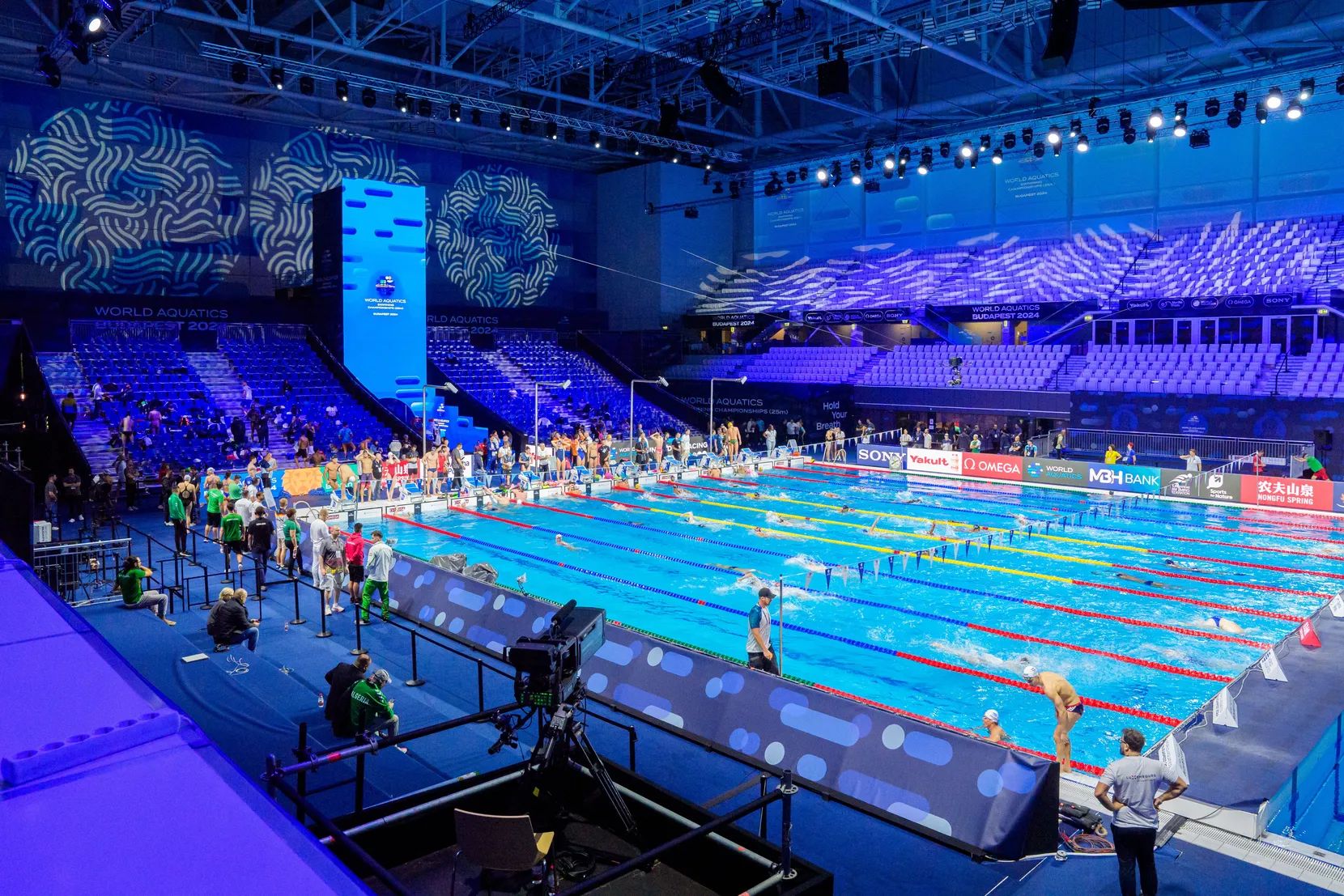
Four years after the invasion, while Ukrainian cities remain under fire, World Aquatics became the first major international federation to completely lift restrictions for adult athletes from Russia and Belarus — including the right to compete under the national flag, anthem, and national team uniform.
The federation's Bureau decision was dated April 13. It applies to swimming, diving, water polo, and other disciplines under the organization's jurisdiction. Russia and Belarus also regained full membership rights in the organization.
«We are firmly committed to ensuring that pools and open water venues remain places where athletes from all countries can gather together for peaceful competition»
— World Aquatics President Hussein Al-Musallam
According to the president of the Russian federation of aquatic sports, Dmitry Mazepin, the return under the flag was the result of long lobbying — he personally met with Al-Musallam to negotiate reintegration before the Los Angeles 2028 Games begin.
What lies behind "background checks"
Formally, the federation set a condition: each athlete must pass four anti-doping tests and so-called "background checks" before their first start. However, as AP notes, the federation never clarified exactly what is being checked in these "checks." According to World Aquatics, since 2023, athletes have already undergone over 700 such screenings — but the screening criteria have never been publicly disclosed.
The decision was adopted without any link to a ceasefire, peace negotiations, or other conditions related to the war.
Where World Aquatics diverged from the IOC
This is a principally important moment. The IOC in December 2025 recommended lifting restrictions for junior competitions — but maintained neutral status for adults. At the 2026 Winter Games, Russians and Belarusians officially competed as «Individual Neutral Athletes». World Aquatics essentially went against this recommendation — and became a precedent among federations recognized by the IOC.
Some organizations — particularly in volleyball and fencing — still maintain restrictions at the adult level. This means that World Aquatics' decision does not automatically entail a general review of sports sanctions, but, as AP notes, «may add momentum for the full return of Russian athletes before the 2028 Games».
Ukraine's reaction
Ukraine's Ministry of Youth and Sports called the decision a «legitimization of aggression». The Ukrainian Swimming Federation also reacted critically — earlier, the national water polo team officially refused to play against Russians even under a «neutral» flag. Now the question is more acute: will Ukrainian athletes participate in competitions where Russians compete not as «neutral» athletes, but as a full national team.
The decision applies only to events under World Aquatics' jurisdiction — but a precedent has been set. If one or two other major federations follow the same path by the end of 2026, the IOC will come under pressure to review the neutral status for Los Angeles as well. Everything depends on whether there is even one organization that publicly explains exactly what "background checks" verify — and whether admission is linked to any condition related to the war.