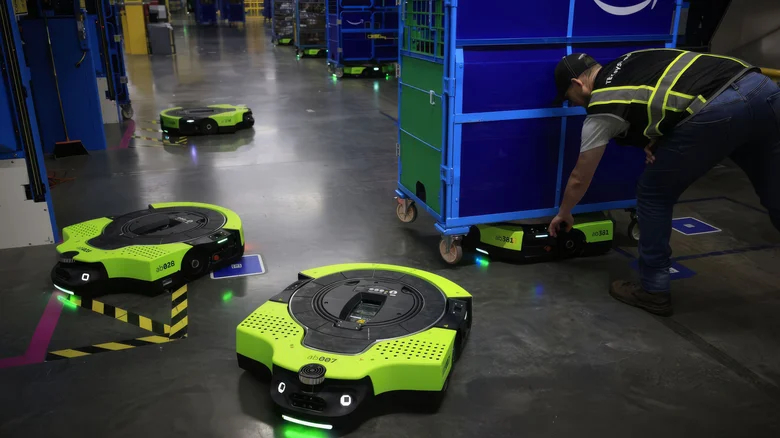
On June 4, at the Delivering the Future presentation in Dartford, UK, Amazon showcased an updated Proteus — a heavyweight wheeled platform resembling an industrial Roomba that moves cargo carts weighing up to 400 kilograms. The novelty is singular: the robot now understands natural language.
"You tell it what needs to be done. It determines the priority, route, and timing itself."
Scott Dresser, Vice President of Amazon Robotics
Before the upgrade, operators entered commands through specialized software. Now — as if speaking with a colleague. An AI layer analyzes the request, creates a plan, and executes it without additional instructions. Meanwhile, the scope of operations has also expanded: whereas the old Proteus only operated between loading docks, the new one can work throughout the warehouse — from container reception to movements between workstations.
€10 billion and one million robots
The presentation took place against the backdrop of Amazon's announced €10 billion investment in developing Europe's logistics infrastructure. Proteus is part of this package. According to Engadget, the company has already deployed over one million robots across its warehouse network worldwide, and the ratio of robots to human workers is approaching 1:1 — with a workforce of approximately 1.5 million people.
For now, the new version of Proteus is deployed at 25 facilities in the US, but scaling is built into the product's logic itself: the less training required to work with a robot, the faster it can be replicated.
Official version and leaks
Amazon traditionally frames automation as a "complement to human labor": robots take on physically demanding tasks, while people focus on quality control and equipment maintenance. This exact message was delivered at the Dartford presentation.
However, internal company documents previously appeared online, according to which the robotics division aims to automate 75% of operations, and between 2025 and 2027, automation could allow the company to avoid hiring approximately 160,000 new workers in the US. By 2033, according to the same materials, up to 600,000 positions — stackers, pickers, packers — could be replaced. Amazon responded in standard fashion: the documents "do not reflect the company's overall strategy."
What actually changed
Technically, a language interface is a reduction of entry barriers: a warehouse worker with no technical training can assign a task to the robot the same way they would dictate a voice message. But this is exactly what makes automation cheaper to deploy and maintain.
- Old Proteus — fixed route, dock zone, specialized software for management.
- New Proteus — entire warehouse, natural language, autonomous task planning.
The difference between these two lines is the difference between a tool and the replacement of an entire category of work.
If Amazon deploys the new version of Proteus across all 25 current facilities by year's end and publicly confirms efficiency metrics — the question of how many "new jobs in robot servicing" will actually compensate for lost picker positions will become significantly more concrete than it is now.