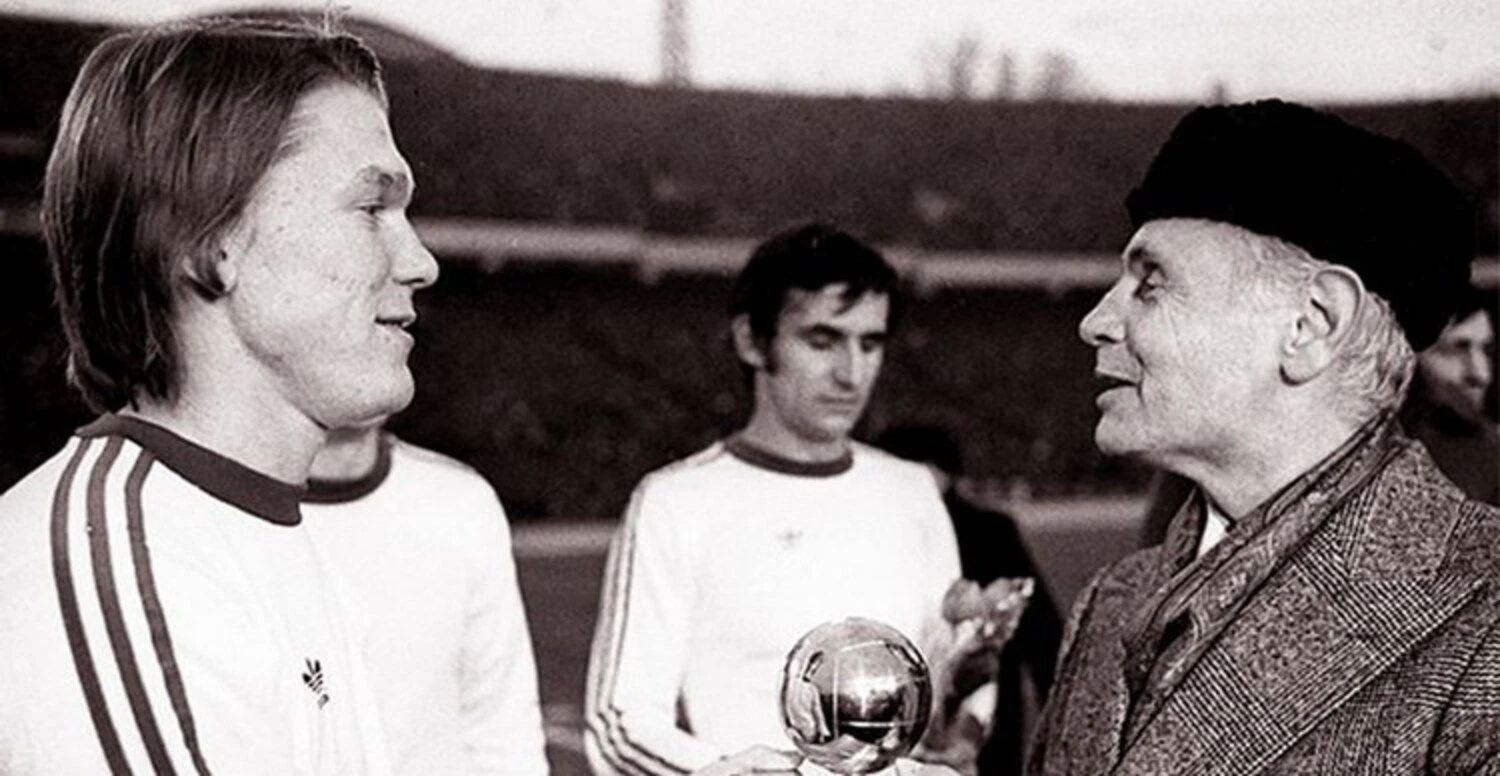
Memorable winter of 1975: the award that put Ukrainian football on Europe’s radar
On 30 December 1975 the magazine France Football published the results of the vote to determine Europe’s best footballer — the "Golden Ball." In the jubilee, 20th poll the winner was the striker of Kyiv’s Dynamo and the USSR national team, Oleh Blokhin (122 points). He comfortably outpaced such renowned rivals as Franz Beckenbauer (42 points) and Johan Cruyff (27 points). This information is provided by the Ukrainian Association of Football and the archives of France Football.
An undisputed victory in the jubilee, 20th poll was claimed by the striker of Kyiv's "Dynamo" and the USSR national team, Oleh Blokhin (122 points), who crushed in the voting such stars of world football as the German Franz Beckenbauer (42 points) and the Dutchman Johan Cruyff (27 points).
— Ukrainian Association of Football / France Football (archive)
Not just talent: why Blokhin was noticed in Europe
This distinction was the result of the systematic work of Kyiv’s Dynamo under Valeriy Lobanovskyi. In 1975 the team won the Cup Winners’ Cup and the UEFA Super Cup, beating Munich’s Bayern twice. It was precisely the combination of Blokhin’s individual class and the team’s tactical discipline that made him visible to European journalists and club captains who voted in France Football.
The laureate’s voice
I found out about the victory a week before the New Year. I think I was sitting at home — I supposedly had something wrong with my leg then. Someone from the editorial office of the newspaper "Sovetsky Sport" called me and informed me of winning the "Golden Ball." At first I thought it was a pre-New Year’s joke.
— Oleh Blokhin
Legacy and significance for Ukraine
Blokhin became the second Soviet holder of the "Golden Ball" after Lev Yashin, but the first to be recognized specifically as a Ukrainian in spirit and in the place where he developed as a player. This path was later continued by Ihor Belanov (1986) and Andriy Shevchenko (2004). For Ukrainian football, 1975 is not only a personal accolade but a symbol: proof that club academies and Lobanovskyi’s coaching school could produce players of world-class level.
From 1975 to today
Today the "Golden Ball" remains one of the benchmarks for recognizing individual excellence — its recent holders include Ousmane Dembélé and Aitana Bonmatí. But for Ukraine the year 1975 carries special weight: it is an example of how systematic work, investment in coaching and playing culture produce results that go beyond statistics.
Analytical summary: Blokhin’s victory was both a sporting triumph and a message to the world — Ukrainian football can compete at the highest level. Today this reminder is important not only for memory but also for how to build future successes — through infrastructure, coach education and support for youth programs.







