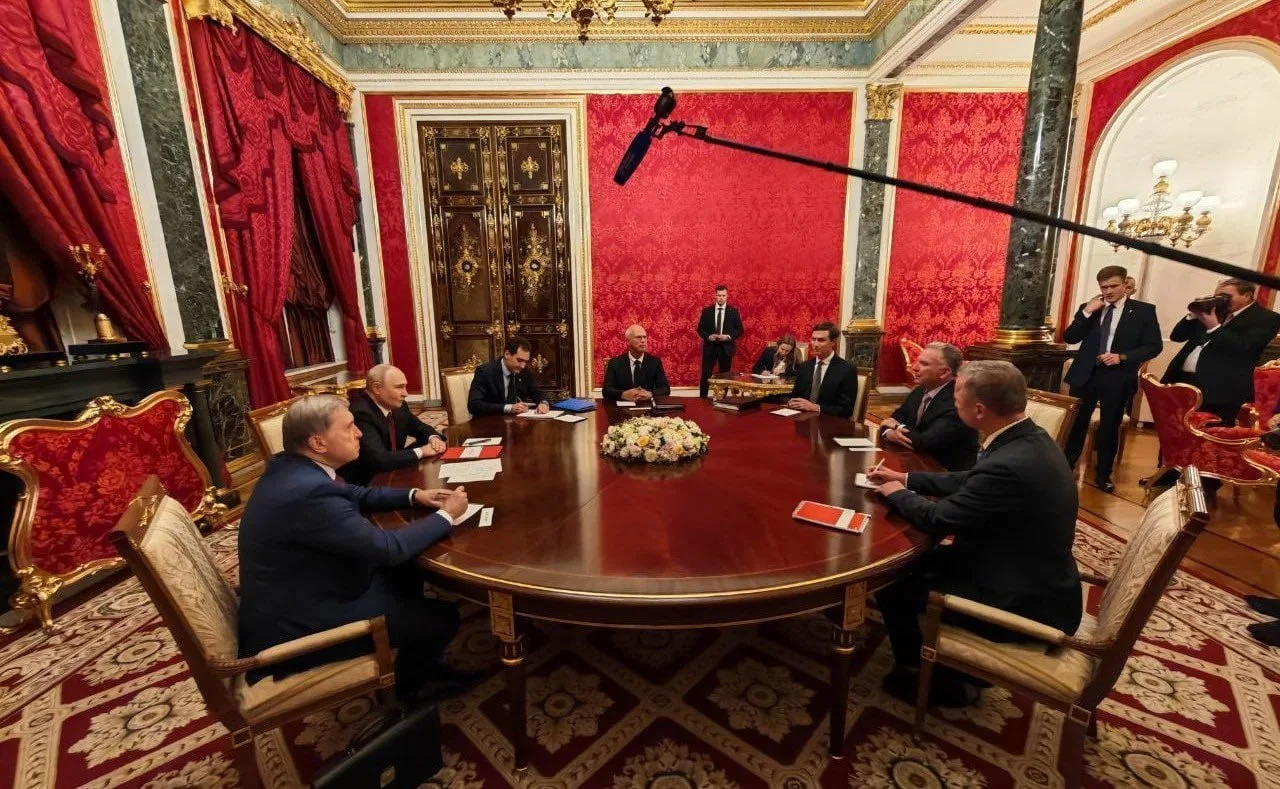
On Saturday, September 5, U.S. presidential special envoys Steve Witkoff and Jared Kushner spent more than three hours at the negotiating table with Vladimir Putin in Moscow. Putin's assistant Yuri Ushakov called the conversation "substantive, constructive, and maximally frank" after the meeting, and clarified that it lasted 3 hours and 10 minutes. The problem is that none of these characteristics represent commitments, but merely the Kremlin's assessment of its own conversation.
What Actually Happened
Formally, the fact of the meeting is confirmed: the Kremlin on Saturday, September 5, conducted negotiations with two U.S. representatives — Steve Witkoff and Jared Kushner — for more than three hours. However, after the conversation ended, the American envoys made no public statements and immediately left Moscow. The Kremlin called the negotiations "extraordinarily important," but announced no specific breakthrough.
The White House was more cautious than the Russians in its commentary: the conversation was described as "substantive," and regarding next steps they promised to announce details only "in the coming weeks" — a formulation that fixes neither the content nor the timeline.
Ushakov's Declaration vs. What It Actually Means
The list of theses voiced by Ushakov at the conclusion of the meeting reads like an action plan, but in fact is merely a recapitulation of one side's position:
- Witkoff and Kushner allegedly "took note" and promised to consider Putin's assessments regarding paths to settlement in tomorrow's negotiations in Kyiv — meaning they are bringing the Russian framework to Kyiv, not an agreed-upon compromise;
- Putin insisted on "eliminating all root causes" of the conflict — a formulation Russia has used for years to justify maximalist demands and which has no agreed-upon definition;
- the dictator noted the "successes" of Russian military forces and confidence in achieving the goals of the war — a thesis for domestic audiences, not for negotiations;
- as a separate point in the report is the phrase that "the Kyiv regime stopped hiding its essence, by reburying Nazis" — a rhetorical insertion without any specifics, which diplomatic protocol somehow records on the same level as points about settlement.
The last point is telling: when a propaganda formula appears in an official account of negotiations alongside mentions of "major Russian-American projects," it means that for Moscow the line between diplomatic protocol and television rhetoric has long been erased.
Mechanism of Implementation — Or Its Absence
Neither a joint statement, nor a signed document, nor an agreed-upon agenda resulted from the meeting. There is only a one-sided account from the Kremlin and a White House promise to provide details later. According to sources familiar with the negotiations, Witkoff's and Kushner's previous trips to Russia have produced no progress, and Moscow's demands are becoming increasingly harsh because the Kremlin believes it has military advantage. It is unclear even whether the American envoys brought any new ideas capable of breaking the deadlock in negotiations.
Putin also made clear during the meeting that he does not consider himself bound by Kyiv's initiatives: he stated that Ukraine's call for a broader ceasefire lasting three days was never coordinated with Moscow. This is a direct illustration of the fact that Russia rejects even partial humanitarian proposals without explanation — and this is precisely what will be presented in Kyiv as part of "Putin's assessments."
What's Next
Witkoff's and Kushner's next stop is Kyiv, where they are due to arrive on September 6. If they present there only a recapitulation of Moscow's position on "root causes" and repeat the thesis about "zero strikes on Kyiv" as a gesture of good faith, this will become another round of contacts without consequences — simply the third in a row after previous unsuccessful trips. The question that should be asked already tomorrow is: will the Americans bring to Kyiv even one point fixed on paper and confirmed by both sides, or will it again be only about a "constructive atmosphere" that each side interprets in its own way.