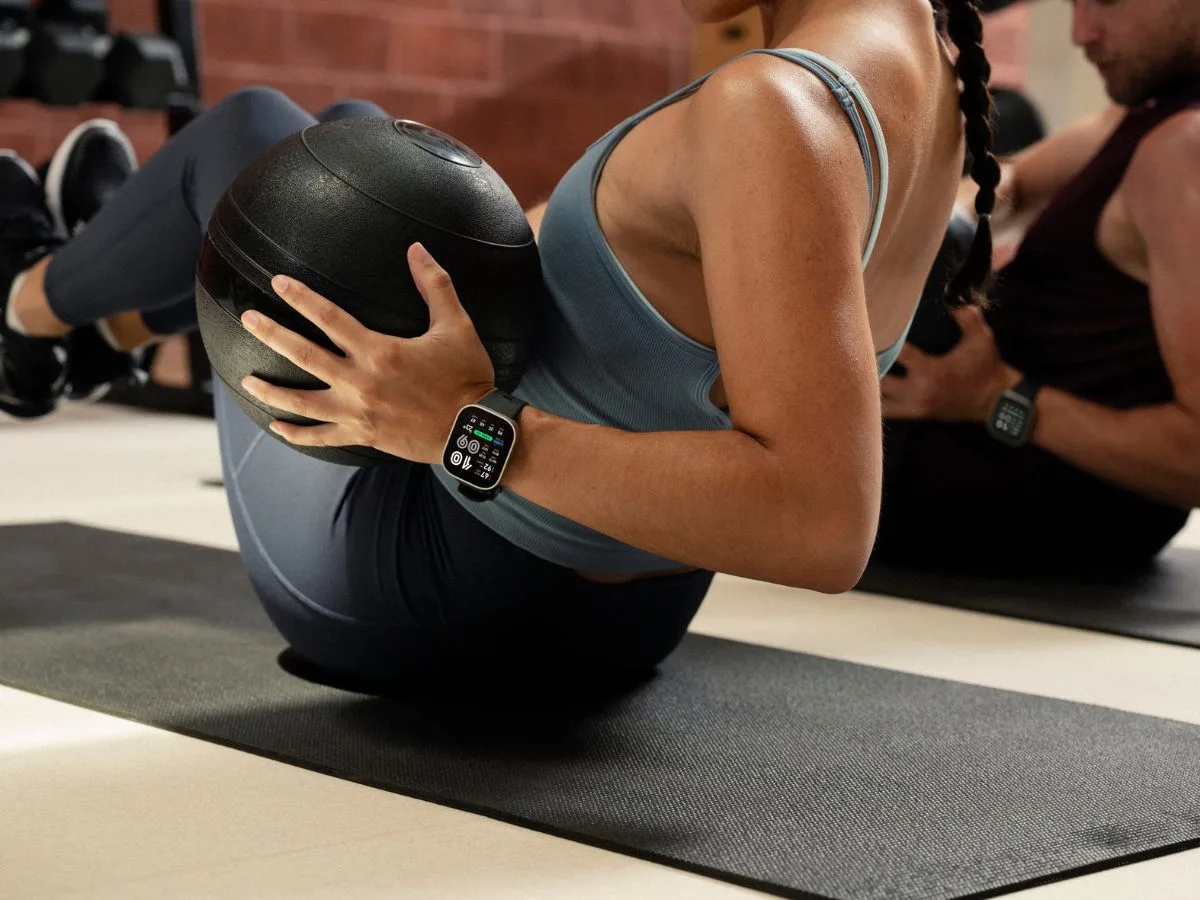
There are things that annoy users about smartwatches more than anything else: a small screen, constant charging, and lack of memory for anything useful. Amazfit Bip Max attacks all three problems at once — and does so at a price below $100.
What changed compared to Bip 6
Bip Max received a 2.07-inch AMOLED display with brightness up to 3000 nits — 0.1 inches larger than the Bip 6, but the difference is noticeable: the same chassis now looks like a full-fledged device, not a "basic fitness band on the wrist". Battery life lasts up to 20 days, exceeding most competitors in a segment where 7–14 days is the standard.
The most striking difference is in memory. Bip Max has 4 GB, while Bip 6 has only 512 MB, with about 100 MB available for files. This is a fundamental difference: on Max you can store offline maps and music, meaning the watch gains real independence from your smartphone, rather than just "duplicating" its notifications.
«Bip Max feels less like a basic fitness watch and more like a low cost smartwatch with some proper offline capability»
— Wareable, comparing Bip Max and Bip 6
Where Amazfit isn't rushing to change
The sensor base remained virtually unchanged: both watches use BioTracker PPG with 5PD and 2LED, accelerometer, gyroscope, and light sensor. In other words, this is not a health monitoring upgrade — it's an upgrade to form factor and convenience. NFC is absent on both; wireless payments are not available and won't be.
Among new features are BioCharge (energy level monitoring), hybrid workout support, offline maps for over 40,000 routes, and up to 100 hours of podcasts in memory. ZeppOS 5.0 adds Flow 2.0, screenshots, and navigation.
Market context: $100 is the new front line
The budget segment under $100 is now the most competitive in wearable electronics. Xiaomi, Honor, Huawei, and CMF by Nothing are actively competing for the same audience: people who need a reliable tracker without a premium price tag. Amazfit responds by bringing mid-range specifications into the lower price range: 3000 nits and 4 GB are not budget characteristics.
The Bip Max price is around $100, compared to $80 for Bip 6. For a $20 difference, the user gets eight times more memory and 6 additional days of battery life — if Amazfit's figures are confirmed in independent tests.
If real battery life in daily mode turns out to be at least 14–15 days (not laboratory 20 days), Bip Max becomes one of the strongest arguments in its price range. But if independent tests show 8–10 days — the marketing bet on "20 days" will backfire against the brand: this is exactly what Amazfit is building the difference between Max and all competitors on.