When a fund like Resist.UA completely exits a project and the founder sells part of their stake — this is not just a restructuring. It's a moment when volunteer logic gives way to production logic. This is exactly what happened with the ground robotic complex "Tesla".
What is "Tesla" and why it matters now
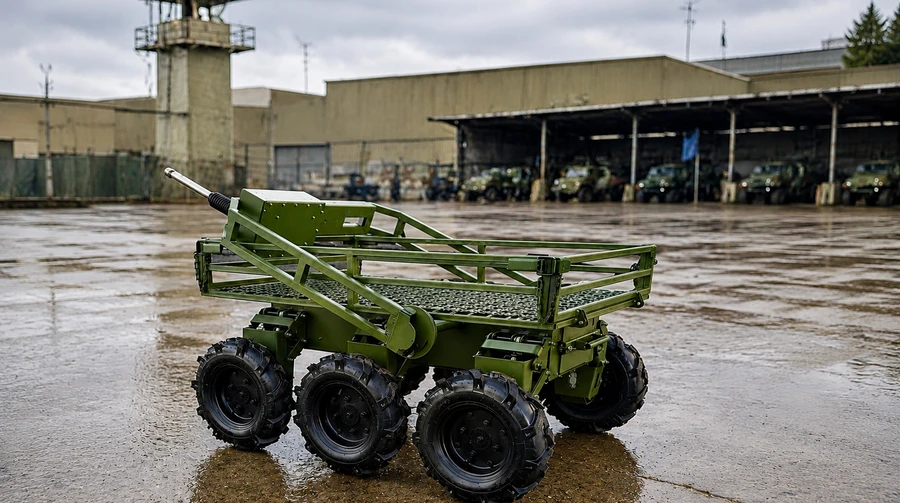
According to Defender Media, the company TAF Industries became the majority owner of Phantom Technology — the developer of the GRC "Tesla". The platform is capable of transporting up to 180 kg of cargo in autonomous or remote-controlled mode and is already being used on the front lines for two critical tasks: delivery of ammunition and equipment, as well as evacuation of the wounded from zones where human presence is an excessive risk.
Combat trials have been completed. This is not a concept or a bench model — the complex works in real conditions. This very fact makes TAF Industries' deal strategically significant: it's buying not an idea, but a verified technology.
The logic of the deal
Ground unmanned logistics-class platforms solve a specific tactical problem: the "last mile" to positions under fire costs human lives. According to estimates from various AFU brigades, a significant portion of non-combat casualties in certain sectors of the front is related precisely to supply under fire. A logistics robot does not replace a soldier — it removes him from under fire where possible.
TAF Industries positions itself as a defense-industrial sector company focused on scaling developments that have already proven effective. Resist.UA's exit — a fund that typically finances early stages — confirms that the project has outgrown the grant model.
"The platform has been tested in combat conditions and is being used for delivering equipment and evacuating the wounded from the front line."
TAF Industries, official communication
Context: ground drones in this war
Ukraine is one of the few theaters of military operations where ground robotic platforms are being tested in conditions of real high-intensity conflict. The ISW and a number of analytical centers note that both sides are accelerating UGV development after the saturation of the theater with FPV-drones complicated traditional front-line logistics. "Tesla" in this context is not an exotic solution, but a response to a documented tactical need.
- Payload capacity: up to 180 kg — sufficient for a stretcher with a wounded person or several boxes of ammunition
- Operating modes: autonomous and remote-controlled
- Confirmed application: logistics and medical evacuation in combat conditions
- Status: transition from research and pilot phase to serial production phase
The key scaling question is not technical, but organizational: will TAF Industries be able to integrate "Tesla" into the logistics chains of specific AFU units with unified operator training and service support? If so — the platform has a chance to become a standard tool rather than just another single solution in separate sectors of the front.