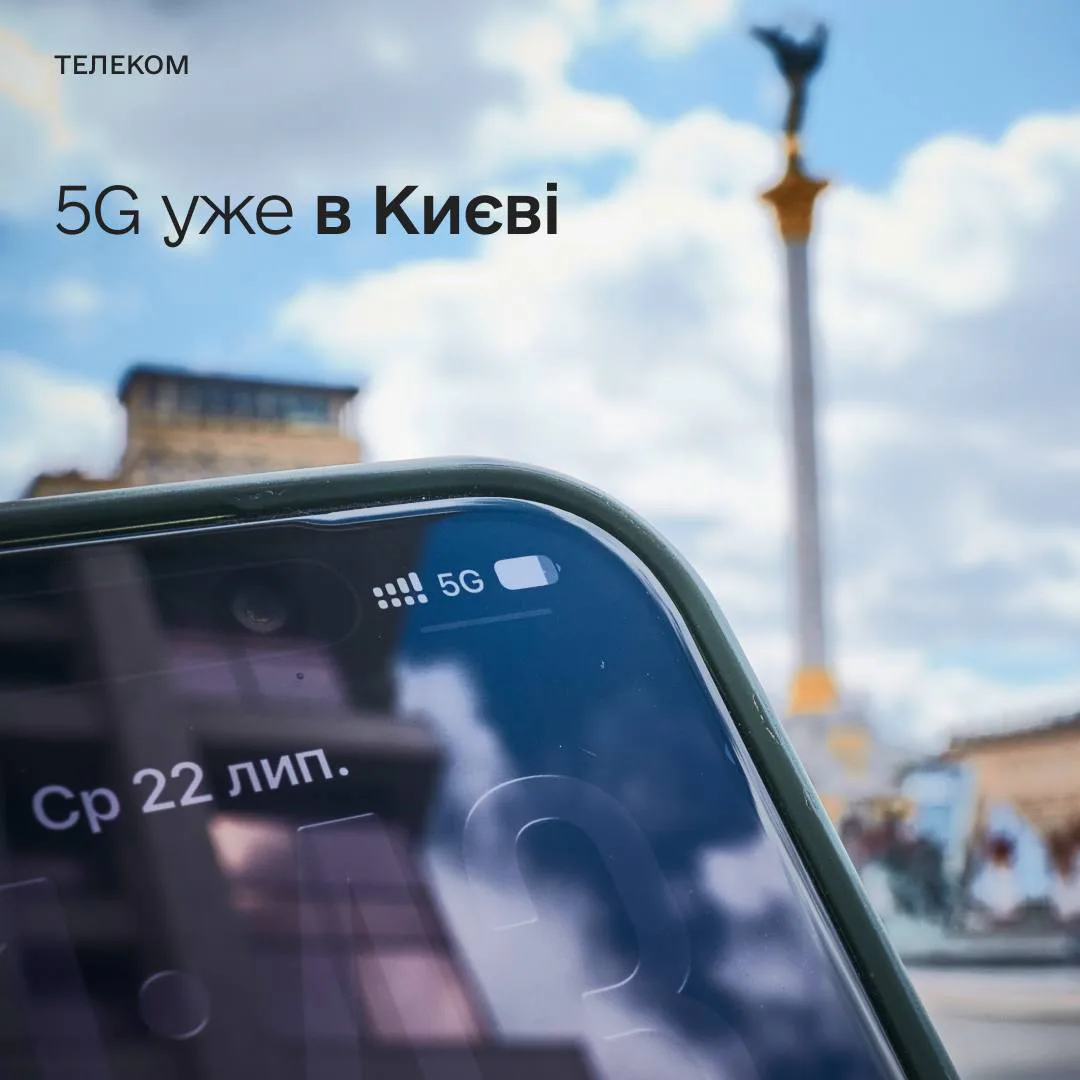
In central Kyiv — from Maidan Nezalezhnosti to Bessarabska Square — a pilot 5G network has officially launched. This is the fourth city after Lviv, Borodyanка, and Kharkiv where the Ministry of Digital Transformation is testing the next-generation network. According to Deputy Minister of Digital Transformation Stanislav Prybytko, the average speed in pilot zones is approximately 500–600 Mbps, with peaks exceeding 1 Gbps recorded — several times faster than standard 4G.
How to connect — and what's the catch
A new SIM card is not required. All you need is a 5G-compatible smartphone and to be within the coverage zone. All three major operators — Kyivstar, lifecell, and Vodafone Ukraine — confirmed that tariffs will not change during the testing phase: 5G will be available within existing 4G plans.
5G technology is new, and the impact on interaction with operator systems is still unknown. There are general requirements and expectations for how it will work. But the pilot will provide exactly the kind of testing needed to make it as effective as possible.
— Stanislav Prybytko, Deputy Minister of Digital Transformation, RBC Ukraine
However, there is a limitation: coverage spans only a few hundred meters in the city center. Outside the pilot zone, the network does not work — and for now, zone expansion is tied to the pace of operator preparation.
Why scaling is not a technical issue
The main barrier to 5G deployment across all of Ukraine is not equipment or budgets. The frequencies needed for a full fifth-generation network are adjacent to those used by the military. According to Prybytko, a full-scale launch across the entire country will only occur after the war ends — for security reasons. The pilot in Kyiv and previous cities is designed to gather practical data and technically prepare operator networks so that after deoccupation and lifting restrictions, deployment can proceed quickly.
- Lviv, Borodyanка, Kharkiv — the first three pilot cities, where the technology has already been used by over 300,000 subscribers
- Kyiv — the fourth city, coverage zone: Maidan Nezalezhnosti — Bessarabska Square
- Odesa — next in line after the capital
- All of Ukraine — only after martial law ends
What this pilot actually tests
The Ministry of Digital Transformation openly acknowledges: the pilot's goal is not so much to provide Kyivans with fast internet, but to understand how 5G interacts with operator infrastructure in real conditions. Kyiv was chosen deliberately: a city of millions with peak loads provides data that cannot be obtained in Borodyanка. Prybytko noted that the pilot is planned to continue beyond 2026 — to gather as much technical data as possible before full deployment becomes legally possible.
If operators gather sufficient data in Kyiv and Odesa by the end of 2026 — will that be enough to deploy the network across the entire country within the first year after the ceasefire, or will technical preparation lag behind political decision-making once again?







