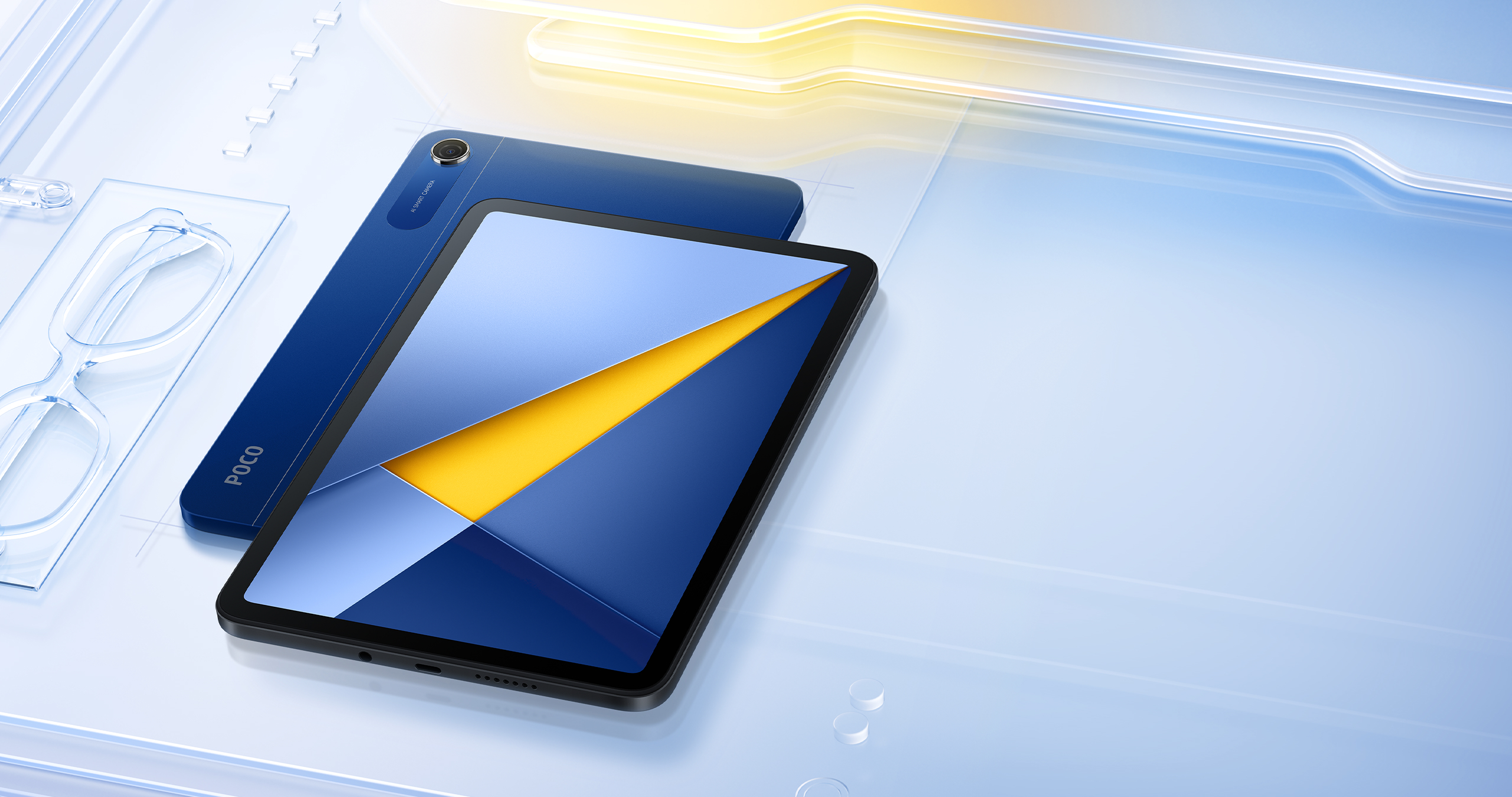
When Xiaomi launches the same device on the market under two different names, it's not a marketing mistake — it's a segmentation strategy. Poco Pad C1 is a direct rebrand of the Redmi Pad 2 9.7, which the company is simultaneously selling in Malaysia starting from MYR 549 (approximately $139–$150 depending on configuration). The Poco version targets a younger audience that buys based on brand identity rather than specifications alone.
What's Inside
The foundation is the Snapdragon 6s 4G Gen 2 processor built on a 6-nanometer process with Adreno 610 graphics. In the base configuration for the global market: 6GB of LPDDR4X RAM and 128GB of UFS 2.2 storage. The display is 9.7 inches with 2K resolution, 120Hz refresh rate, and peak brightness of 600 nits; the tablet holds triple TÜV Rheinland certification for eye protection.
Cameras — 8MP main (f/2.0) and 5MP front (f/2.2), both supporting 1080p/30fps video. For a tablet in this price range — standard rather than an advantage.
A 7600 mAh battery with support for 18W fast charging and 10W reverse charging — one of the main selling points: according to the manufacturer, the charge lasts 1.7 days of typical use. Device weight is 519g, body thickness is 7.4mm.
HyperOS 3 and Update Reality
The tablet comes with Xiaomi HyperOS 3 pre-installed — a new interface that the company positions as a unified platform for its entire "Human × Car × Home" ecosystem. However, the budget segment traditionally receives updates later and less frequently: flagship Poco F8 series already received HyperOS 3 first, while previous budget tablets in the C line lagged by at least a quarter.
Market Context
In the sub-$200 segment, Poco Pad C1 faces direct competitors: Lenovo Tab One starts at $100, Samsung keeps its tablet floor around $150–$180. Poco's advantage — larger battery and newer interface; disadvantage — lack of Wi-Fi 6 (only Wi-Fi 5, 802.11ac) and Bluetooth 5.0 instead of newer standards.
"Global launch confirmed on Xiaomi's official website. Poco Pad C1 expands the brand's AIoT ecosystem as a tablet for everyday entertainment on the go"
Xiaomi Global, official announcement
What This Means for the Buyer
Rebranding itself is not a problem — what matters is what the buyer gets. In the case of Poco Pad C1, it's a compact tablet with a large battery, a respectable display for its budget class, and a current interface at a price already confirmed in Malaysia at $139–$175 depending on configuration and LTE availability. For markets where the Redmi brand is not represented or less popular, the Poco version is a logical distribution choice.
However, there's a caveat: 18W charging for a 7600 mAh battery means approximately two hours to full charge. Competitors in the same segment are gradually moving to 33–45W. If Xiaomi doesn't adjust specifications in certain regional versions, charging speed will become the main point of criticism.
Poco Pad C1 will be available in black and blue. Xiaomi hasn't yet revealed official prices for specific markets — if they exceed the psychological $160 mark for the base Wi-Fi version, the advantage over Samsung and Lenovo in the same class becomes significantly less obvious.