What was shown at CES 2026
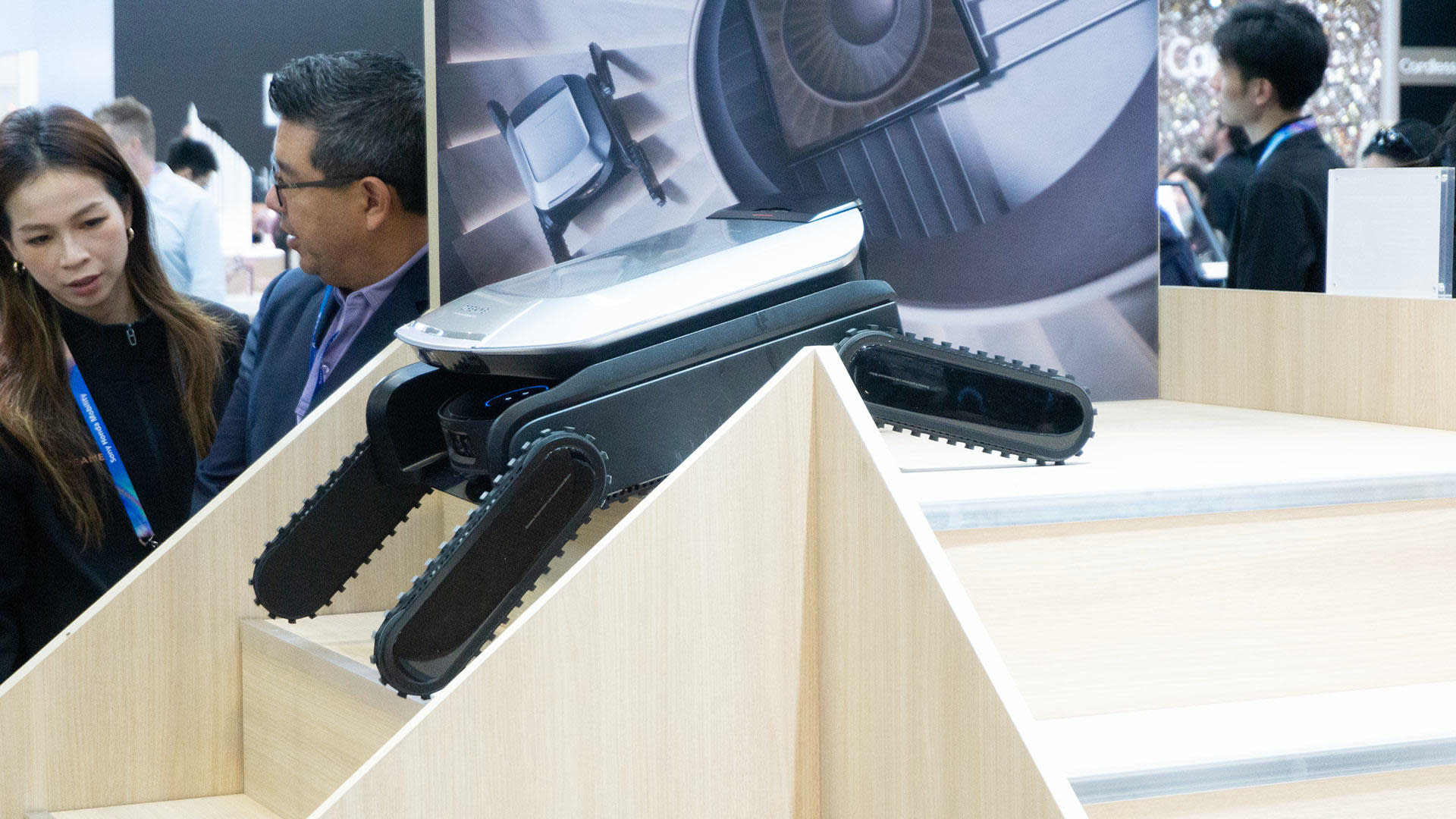
At CES 2026 Dreame demonstrated a concept called Cyber X. According to the demo, the device can overcome steps up to 25 cm high, climbs inclines up to 42°, and traverses one flight of stairs in roughly 27 seconds. This is a research prototype; mass production has not been announced yet.
How it does it
The vacuum doesn't climb stairs directly: a separate lifting module with tracked "legs" is used to move between floors, into which the device itself drives. Cyber X also has a water tank and a floor-washing function, laser navigation, and a braking mechanism for stability on stairs even when the battery is low. For now it is not intended to clean the stairs themselves — the module only provides movement between floors.
"Dreame brought another crazy robot vacuum prototype to #CES2026. This is the Cyber X Ultra, which is able to climb up and down entire flights of stairs."
— Karissabe (Twitter @karissabe5), CES attendee
Technical context and production models
In addition to the prototype, Dreame announced a production model, the X60 Max Ultra, priced at $1699, which overcomes thresholds up to 8.8 cm — enough for household obstacles, but insufficient for stairs. The company also said it planned to release a smartphone in September 2025; at CES 2026 other innovations were displayed nearby as well, such as smart bricks — LEGO Smart Bricks.
Why this matters for Ukraine
The technical uniqueness of Cyber X is more than a showpiece. The ability to autonomously move between floors expands practical scenarios: delivering medicines in multi-storey buildings without a working elevator, autonomous logistics in temporary shelters, assisting rescuers in surveying rubble and transporting small loads. Robotics analysts note that such platforms could become the basis for applied solutions in infrastructure recovery.
Limitations and realities
It's important to stay cool-headed: this is a prototype with an additional module, not an autonomous all-purpose machine that will replace humans in complex conditions. Energy-efficiency issues, reliability in dusty or collapsed environments, and the cost of mass production remain key barriers. Moreover, wide deployment of such solutions will require adaptation to local conditions and safety standards.
Conclusion
Cyber X is an example of a trend: robotics is becoming more mobile and focused on navigation in complex environments. For Ukraine this is a signal: innovations shown at CES can be not only a curiosity but also a source of ideas for local solutions in logistics, rescue, and reconstruction. The question is how quickly these concepts will turn into affordable mass-produced products and who will be able to adapt them to our needs.