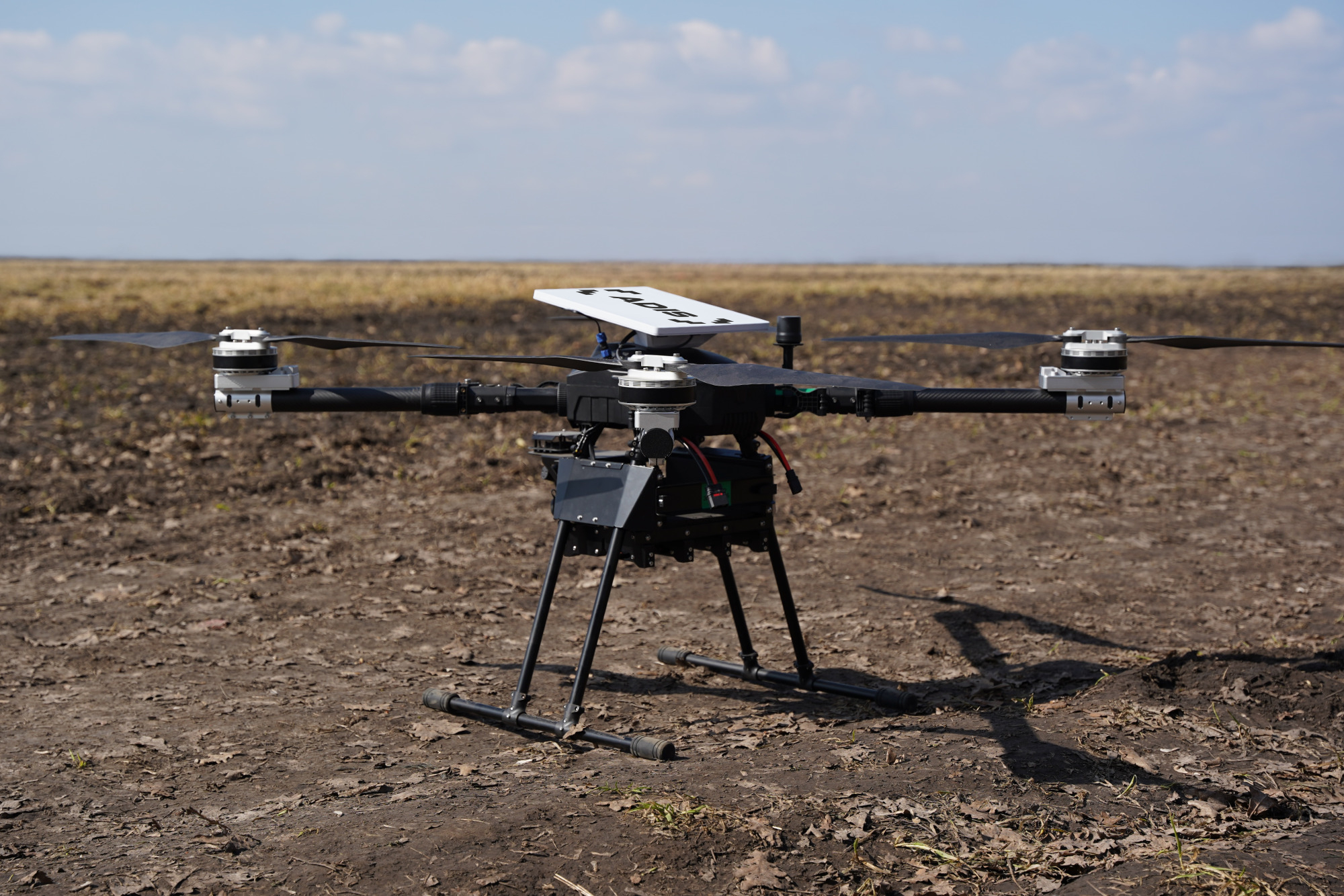
Martyn Tech company presented a heavy-strike quadcopter Adis — a bomber drone developed on direct order from the front. The main technical difference from most analogues: control via satellite communication, which removes radio horizon limitations and allows the operator to be located anywhere in the world.
Name as a technical requirement
The drone is named after a fighter of the 72nd Separate Mechanized Brigade named after the Black Cossacks of Zaporizhzhia with the callsign Adis, who died in June 2022 in Donetsk region. According to the developers, the name is not a symbolic gesture: the drone was created taking into account the specific combat experience of units that fought in that direction.
What the device can do
Combat range — 20 km with a 10 kg payload, flight time — about an hour. According to Militarnyi, during testing Adis exceeded the stated parameters: it carried 12 kg for 20 km and covered 50 km with a 3 kg payload. The modular design allows for quick reconfiguration of the platform for various types of missions.
- Precision ammunition dropping
- Remote mining
- Logistical supply to the front line
- Reconnaissance and target designation
The optical system includes a dual camera: object detection during the day — up to 600 m, at night — up to 150 m.
Satellite communication: advantage or vulnerability
Satellite control is an unconventional solution for drones of this class. It eliminates the problem of electronic warfare in the radio range, but at the same time creates dependence on a third-party satellite provider and potentially increases signal delay. Martyn Tech has not yet disclosed which specific satellite channel is used and how the latency issue is resolved during strike missions.
"Adis is not just a new drone, it is a logical evolution of our product line. It was created at the direct request from the front to perform complex strike missions"
Martyn Tech
According to Defence Blog, the drone has already passed codification for procurement by the Ukrainian armed forces — this means that the technical barrier to serial delivery has been removed.
An open question: how quickly will Adis appear in units in sufficient quantities — and whether the satellite control channel will withstand the conditions of active electronic warfare, which Russia is consistently escalating along the entire contact line.