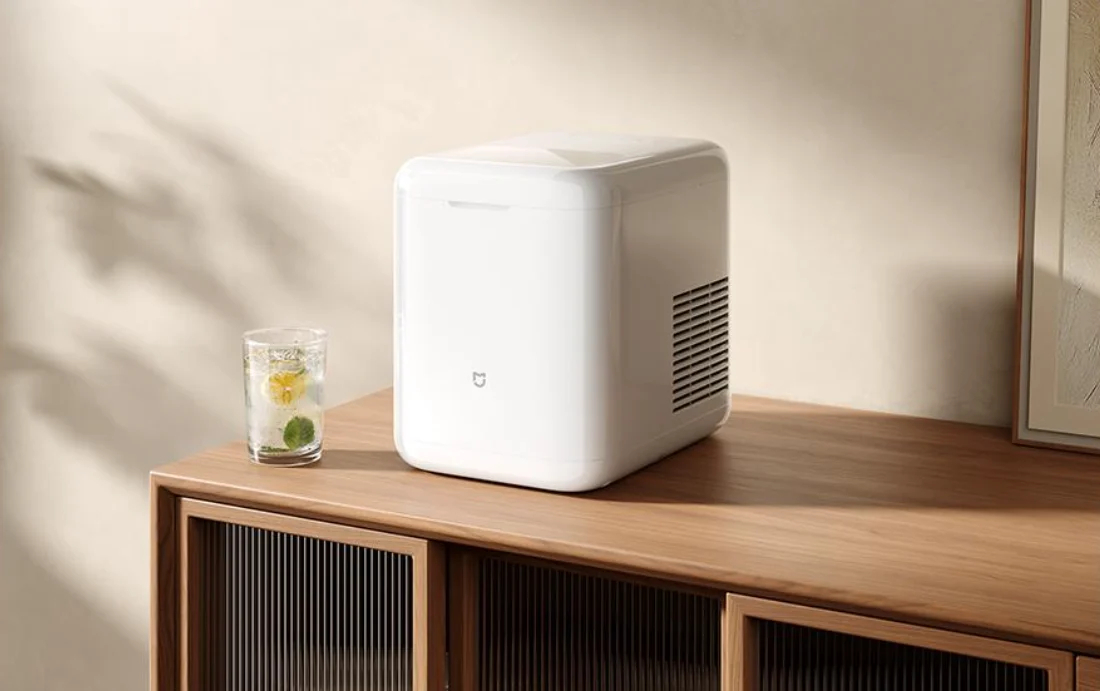
Xiaomi has announced the Mijia portable ice maker. The device is already available on the Xiaomi Youpin platform as part of a crowdfunding campaign, with general sales scheduled for August 17.
The new device produces eight ice cubes per cycle. In fast mode, the first batch is ready in 6-8 minutes, while standard mode is designed for larger and more transparent cubes. Maximum productivity reaches up to 13 kg of ice per day, with a 1-liter water reservoir and storage capacity for up to 80 cubes. The device weighs 6.1 kg and consumes 110 watts.
Additional features include: ultraviolet purification, self-cleaning, LED indicators, delayed start, transparent lid, and an ice scoop compartment.
Why does a smartphone brand need ice?
At first glance, this is another whim of an electronics manufacturer that has long expanded beyond gadgets. But that's precisely the point: Xiaomi is not building a collection of separate devices, but the Mijia ecosystem, where every household item — from rice cookers to ice makers — is connected to a single app, a single account, and a single control logic.
An ice maker is not breakthrough technology. Similar household models have been sold for years by Ninja, GE, and Igloo. The difference lies in the approach: Xiaomi is not trying to make the world's best ice; it creates a device that fits organically into a smart home while costing significantly less than Western analogues thanks to production scale and the crowdfunding launch model.
The practical angle
For Ukrainian consumers, the story is interesting not because of the ice itself, but because of the market entry model. Crowdfunding on Youpin is a way to test demand and raise money for mass production before sales even begin, minimizing risks. If the device justifies demand in China, the next step traditionally becomes an adapted version for global markets, including exports through parallel imports to Ukraine — this has already happened with dozens of Mijia gadgets.
The question is not whether you need a 110-watt ice maker, but how many more household appliances Xiaomi will transform into smart devices before competitors manage to respond with their own ecosystem.