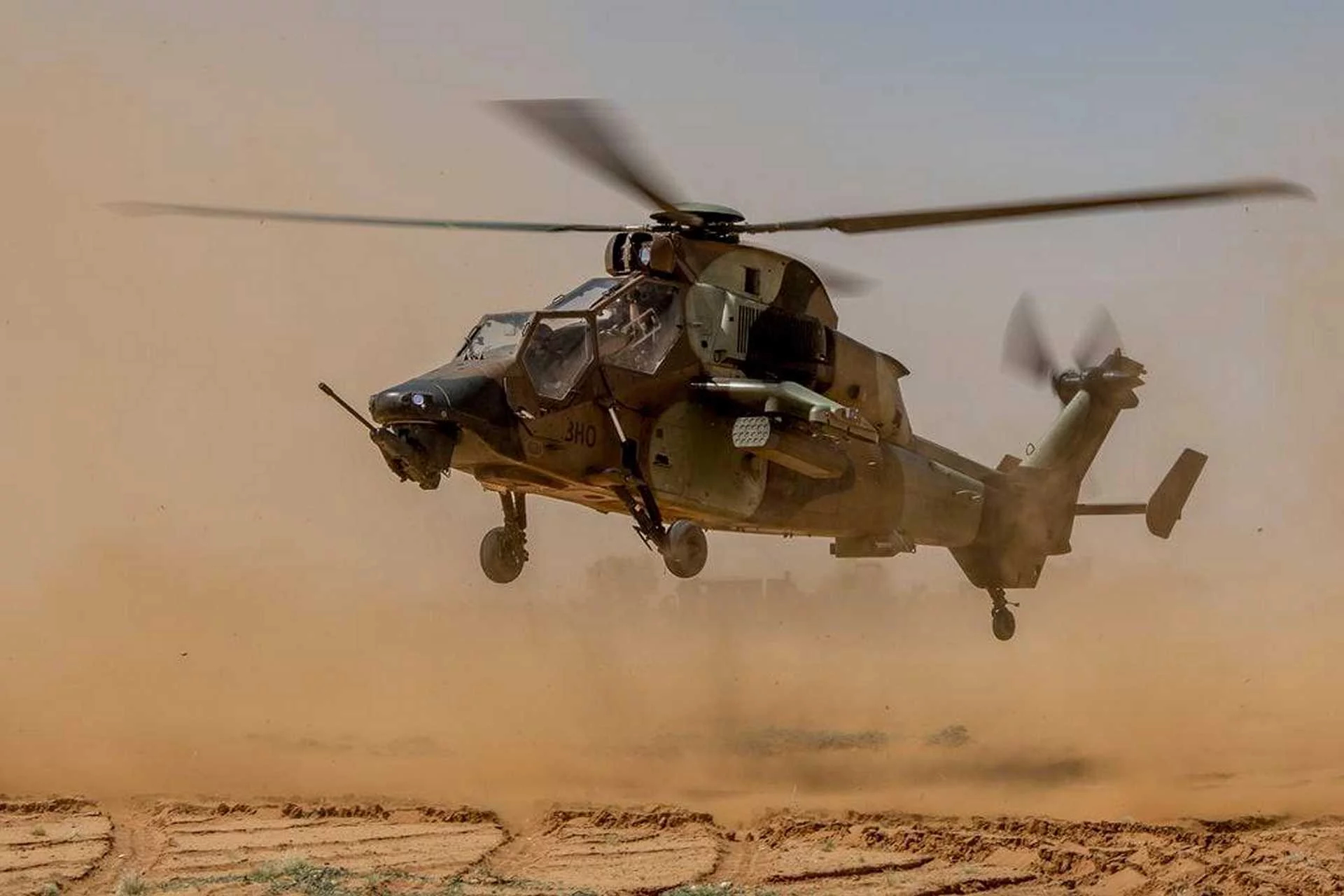
Four French EC-665 Tiger attack helicopters were deployed to the UAE at the end of March 2026 as part of Operation Epic Fury — an American operation against Iran that began on February 28. On March 31, Pierre Chille, Chief of Staff of the French Army, acknowledged in an interview with Le Point: the machines are in the region, but there have been no confirmed kills yet — the helicopters are often unfit for flight due to technical problems. Less than a week later, the situation changed.
On April 9, during parliamentary hearings, General Fabien Mandon confirmed: Tiger destroyed air targets in combat for the first time. To intercept Iranian Shahed kamikaze drones, they used the onboard 30mm cannon — the Nexter 30M781, which can fire at a rate of up to 720 rounds per minute.
«We are using Tiger against UAVs in the Middle East. The cannon is the best tool: fast reaction and significantly lower cost of interception».
General Pierre Chille, Chief of Staff of the French Army, Le Point, March 30, 2026
Why a cannon, not a missile
Previously, France shot down Iranian drones mainly with MICA missiles from Rafale fighters. According to La Tribune, the French Air Force spent over 80 MICA missiles — each costing approximately €700,000. A Shahed costs about $20. Defense Minister Catherine Vautrin publicly questioned the proportionality of such an approach.
In parallel, France re-equipped Fennec and Caracal helicopters with FN Minimi and M3M machine guns — to have a cheaper solution for close-range interception. Tiger fits into the same logic: a cannon instead of a missile against a $20 target.
Tactical context: advantages and limitations
Attack helicopters have one structural advantage over fighters in the role of drone interceptor: they move at approximately the same speed as Shahed — this gives several opportunities for a shot. A jet aircraft passes through the engagement zone too quickly.
- Tiger cannon: Nexter 30M781, 30×113mm, 720 rounds/min, ammunition — 450 rounds (compared to 1,200 on Apache M230).
- Speed: Tiger — up to 290 km/h, Shahed-136 — approximately 185 km/h; there is a margin.
- Sensors: Tiger is inferior to Apache in detection range and thermal imaging quality — a critical factor for night interceptions.
- Reliability: Tiger's operational readiness rate among operators is consistently below 50% — this is exactly what Chille acknowledged on March 31 when explaining the lack of results.
Apache operators — the United States, Israel, and the UAE — have been conducting Shahed interceptions since February 2026. According to Aviationist, the UAE documented the destruction of eight Iranian drones in a single combat sortie. Tiger achieved the same later and with less technical capability onboard.
What this means for Ukraine
Australia is already phasing out its Tiger helicopters early — in favor of the AH-64E Apache. In December 2025, The Aviationist reported that Australia was considering transferring Tiger to Ukraine: 22 aircraft, support closer to Europe than to Canberra, and combat experience against drones — no longer hypothetical.
If the French military publishes the number of confirmed Tiger kills and reliability indicators in the Gulf operation conditions, this will become the first real test protocol for the platform in the counter-drone role — and an argument either for or against its transfer to Ukraine.