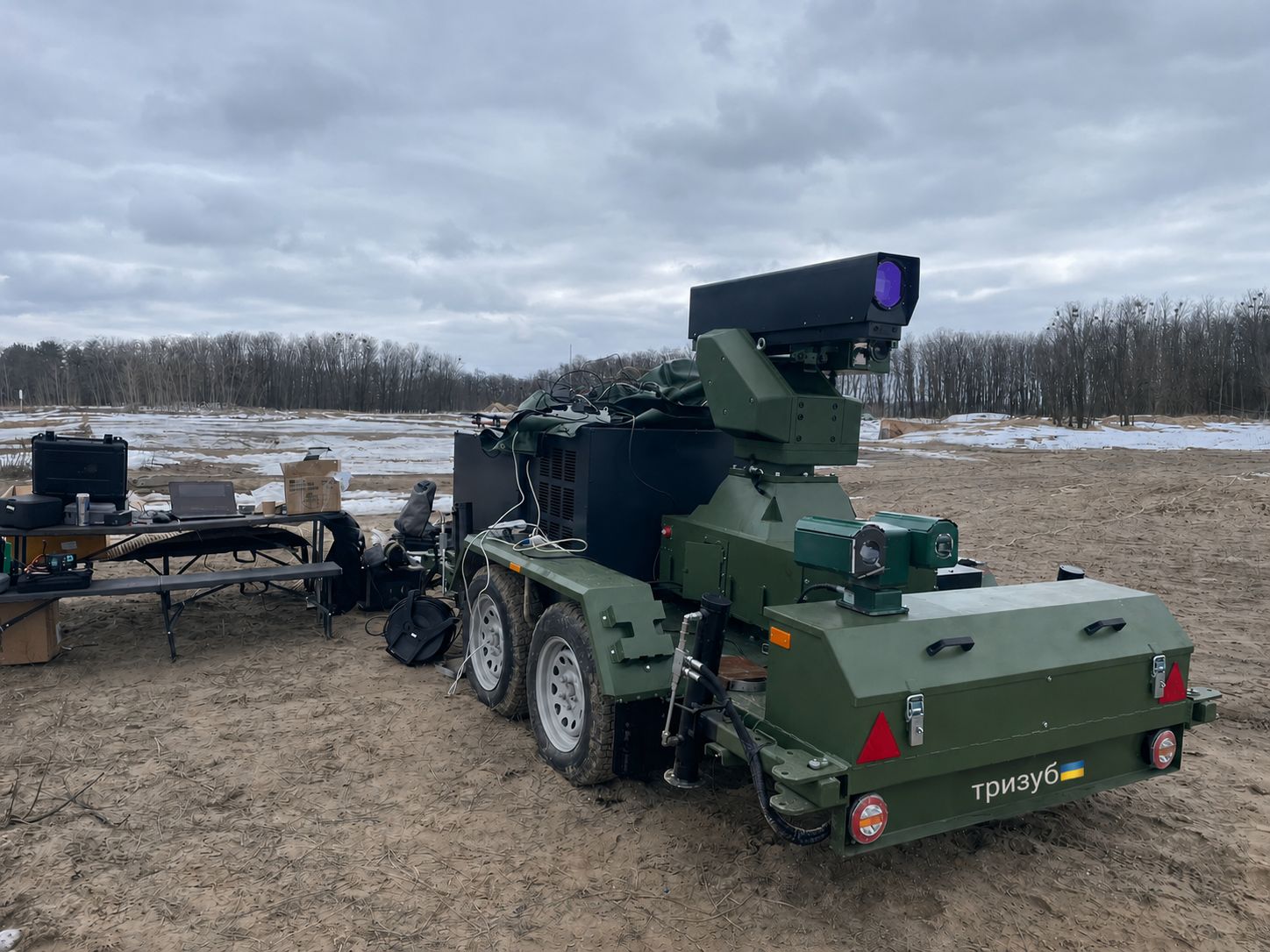
At the conference "European Defense Industry: Prospects for Cooperation with Ukrainian Defense Sector," Vadym Sukharevskyi, Commander of the Unmanned Systems Forces of the Armed Forces of Ukraine, publicly demonstrated the "Tryzub" laser complex for the first time. Footage from the tests confirmed: the system is real. The question is — how ready it is.
What the system can do — and what it claims
According to the disclosed characteristics, "Tryzub" destroys attack drones, aerial bombs, cruise and ballistic missiles at distances up to 3 km. Helicopters and aircraft — up to 5 km. In optical blinding mode, the range reaches 10 km. According to Sukharevskyi, Ukraine is already the fifth country in the world that can confirm the presence of a combat laser.
"It really works, it really exists. Today we can already shoot down aircraft at altitudes above 2 km with this laser"
Vadym Sukharevskyi, Commander of the Unmanned Systems Forces of the Armed Forces of Ukraine
Over two years, the project progressed from concept to an approved combat prototype. Last winter, the system successfully destroyed FPV drones of various sizes; earlier — it damaged optics and electronics of reconnaissance UAVs at distances up to 1,500 meters.
What didn't make the headlines
Video from the presentation captures an important detail: despite the claimed AI guidance integration, the operator controls the laser cannon manually — using a joystick. An optoelectronic station on the complex is present, but automatic target acquisition and tracking are not visible in the footage.
Analysts who reviewed the published materials believe that "Tryzub" currently remains a functional prototype: the system confirms the physical concept, but autonomous guidance mode will likely be added at the next development stage.
Scale and context
As of April 2025, over 40% of weapons used by Ukraine's Defense Forces are products of domestic manufacturers. In 2024, Ukraine increased cruise missile production by eight times. "Tryzub" fits into a broader strategy: replace imported air defense systems with cheaper per-shot alternatives — one laser shot does not require an expensive interceptor missile.
- Cost per shot — essentially the price of electricity, not a missile
- Weak point — dependence on weather and atmosphere clarity (fog, smoke reduce effectiveness)
- Competitors — Israel (Iron Beam), USA (HELIOS), Turkey (ALKA) have greater financial resources and years of testing
Celebra does not disclose serial production plans or the system's cost. The public presentation, which the company announces as the "final stage," may turn out to be exactly that — not the beginning of deliveries.
If the next video shows automatic target acquisition without operator involvement — "Tryzub" will indeed move from the "prototype" category to the "weapon" category. Until then, it is a strong concept with confirmed physics.