Ukrainian company Airlogix and Finnish Innokas have signed a document on joint production of unmanned systems in Finland. The news was immediately presented as another step towards an "overseas factory" — and formally that's true. But it's worth distinguishing between two levels: what was signed and what this signing actually obligates the parties to do.
What exactly was signed
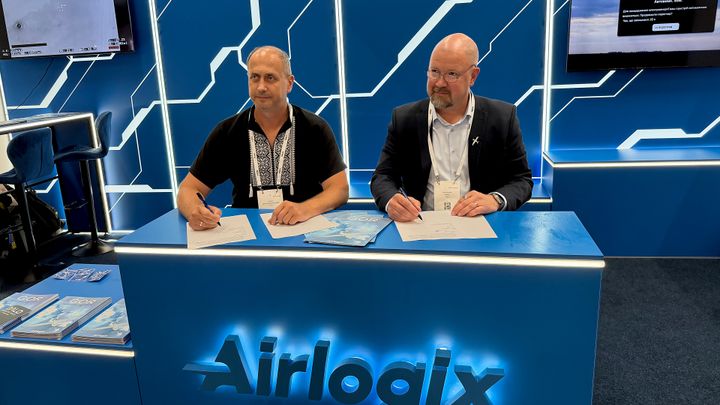
Ukrainian company Airlogix and Finnish Innokas signed a letter of intent regarding the creation of production facilities in Finland for manufacturing unmanned systems using technologies from the Ukrainian manufacturer. The document was signed by Airlogix CFO Oleksandr Androschuk and Innokas CEO Janne Kostamo during DALO Industry Days in Denmark.
A Letter of Intent is not a contract or investment agreement. It is a record of intent to move forward together, without specific figures, timelines, or financial commitments. The signed document will also serve as the basis for the next stage of partnership, including the development of a potential joint venture between the companies or other forms of cooperation. In other words, even the form of future cooperation — a joint venture or something else — is still a subject of discussion, not a fact.
The mechanism that should implement it
The next step is described more specifically: the companies plan to develop legal, technical, and production models of cooperation. This is the real work — it is at this stage that it becomes clear who invests, who bears the risks of certification, and whether the model will withstand the test of time.
The division of roles is outlined more clearly: under the partnership terms, Innokas will provide the capabilities necessary for localization and scaling of production in Finland, while Airlogix will provide technology and engineering solutions. However, there is a key caveat from the developer: "Our role is to help scale the production of these systems in Finland and increase the volume of equipment that can be supplied to Ukraine," said Innokas CEO Janne Kostamo.
Airlogix's statement was equally revealing — about what this cooperation is actually for: "For us, it is fundamentally important that this cooperation takes place within the Build with Ukraine initiative and serves one clear goal: increasing the production of Ukrainian unmanned systems for the needs of Ukraine's security and defense forces," said Airlogix Director of Investment and Finance Oleksandr Androschuk.
The rule that makes the format less declarative
Build with Ukraine has one detail that distinguishes it from a typical export contract. According to Airlogix CMO Viktor Lokotkov, these initiative contracts have a rule: "100% of products manufactured at these factories are shipped to Ukraine." In other words, the factory in Finland is not a way to enter the European sales market, but a way to increase production volumes specifically for the Ukrainian front, bypassing capacity constraints within the country.
The initiative itself was announced in June 2025 by Ukrainian President Volodymyr Zelensky, and since then Ukrainian companies have joined forces with several foreign countries, including Germany, Denmark, Finland, Great Britain, Sweden, the USA, Canada, and others. Airlogix and Innokas are not the first or last example: literally at the same time at DALO Industry Days, Ukrainian ground robotic systems manufacturer Tencore agreed on a joint venture with Danish Copenhagen Global, and drone manufacturer TAF Industries signed a joint venture memorandum with Danish Upteko.
The similarity in wording in all three cases is not a coincidence: all of these are currently letters of intent and memoranda, not signed production contracts with budgets and line launch timelines.
Where the line between declaration and fact lies
The honest frame here is simple: an obligation to continue talking has been signed, not an obligation to produce. The key decision points that will determine whether this letter becomes a factory are:
- Legal form — a separate joint venture, licensing agreement, or contract manufacturing — and who finances the launch of the production line in Finland.
- Who is the end customer and payer for Finnish products — Ukraine's Ministry of Defense, a foreign donor government, or a mixed scheme like Airlogix's Canadian precedent.
- Whether Finland will maintain 100% redirection of products to Ukraine when it comes to specific volumes and prices, rather than just framework statements.
None of these decision points have been discussed publicly — and that's normal for the letter of intent stage. What would be abnormal is to present this document as "production has already started."
What's next
If over the next few months Airlogix and Innokas do not announce a specific legal model — for instance, the registration of a joint venture — this letter of intent risks repeating the fate of many similar memoranda that remain framework agreements without production lines. However, if the model emerges by the end of the year, it will become the first real test of whether Build with Ukraine is capable of turning political announcements into industrial capacity faster than previous formats of defense cooperation with Europeans.