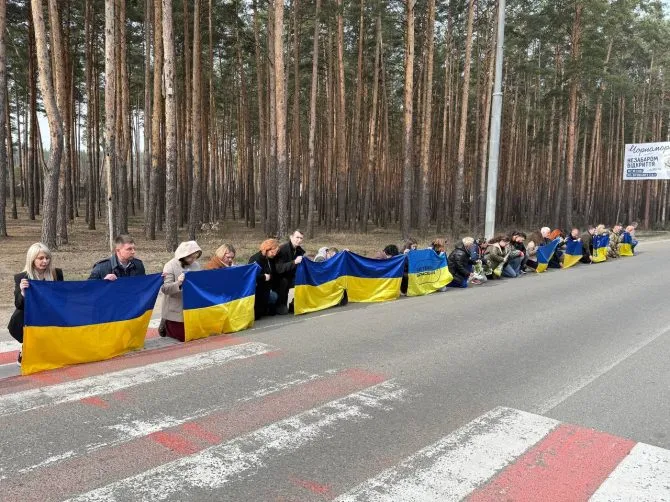
The Irpin community bid farewell to senior gunner Taras Khizhko of the 36th Separate Marine Brigade named for Rear Admiral Mykhailo Bilynskyi. Irpin residents formed a "human corridor" — the same street where he chose to settle, where his children were born, became the route of farewell.
Since 2014 — without pause
Taras Khizhko joined the armed forces in 2014, when most still hoped it would all end quickly. Eleven years is not a conscription by summons; it is a conscious choice he reaffirmed twice: first in the ATO, then in the full-scale war.
"Taras Volodymyrovych was a warrior by vocation. In 2014, when the enemy was only beginning its advance, Taras did not wait for invitations and went to defend the country in the hottest spots of the ATO."
Acting Mayor of Irpin Anzhela Makeieva
He moved to Irpin in 2016 — already carrying frontline experience. There he married Tetiana and their two sons were born. The city had become home: not a temporary stop, but a place to stay.
Death and months of uncertainty
On 25 December 2025, while carrying out a combat mission in the area of Kostiantynivka, Taras Khizhko was struck by an enemy FPV drone. For a long time he was listed as missing — a status that for families means not only grief but a legal and financial limbo: benefits, paperwork, and even the possibility of saying goodbye remain frozen until confirmation is received.
The identity was established by DNA examination. According to the Ministry of Internal Affairs, more than 12,000 such examinations were carried out in Ukraine in 2025 — and behind each one lies a similar story of waiting.
"Human corridor" and what remains
At the funeral, Irpin residents lined the street to pay tribute. According to first deputy mayor Oleksandr Pashchynskyi, Khizhko "without hesitation stood to defend his native land" — a phrase spoken here more than once: Irpin experienced occupation in 2022 and has been burying its defenders regularly ever since.
Taras is survived by his mother, his wife and two sons. Their ages are unknown. But using 2014 as a starting point suggests the elder son may already remember his father in uniform.
The 36th Marine Brigade, where Khizhko served, was formed in 2015 on the basis of units withdrawn from occupied Crimea. It went through the defense of Mariupol, Azovstal, the battles near Mykolaiv — and continues to fight in the east. A gunner in such a unit is not rear echelon: he directs fire on the frontline, where FPV drones became the main cause of infantry losses in 2024–2025.
When the number of missing in Ukraine is measured in thousands, DNA identification is not a formality but the only way to bring a person home, at least after death. The question is whether there will be enough resources and time so that none of those thousands of families have to wait for years — as Tetiana and her two sons did.