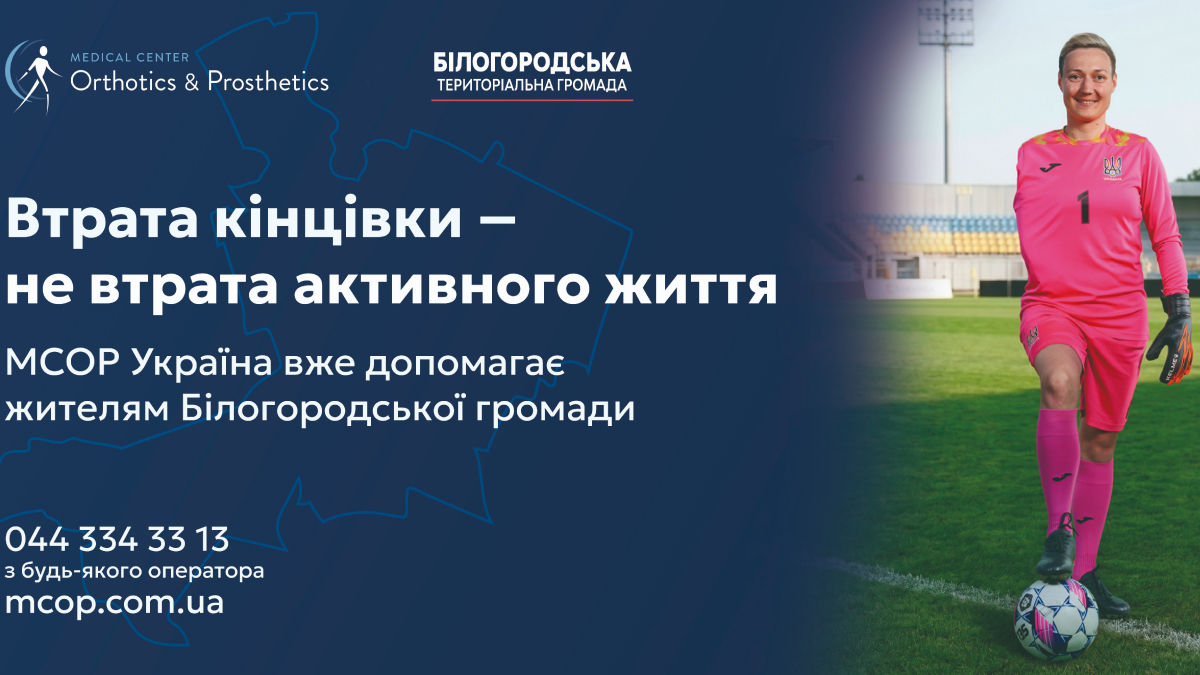
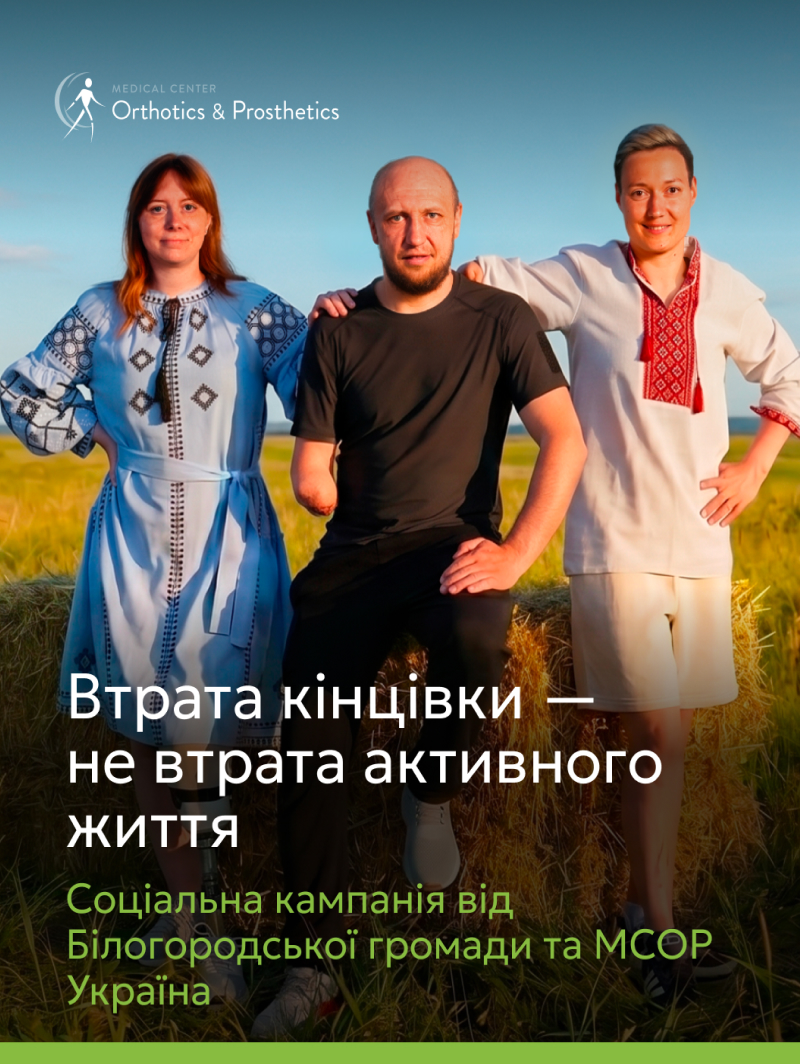
In response to current challenges, the Bilohorodska community, together with the International Center for Orthopedics and Prosthetics MCOP Ukraine, launched an information campaign on July 1 for residents who need prosthetics or rehabilitation after amputation.
The goal is to tell people about the opportunities that modern prosthetics provide and to offer solutions for modern and free prosthetics according to international standards.
Members of the Bilohorodska community who have gone through the prosthetics process participated in the campaign, proving by their own example that the loss of a limb is not a loss of an active life.
How to find out?
Information is placed on outdoor billboards in the community, on information posters in the CNAP and medical facilities, as well as on the website of the Bilohorodska territorial community.
The community's task is to provide residents with access to the services they need. Knowledge about the opportunities that modern prosthetics provides, and most importantly, personal examples of our people who, thanks to prosthetics and rehabilitation, walk again, raise children, play football – this is motivation for those who are just beginning their journey after limb loss," notes Bilohorodska community head Anton Ovsienko.
The story of community resident and veteran Olha Benda
Olha Benda is a veteran of the Russian-Ukrainian war since 2017, an ambassador of the Ukrainian Veterans Fund of the Ministry of Veterans, and captain of the Ukrainian women's amputee football team. She raises two sons, runs marathons on a prosthetic, and participates in charitable initiatives supporting people who have lost limbs.
Olha was mobilized to the Ukrainian Armed Forces in 2016 and served in the 72nd separate mechanized brigade named after the Black Cossacks of Zaporizhzhia. The following year, during a Russian shelling near Avdiivka, she was wounded and lost her leg as a result.
While still in the hospital, Olha made herself a promise: even after the wound, she would do everything she was able to do before – walk, run, care for her child, cook, and play sports. After four months of rehabilitation, the woman was already walking on a prosthetic without crutches and returned to sports. After her injury, Olha became the only woman among marines who completed the Marine Corps Marathon in the USA. She continues to play amputee football and remain active.
In 2025, Olha underwent re-prosthetics and a gait adaptation program at the MCOP Ukraine center. It was here that she found what she was looking for: a team with real experience and understanding of what it means to live actively with a prosthetic. As someone who has been using a prosthetic for over 8 years, she has something to compare it to.
I have high standards for prosthetics because I don't sit still, and to be productive throughout the day, the prosthetic needs to feel like my own limb. The expertise of prosthetists and physical therapists you work with plays an important role here. And also – experience working with similar cases," Olha said.
How to get free prosthetics at the MCOP Ukraine center?
The International Center Medical Center Orthotics & Prosthetics (MCOP) has provided high-tech prosthetics and recovery for people with amputations of any complexity for over 20 years. For more than 17 years, the center was the official partner of the U.S. Department of Defense in prosthetics for American military personnel who participated in wars in Afghanistan and Iraq.
Since March 2025, the MCOP center operates in Kyiv.
Thanks to modern prosthetics and adaptation programs from MCOP, more than 100 Ukrainian veterans have already been able to return to their usual lives, hobbies, find work, and start families.
We see not a diagnosis, but a person with specific goals, and our task is to help them achieve them: select the right prosthetic, adjust it, restore motor skills. After all, the goal of prosthetics is not just to restore movement, but also a full life that our patients had before the injury," noted MCOP Ukraine director Andrii Petruk.
As part of the cooperation between Bilohorodska community and the international prosthetics center MCOP Ukraine, a memorandum was also signed between community head Anton Ovsienko and MCOP Ukraine director Andrii Petruk. This document allows for a clear pathway for military and civilian patients from the community who turn to the center for prosthetics and recovery.
You can submit an application for prosthetics on the MCOP Ukraine website or by calling +380 44 334 33 13.