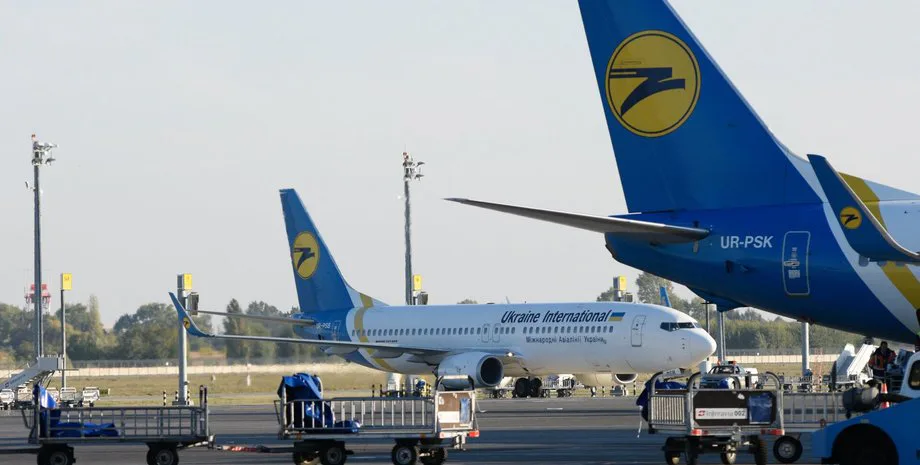
While Ukraine convinces investors of the stability of its business environment, the Bureau of Economic Security has developed its own legal theory: an aircraft is not a means of transport or movable property, but intellectual property. Therefore, leasing payments for its rental are royalties, from which airlines should withhold 15% and pay to the Ukrainian budget. This interpretation has caught MAU, "Aviation Company Konstanta," "Urga," H3Operations, and "Skyline."
What exactly they are accused of
Each case has its own "profile," but the logic is consistent throughout. In MAU's case, the investigation believes the company should have paid royalties for leased aircraft instead of applying double taxation avoidance conventions. "Aviation Company Konstanta" is accused of improper use of Article 8 of the Convention between Ukraine and the UAE — according to BES, the company, in collusion with a non-resident lessor, failed to withhold non-resident income tax from leasing payments for aircraft from January 2023 to March 2025. "Urga" — application of a zero rate under the convention with Singapore for helicopter leasing that operated outside Ukraine.
Common denominator: BES investigators do not recognize aircraft as means of transport, classifying them as "equipment," and therefore operations fall under the article on royalties, not under articles on international transportation.
Why this is legally flawed
Director of H3Operations Vladislav Klipachenko stated the business position directly in a comment to UNN:
"We have conclusions from a well-known international audit company that confirm our company correctly applied international conventions with the UAE, China, and Cyprus. We should not have paid taxes on leasing in Ukraine, as this would be a violation of these conventions and double taxation."
Vladislav Klipachenko, Director of H3Operations
The position is supported by international court practice. The Mumbai tribunal in 2025 confirmed that the mere presence of an aircraft on a country's territory does not create permanent establishment of the lessor and does not give the state the right to taxation. This is a standard IATA and ICAO norm: leasing payments for aircraft are not royalties under the OECD Model Convention.
Notably, legislation on taxation of aircraft leasing from non-residents has not changed for 30 years. The new interpretation appeared after 2024 — along with a new team in the tax authority.
The bill: 702 million per year — and under threat
According to the State Tax Service, in 2025 alone the aviation industry paid 702.23 million UAH to the budget — a record high in eight years. That is, the industry being persecuted is one of the few sectors of the economy that is increasing tax revenues during a full-scale war.
Head of the Committee of Economists of Ukraine Andriy Novak calls aviation one of the key sectors for post-war recovery — "one of the most important and one of the most promising for development." In his view, aviation and the agricultural sector are precisely those capable of becoming drivers of economic growth after the war. Criminal prosecution for operations that have been standard practice for 30 years sends potential investors an unambiguous signal: the rules of the game can change retroactively.
Signs of orchestration
Several details go beyond ordinary "interpretation error." First, proceedings have been opened almost simultaneously against five different companies with different leasing schemes and different partner countries — but with identical legal logic. Second, the investigation ignores conclusions from international auditors and its own court economic expertise provided by the companies. Third, none of these companies has claims from the tax authorities of partner countries — the UAE, Singapore, Cyprus, China.
- MAU — leasing from non-residents, double taxation avoidance conventions with several countries
- Aviation Company Konstanta — convention with UAE, Article 8, aircraft leasing 2023–2025
- Urga — convention with Singapore, zero rate, helicopters outside Ukraine
- H3Operations — conventions with UAE, China, and Cyprus, has international audit opinion
- Skyline — similar international leasing scheme
If BES's interpretation becomes entrenched — Ukrainian airlines will find themselves in a unique situation: they will pay 15% of leasing payments in Ukraine and face taxation in the lessor's country. Increased operating costs will make Ukrainian carriers uncompetitive compared to any foreign airline operating flights to Ukraine after airspace opens.
The question is not rhetorical: if MAU or "Konstanta" do not survive criminal pressure by the time Ukrainian airspace opens — who will take their slots and routes? And will it be a coincidence if the answer turns out to be a specific name with specific connections.