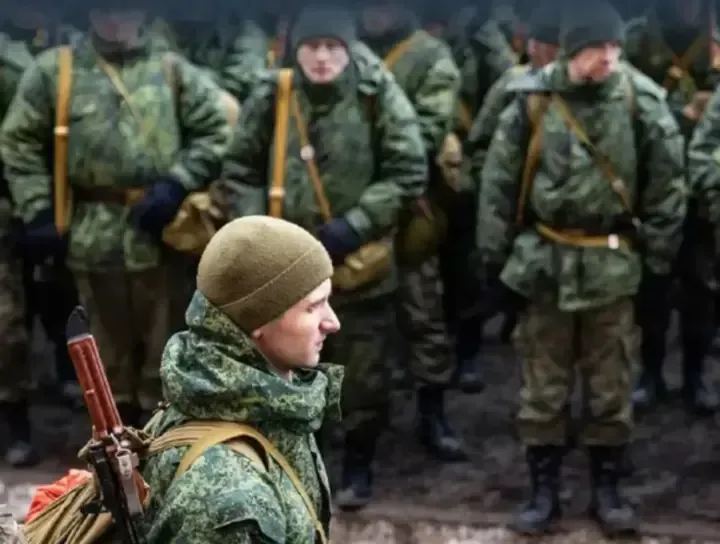
Andriy Kovalenko, head of the Disinformation Resistance Center at the National Security and Defense Council, released an intelligence assessment: Russia is preparing an autumn mobilization of 500,000 people with two separate streams of training and deployment.
Some are planned to be thrown into battle in the first two weeks to plug holes in the East, while others will be trained for a month for a potential opening of a new front direction. This is Russia's plan.
Andriy Kovalenko, head of the Disinformation Resistance Center at the NSDC
Two weeks — this is not training, this is a patch
The first stream of mobilized personnel will essentially have no combat training. This confirms the logic that the Institute for the Study of War has been documenting for several months: new recruits receive no more than a month of training before being sent to the front, and the command is consciously sacrificing their combat effectiveness to maintain the pace of operations in the East. According to the IISS assessment, Russian personnel losses in 2025 are being held at around a thousand people per day — this is precisely the deficit that needs to be filled.
The second stream — a month of training — indicates a different intention: not to patch holes, but to form a strike force for a new direction. The most likely targets remain Sumy and Kharkiv regions: it is there, according to intelligence, that Russia is concentrating personnel due to logistical convenience — proximity to its own territory.
Why "from 500,000" is an important detail
The phrasing "from 500,000" is not a rounded figure but a lower bound. Individual pro-Russian sources tracked by EUobserver cite figures up to 1.2 million. Putin has not officially announced a mobilization since November 2022 — Moscow continues recruitment through contracts, prisons, and financial incentives. However, as documented by the independent Russian publication Verstka, in the fourth quarter of 2025, the number of volunteers dropped by half compared to the same period in 2024: money is no longer working as a motivator the way it used to. Forced mobilization is becoming the Kremlin's only option.
What this means for the Armed Forces of Ukraine
Kovalenko gave a direct warning: autumn and winter will be heavily saturated with infantry battles involving troops, drones, guided aerial bombs, and other weapons systems. For Ukrainian positions in the East, this means maintaining or even increasing pressure despite the already noticeable fatigue of both sides. A new direction — if it opens — will create additional strain on Ukraine's reserves, which Kyiv is methodically building through army restructuring into 18 army corps.
- Short-term risk: intensification of assaults on the Donetsk and Zaporizhzhia fronts already in October-November due to the first wave of mobilized troops.
- Medium-term risk: opening of a new direction — most likely Sumy — by a force with at least a month of training.
- Systemic risk: even poorly trained masses of 500,000+ people can change the balance on specific sections through sheer density.
If the West does not accelerate the supply of long-range systems by the end of October, Ukraine will face the first wave of mobilized troops without the tool that could destroy logistics at the concentration stage — and then containment will become purely an infantry task.







