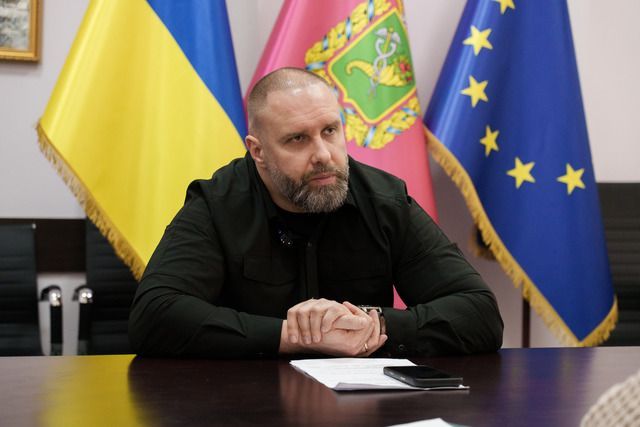
The head of the Kharkiv Regional State Administration, Oleh Syniehubov, commented on the situation with Kharkiv's air defence, explained why reconstruction continues despite the risk of renewed destruction, and spoke about the region's development prospects.
Situation at the front
There is currently no threat of the front approaching Kharkiv to the extent that the city would again come under fire from tube artillery. The main dangerous directions are Lypetskyi and Tsyrkunivskyi in the north of the region, where the front remains stable.
The toughest situation now is in Vovchansk. The town practically no longer exists — there is nothing to hold on to there. The military are taking all necessary measures to stabilise the situation. In Kupyansk the situation is calmer — it was stabilised several weeks ago.
Another difficult direction is Borivske in the Izium district. Ukrainian positions there are holding, but there is concern due to active fighting on the Lyman front. This creates a threat to Borova and Izium.
City air defence
The head of the regional military administration dismissed claims about the absence of air defence in Kharkiv. If it did not exist, the city would be left without power and energy. Mobile strike groups are constantly shooting down Shahed drones; that work does not stop.
Certain measures helped get through the winter of 2024–2025. In particular, business financed more than 200 million hryvnias for the installation of electronic warfare systems, which worked against KABs and Shahed drones. The region is now working on strengthening this direction at a higher level.
Support for the Armed Forces
If you take the region's own budget excluding social spending, about 35% goes to supporting the army. From the so-called development budget — about 70%. Statistically, that's more than a billion hryvnias a year.
Initially the priority were Kharkiv brigades: the 92nd, two National Guard brigades, two territorial defence brigades, and the border guards. However, they help everyone who defends Kharkiv region. Requests are the same: drones, pickups, anti-drone nets, generators, Starlinks.
The region cooperates with territorial communities on drones to have an operational reserve. When a brigade's combat activity ramps up and expenses increase severalfold, that need must be covered.
There are far more requests from brigades than we can financially satisfy, unfortunately. However, we concentrate on the most priority requests and directions
– Oleh Syniehubov noted
Reconstruction directions
Reconstruction of the housing stock is currently paused due to lack of funds. In Izium alone more than 30 apartment buildings need their structures restored. Right now the focus is on urgent needs.
First priority is creating safe educational environments. Underground schools perform a double function: they allow children to study offline and serve as shelters. In settlements such as Korotych and Blyzniuky there were previously no shelters at all.
Forty-three underground schools are currently being built. Seven of them are being constructed by international partners: five by the Buffett Foundation, two by Lithuanian partners. This will allow about 50,000 children to return to in-person learning.
After the war these schools will be used as additional educational spaces. They are designed so they won't become cluttered: they include laboratories and computer classes. Externally, functionally and technically they are several levels above some existing institutions.
Underground kindergartens are also a priority. Next year they expect to launch a program and implement about 10 projects. The first underground kindergarten in Pisochyn is already being built and they hope to complete it at the beginning of next year.
Medical projects
Among the flagship projects is the reconstruction of the regional hospital, which already receives about 260,000 patients a year. The level of medical care there has significantly improved.
Syniehubov gave the example of a new angiograph. Previously a man came in with headaches, but the old equipment did not help identify the problem. Almost a year after the new device was installed he was asked to come back. Doctors did not expect him to be alive at all. They found and removed clots — the person recovered. It was effectively a life saved.
More than a thousand examinations have been carried out in a few months on the installed CT and MRI machines. Some of the equipment is unique not only for Kharkiv region but for the country.
The concept was for the region to become a centre of high-quality medical care even during the war. After shelling, people are taken there because there is equipment for rapid diagnosis of a large number of casualties at once.
An underground hospital project is being implemented there, unique for the whole country. It is very complex, but it is about resilience and preserving the ability to provide medical care even under extremely difficult conditions.
Cancer centre in a frontline region
To those who consider building a cancer centre inappropriate, Syniehubov advises speaking with patients who have cancer. Can they wait a month or two, a year or two until the war ends? Of course, a new cancer centre is relevant.
Our doctors in the existing cancer centre continue to provide help and save people not thanks to, but despite everything
– emphasised the head of the RMA
We are talking about 100,000 patients and more than 5,000 surgeries a year. The plan is to build a new centre, not to renovate the old one. There is not a single linear accelerator in the region, whereas neighbouring regions have two or three. People are reluctant to travel for care — it's expensive.
The emphasis is on an underground shelter of more than a thousand square metres where all medical care, including surgeries, will be provided.
Why reconstruction is underway despite the threat of new destruction
Some 1.2 million people live in Kharkiv, and another 500,000 in the region. You cannot write them off and say: leave, there will be no medicine, no education, no one will restore housing here.
People live here and need to be supported. When they see that the state and international institutions are investing in the development of Kharkiv region — that is primarily a signal to them.
Business and industry
Before the full-scale invasion there were 300,000 business entities in the region. 100,000 have so far been lost. The regional budget on average lost a billion in taxes.
Some enterprises are being destroyed, large ones are moving to other regions, even countries. Those that are not damaged and those whose owners are determined not to leave Kharkiv region are operating.
Right now it is not about development — it is necessary to retain business. Additional support levers are being developed: insurance against wartime risks, additional grants, a compensation program of up to 10 million for damaged property.
It is important that measures be differentiated depending on the regions. Conditions in Kharkiv's industrial park after the war should differ from those in Kyiv or Zakarpattia. This will stimulate businesses to return and continue operating.
Insure us against the risk of property damage as a result of wars and shelling; give us cheap financial resources; and then we will do everything ourselves
– Syniehubov conveys the words of business
Internally displaced persons
There are 420,000 IDPs in the region, including in Kharkiv. Some came for a year but have already been living here for the fourth year. Some communities, for example Valky, have in effect nearly doubled in size.
This is not only an additional burden but also an incentive to create jobs and bring in personal income tax. The state sees such communities — a second additional subsidy was recently allocated, one of the criteria for which was precisely the presence of IDPs.
The biggest challenge is housing. The region cannot currently sustain centralized financial programs. The Ministry of Infrastructure is implementing several social housing projects, but this is a small share that will not meet demand.
Now the focus is on support: financial aid from partners, winter assistance from the state, help for children. They are also preparing places for future IDPs. Almost 200 people pass through the transit point in Lozova per day, and there is a risk this figure will grow.
Heating season
Services work around the clock without exaggeration. Employees of power-generating and heat-generating enterprises constantly respond to challenges and strikes.
Since 2022, efforts to strengthen protection of energy facilities have not stopped. Before the heating season 800 million were allocated for protection. After the season they will again appeal to the government for the next tranche to protect other facilities at the next level.
The future of Kharkiv
Syniehubov is convinced that Kharkiv will remain the student capital. Twenty-one higher education institutions are not just buildings, but schools, scientists, whole branches of science and engineering.
The city will remain industrial. The potential that is being preserved now and trying to develop despite the war will need workers. They need to be trained somewhere, and scientific schools will be needed here.
After the end of the war even international students will return to Kharkiv. Given the quality of education, people will come back — demand already exists.
Kharkiv is a comfortable city, and people choose where to live taking that factor into account. First and foremost will be safety, the terms for ending the war and security guarantees.
At least half of the people who left Kharkiv region say they want to return and continue their lives, business and studies here.
Context
Kharkiv region remains one of the regions of Ukraine most affected by the war. The city is regularly subjected to missile strikes, the energy infrastructure is damaged, and part of the territory remains a frontline zone.
Despite the difficult situation, authorities continue to implement reconstruction projects with an emphasis on critical infrastructure: health, education and energy. International partners are actively involved in financing these projects, which demonstrates trust in the region's prospects even amid the ongoing war.