The idea of a pipeline across the Sahara was first proposed back in the 1970s. Since then, the project has been mired in negotiations, technical studies, and regional crises. Now, in 2025–2026, it is finally taking physical shape — but with a geopolitical knot at the center of the route.
What is being built and where
The Algerian section of the pipeline is 2,300 km long, the Nigerian section is 1,030 km; supporting infrastructure in both countries is approximately 70% complete. The most problematic stretch — 841 km through Niger — has not yet begun. President of Algeria Abdelmadjid Tebboune announced that state-owned Sonatrach will lead the construction and begin laying pipe through Niger's territory.
The total project cost is estimated at $13 billion. The pipeline, spanning over 4,000 km, is designed to transport up to 30 billion cubic meters of gas annually to Algeria's Mediterranean coast — for further export to Europe via the Transmed pipeline or as LNG.
What this means for Europe
Russia's share of EU pipeline gas imports fell from approximately 40% in 2021 to about 6% in 2025; combined with LNG, Russia covers approximately 12% of total EU gas imports. Algeria already supplies 25–30 billion cubic meters per year to Italy and Spain via existing pipelines. The additional 30 billion from TSGP represents potential doubling of the Algerian corridor and could replace the volume Russia still maintains.
Nigeria already supplies Europe with 8–12 billion cubic meters of LNG annually — the pipeline could increase this figure threefold without requiring a fleet of tankers.
The junta as transit operator
The main risk to the project is not technical. Anelise Bernard, director of Strategic Stabilisation Advisors and former U.S. State Department official, noted that security experts are concerned about regional instability. Analysts point to two key factors: the security situation in Niger and neighboring areas poses a significant risk both during and after construction; additionally, dependence on the still-incomplete Nigerian AKK pipeline adds uncertainty.
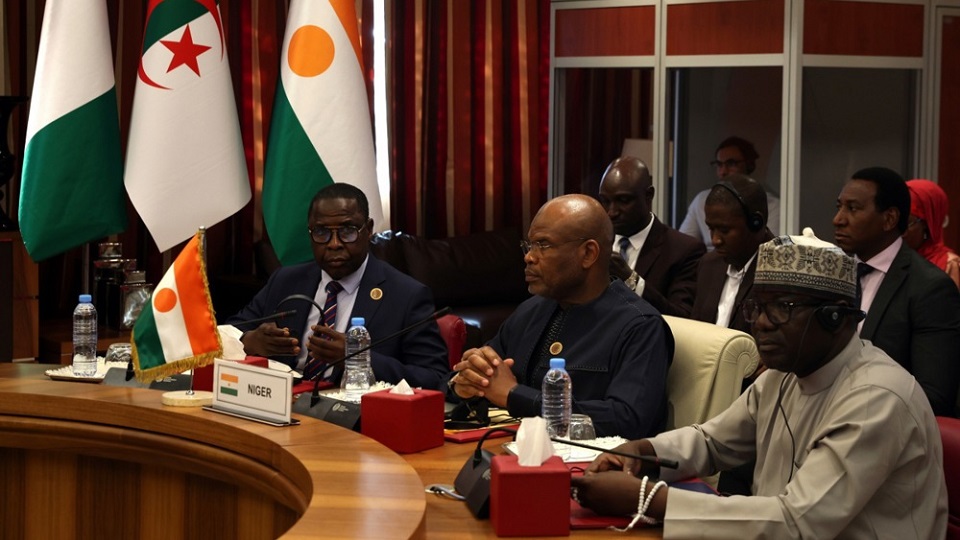
In July 2023, a military coup occurred in Niger. Diplomatic rapprochement between Niger and Algeria, formalized during General Abdurrahaman Tiani's visit to Algeria in February 2026, became possible after a 10-month "freeze" caused by a border drone incident. In other words, the construction schedule for the Niger section depends directly on personal relations between the two leaders — not on institutions.
"We agreed to launch the project to complete the Trans-Saharan Gas Pipeline through Niger's territory. Sonatrach will take the lead and begin laying pipe."
Abdelmadjid Tebboune, President of Algeria — joint press conference with Niger's leader Tiani, Algeria, February 2026
What is missing from official statements
- Source of financing — $13 billion. The February 2025 agreement updated the techno-economic justification, but did not announce an investor.
- Commissioning date — officially "by 2030," but the project was supposed to be ready in 2015.
- Infrastructure protection mechanism — 841 km of pipeline through a zone of active jihadist group activity without a publicly agreed security protocol.
American analyst Jeff Kroll noted that from a technical standpoint, TSGP has no serious engineering obstacles, despite concerns about security in the Sahel. Technical readiness and political stability are different things.
If Niger remains under the rule of a junta oriented toward Moscow and Beijing, and if the next diplomatic crisis between Niamey and Algeria freezes the project again — does the EU have a real Plan B to fill this gas corridor, or will the Trans-Saharan Pipeline remain a promise on paper once more?







