The logic is simple: if one large facility can be destroyed in a single strike, break it into six smaller ones. This is the principle behind the second phase of Power One — a private energy project by Dragon Capital's Tomasz Fiala and Negen's Volodymyr Kudrytskyy, the former head of Ukrenergo.
What was signed and where
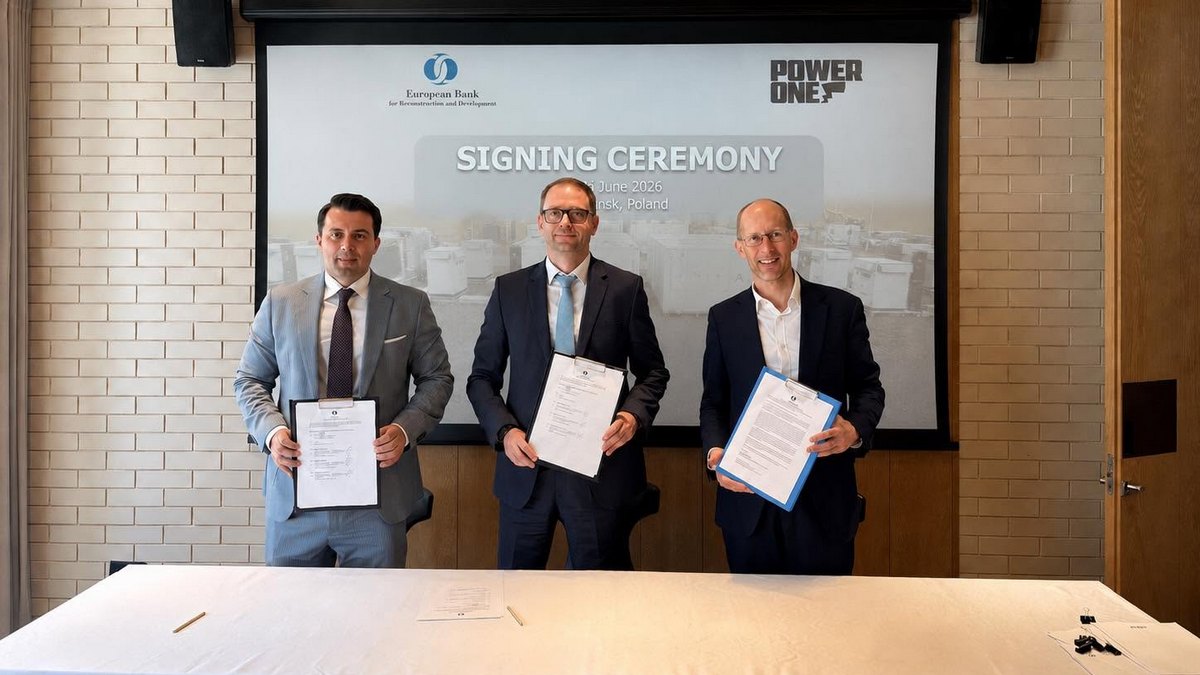
On the sidelines of the Ukraine Recovery Conference (URC 2026), Dragon Capital, Negen, and the European Bank for Reconstruction and Development signed a mandate letter — a document fixing the EBRD's intention to prepare debt financing for the second phase. According to Interfax-Ukraine, the loan could amount to up to €50 million from a total budget exceeding €90 million.
A mandate letter is not a loan agreement. Final financing terms will still be negotiated, and the mechanism for monitoring expenditures has not been publicly disclosed.
What makes up the second phase
170 MW of new capacity is not a single facility. According to Interfax-Ukraine, the project provides for a battery energy storage system of 160 MW and a peak gas-piston power plant of 9 MW, distributed across six sites in different regions of Ukraine. No single facility exceeds 10 MW — this is a deliberate bet on resilience against attacks and local accidents.
Upon completion of the second phase, Power One's total storage capacity will exceed 750 MWh, which, according to Kudrytskyy, will make the company a leader in the energy storage market in Ukraine.
First phase: what already exists
The first phase is financed by the EBRD from 2025 onwards — the bank provided €21.1 million and a Norwegian grant of €3 million. Currently, 28.4 MW has been commissioned; another 40 MW is expected to become operational by the end of 2026. The first phase is concentrated in Transcarpathia and combines gas-piston installations (36.8 MW) with storage systems (31.5 MW).
Who is behind the project
Kudrytskyy left Ukrenergo in September 2024. Already in November, together with former Ukrenergo board member Andriy Nemyrovskyi, he founded Negen. In April 2025, he agreed with Dragon Capital on a joint launch of Power One.
«For us it was very important to create something meaningful for the Ukrainian energy system»,
— Volodymyr Kudrytskyy, co-founder of Negen and managing partner of Power One, Dragon Capital
Dragon Capital, which owns 100% of Power One, acts as the financial partner; Negen acts as the operational partner. Czech company RSE will supply equipment for the project.
Why this matters beyond a single company
Russia has destroyed much of Ukraine's maneuvering capacity — primarily coal and gas facilities. Battery storage systems and distributed gas generation fill exactly this niche: fast start-up, geographic dispersal, absence of a single point of failure. The cost of 1 MWh BESS has fallen to ~€110,000 in 2025, making profitability realistic without subsidies.
- 160 MW — battery storage (second phase)
- 9 MW — peak gas generation (second phase)
- 6 sites in different regions
- 750+ MWh — total capacity upon completion of both phases
- 90+ million euros — budget for the second phase
The question that will determine the real value of this model: will Power One be able to scale the decentralized approach faster than missile strikes adapt to new facility configurations — and will this architecture become the standard for other private investors in Ukrainian energy if the second phase stays on schedule through the end of 2026.