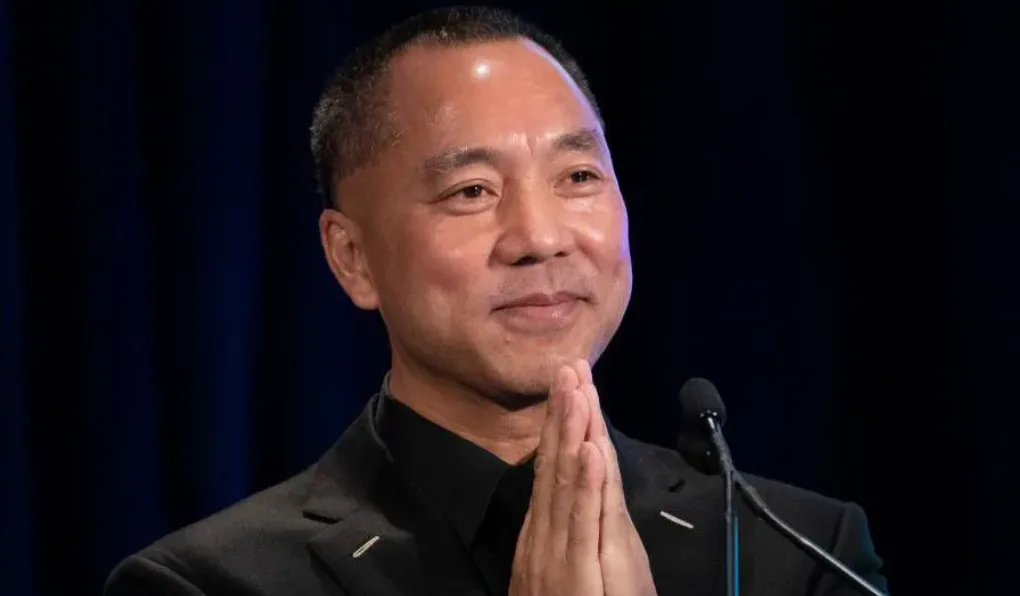
Guo Wengui — a businessman whom the 2014 Hurun China Rich List valued at $2.6 billion — received a 30-year federal prison sentence. The verdict was announced by Judge Analisa Torres in Manhattan on June 30, 2026. In addition to imprisonment, the court ordered him to return $889 million — money that, according to case materials, he spent on a 46-meter superyacht, a penthouse at the Sherry-Netherland hotel on Fifth Avenue, and other luxury items.
How the scheme worked
After fleeing China in 2017, Guo Wengui, also known as Miles Guo and Ho Wan Kwok, built a large online audience in the United States — primarily among the Chinese diaspora — on the basis of harsh criticism of the Communist Party of China. According to NPR, prosecutors claim that he convinced hundreds of thousands of people to invest more than $1 billion in structures he controlled.
The scheme involved several instruments: $452 million — through unregistered placement of shares in media company GTV Media Group, $262 million — in the cryptocurrency project Himalaya Exchange, $250 million — through membership programs, and $150 million — in the form of loans. According to Wikipedia, as early as 2021, Guo reached a settlement with the U.S. Securities and Exchange Commission for $539 million — but this did not stop criminal prosecution.
The defense attempted to present the defendant as a political activist. According to Bloomberg, attorney Melinda Sarafa appealed to his "unwavering support for democracy in China." Prosecutor Ryan Finkel responded briefly:
"Miles Guo is not a political activist. He is a fraudster and a thief."
Assistant U.S. Attorney Ryan Finkel, Federal Court of Manhattan
Victims: not abstract investors
Judge Torres stated that the fraud caused losses to more than a thousand people around the world totaling hundreds of millions of dollars. At the sentencing hearing, victim Wei Chen spoke: according to Courthouse News, she said her family lost all their savings and went into debt because she believed in the promised returns.
"This fraud destroyed my life and my family's."
Wei Chen, victim investor, at the sentencing hearing
Prosecutors noted that most victims invested believing they were genuinely supporting a pro-democracy movement and the struggle against Beijing. It is precisely this motivation — not greed, but ideological loyalty — that distinguishes Guo's case from typical financial pyramids and complicates the return of funds: many victims still publicly defend the convicted man.
Connection to Bannon and Trump
The case has a distinct political context. Together with Steve Bannon — former strategist to Donald Trump — Guo founded GTV Media Group in 2020 and announced an initiative to "destroy" the Chinese government. That same year, according to Al Jazeera, Bannon was arrested aboard Guo's yacht on charges of misappropriating funds related to fundraising for the construction of a wall on the U.S.-Mexico border. Guo was also a member of Mar-a-Lago — Trump's golf club in Florida.
After the verdict was announced, Guo's supporters, who filled the courtroom, applauded him and shouted words of support. If he exhausts all appeal mechanisms — he will not be released before 2044.
The key question of the case goes beyond personal guilt: is American securities law sufficient to block similar schemes before they scale to a billion dollars — or do verdicts in such cases always come too late for hundreds of thousands of victims?







