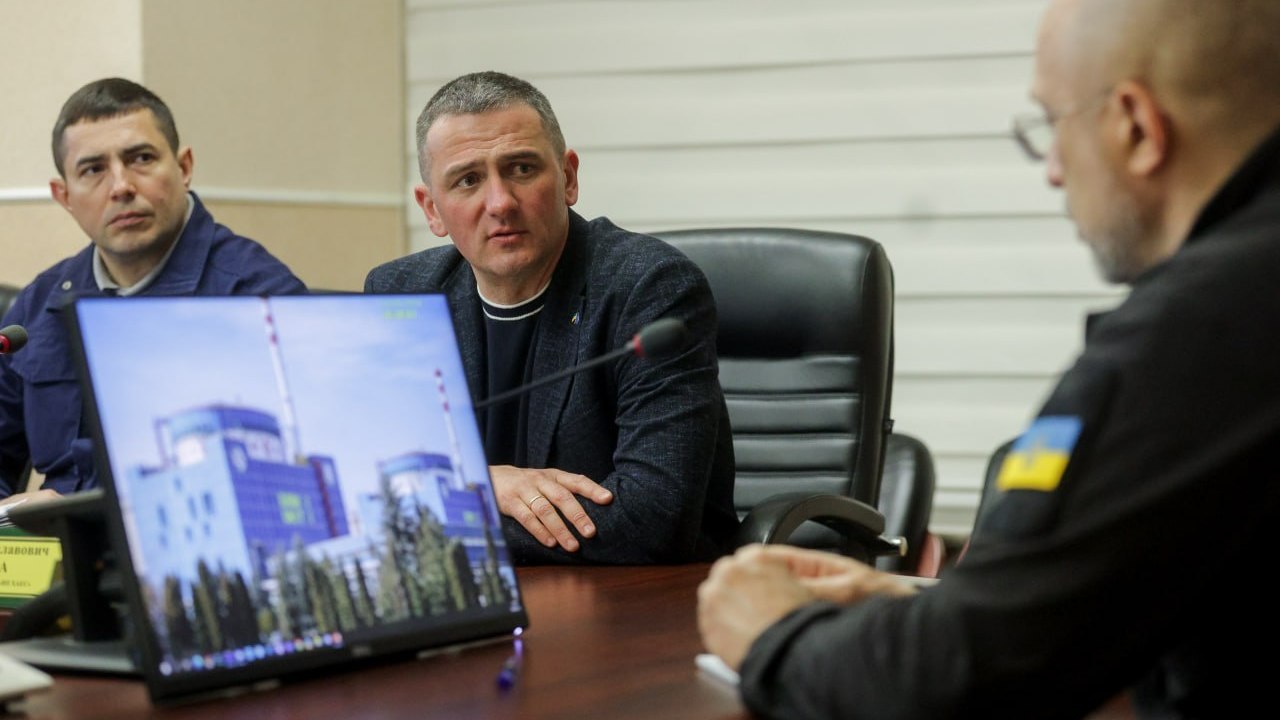
First Vice Prime Minister and Energy Minister Denys Shmyhal announced that the Ministry of Energy is considering two options for completing the third and fourth power units of the Khmelnytsky Nuclear Power Plant. He did not provide details — but the context behind these "options" is significantly more important than the statement itself.
Construction That Was Halted Three Times
Units No. 3 and No. 4 of the Khmelnytsky NPP began construction in 1985–1986. In 1990, a moratorium on new nuclear power plant construction froze the project — with the third unit approximately 75% construction-ready and the fourth unit 28% ready. Since then, the issue of completion has emerged, according to LB.ua journalists' calculations, at least once per decade.
Real momentum came only in February 2025: the Verkhovna Rada supported the procurement of equipment for completing the two units, and Zelenskyy called the project a "key to energy independence" in an evening address. Parliament voted for bill No. 11392, but a similar document had been repeatedly removed from the agenda before — there were not enough votes.
Two Options — Two Different Dead Ends
The first scenario is completion using Soviet VVER-1000 technology. The key problem: reactor vessels were supposed to be purchased from Bulgaria, where they have been stored since the abandoned Belene nuclear power plant. But in April 2025, Bulgarian Vice Prime Minister Atanas Zafirov stated that the country will not sell Ukraine these two VVER-1000 reactor vessels. Negotiations reached an impasse.
"There is indeed significant readiness of major structures there, except for the units themselves, but we are now working to implement these projects as quickly and efficiently as possible, and determine which technology to use"
— Svitlana Hrynchuk, former energy minister, before Shmyhal's appointment
The second scenario is a transition to American AP1000 technology from Westinghouse. The capacity of each such unit would be up to 1200 MW instead of 1000 MW in the VVER version. If both options are implemented — both VVER and AP1000 for future units No. 5 and No. 6 — the total capacity of Khmelnytsky NPP would exceed 6000 MW, making it Europe's largest nuclear power station. However, there's a catch: according to "Nashi Hroshi," Energoatom planned a tender for inspecting Bulgarian reactors valued at 86 million hryvnias only for July 2025 — meaning even the technical assessment of the equipment has not yet been completed.
Financial Plan From 2017
The only public technical and economic substantiation (TES) of the project — approved by the Cabinet in 2018 with prices as of May 2017 — estimated the total cost at 72.34 billion hryvnias. At the current exchange rate and inflation level, this figure has long lost touch with reality. People's Deputy Inna Sovsun, a member of the energy committee, directly stated that the project lacks an up-to-date publicly presented financial plan. An updated TES was never submitted to parliament — neither under Halushchenko nor now.
Former Minister Herman Halushchenko estimated the cost of completing units No. 3 and No. 4 at approximately 160 billion hryvnias — and spoke of combining Energoatom's own funds with credit financing. No specific creditors were named.
What Is Already Happening at the Site
- Unit No. 3 is approximately 85% complete, unit No. 4 is approximately 28% complete.
- More than 600 personnel evacuated from the occupied Zaporizhzhia Nuclear Power Plant are engaged in construction.
- In February 2025, the first phase of GAP analysis was completed: the project was checked for compliance with generation III+ standards with passive safety systems — an IAEA requirement, which announced technical support for construction in September 2024.
- Westinghouse received an order from Energoatom in 2023 to analyze completion options — but public results of this analysis have not been released.
According to nuclear energy expert Maksym Pyshnyi, after Bulgaria's refusal, completion is technically possible, but no one knows the final cost — since Ukraine has effectively lost its own competence in building nuclear units and depends on external contractors and suppliers.
If the government does not present an updated TES with realistic figures and confirmed funding sources by the end of 2025 — Shmyhal's "two options" risk becoming another round of discussion of a project waiting for implementation since Soviet times.