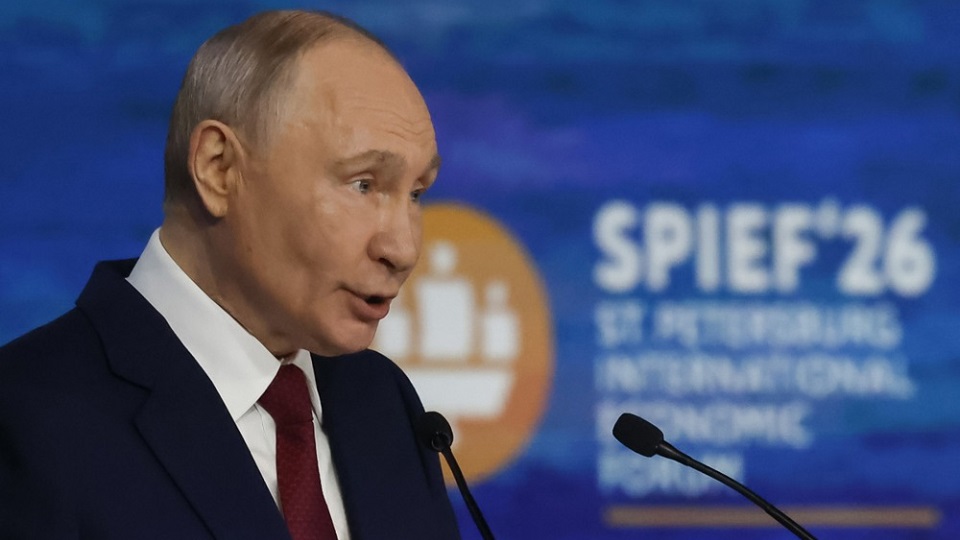
Every year, the St. Petersburg International Economic Forum is a platform where Putin explains to the world that sanctions haven't worked. This year's SPIEF was no exception: the Russian president spoke of "expanded opportunities," new partnerships, and economic resilience. The numbers tell a different story.
Revenues fell, deficit grew — and this isn't anti-Russian propaganda
Ukraine's Presidential Commissioner for Sanctions Policy Vladislav Vlasiuk cited specific figures in a comment to Interfax-Ukraine: Russia's federal budget revenues have declined by 40% compared to last year — against the backdrop of relatively high oil prices. The budget "hole" has already exceeded $80 billion.
"Contrary to the optimistic rhetoric of Russia's leadership, Russia is confidently acquiring the status of a bankrupt state."
Vladislav Vlasiuk, Presidential Commissioner of Ukraine for Sanctions Policy
One detail Putin failed to mention in his speech: while he criticizes the West for budget deficits, 71 of Russia's 85 regions ended last year with negative balances. Their combined deficit has already exceeded $34 billion. Russia's Finance Minister Siluanov acknowledged in the Federation Council that regional debt as a share of revenues has risen to 19% — regions are financing deficits through bank loans at current record-high interest rates.
Stagflation: when stagnation and price growth happen simultaneously
Foreign trade is also deteriorating: over the years of full-scale war, the trade surplus has shrunk by nearly three times — from $337 to $125 billion. Military expenditures over the same period have soared from 6.5 to 19.8 trillion rubles per year.
Economists are documenting a classic trap. According to the Atlantic Council, the Central Bank of Russia held its key rate at a peak of 21% to combat inflation — and achieved only partial results: GDP in the first quarter of 2025 grew by only 1.4%, while inflation remained around 10%. Economist Janis Kluge (Stiftung Wissenschaft und Politik) explains the mechanism: high interest rates make loans impossible for civilian businesses, leading to mass business closures and "releasing" workers for the army. This is not anti-crisis policy — it is a deliberate shifting of the burden of war onto the private sector.
The National Welfare Fund — the Kremlin's main "safety cushion" — has shrunk by approximately 68% since the beginning of the full-scale invasion. To cover the deficit, Russia increasingly resorts to money printing: the volume of Central Bank repo auctions in 2026 increased 12 times compared to the first quarter of the previous year.
What this means for people in Russia
Most of these figures are not abstract. Real incomes of the population have begun to fall, consumer demand has stagnated since mid-2024. Even Magnit — Russia's largest retail chain — ended 2025 with losses. Small and medium-sized businesses are closing en masse: no one takes out loans at 20%+ per year except those who have nothing left to lose.
- −40% federal budget revenues year-over-year
- $80+ billion — federal budget deficit
- 71 of 85 regions — with budget deficits, combined deficit of $34 billion
- −68% National Welfare Fund since February 2022
- ×3 — the factor by which the positive foreign trade balance has shrunk
Vlasiuk emphasizes: sanctions are already eroding the economic base of Russia's war machine, but oil revenues could temporarily ease the crisis. This is the key issue: if the Urals price remains above $60 per barrel through the end of 2025, the Kremlin will have resources for at least one or two more budget cycles — and the St. Petersburg forum will take place again with the same rhetoric.







