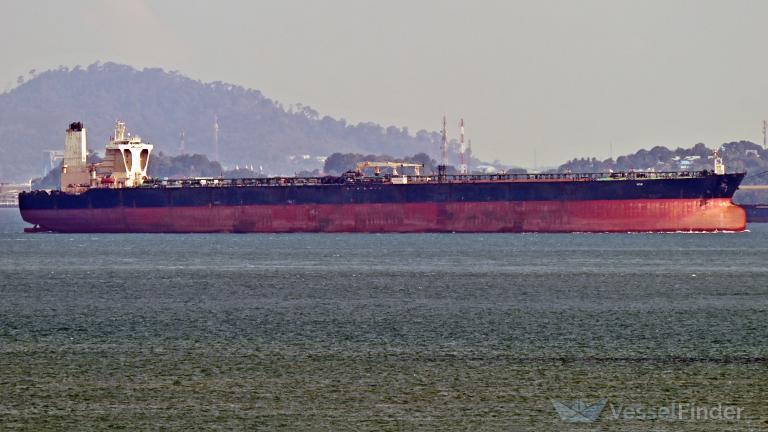
Late in the evening on April 9, the supertanker Arhimeda under the Russian flag passed through the Strait of Hormuz heading toward the Persian Gulf. Bloomberg, which tracked the vessel's movement using AIS data, called this a rare occurrence for ships under the Russian flag.
What is known about the route
The tanker was traveling without cargo — in ballast condition. Initially, Kharg Island was listed as the destination — Iran's main oil export terminal, through which over 90% of Iranian crude oil passes. The status then changed to "for orders" — a designation used when a vessel is awaiting instructions and has no fixed next port of call.
The change in destination is not in itself evidence of violations: "for orders" is standard practice in commercial shipping. However, the combination of three factors — the RF flag, the route to Kharg, and an empty hold — attracted the attention of vessel tracking analysts.
Why the Russian flag in Hormuz is an exception
Russia's shadow fleet numbers, by various estimates, between 1,200 and 1,400 tankers, but most sail under flags of convenience — the Comoros Islands, Panama, Palau, Belize. The transition to the Russian flag accelerated only after the West began massively detaining sanctioned vessels.
"This decision was driven by increasingly frequent incidents of shadow fleet tankers being detained by European countries and the United States. Additionally, it may indicate Russia's coordination with Iran in the context of ensuring safe passage for shadow fleet vessels through the military conflict zone in the Middle East."
Foreign Intelligence Service of Ukraine (SZRU), March 2025
In other words, the Russian flag in this region is not merely a registration mark, but potentially a diplomatic cover: Iran de facto grants certain preferences to "friendly" countries, including Russia, in the strait.
The suspected scheme
Kharg Island is not just a terminal, but a point where Iranian and Russian oil logistics intersect. Analysts have previously documented similar patterns: a tanker enters Kharg in ballast, is loaded with Iranian crude oil, disables its AIS transponder, and disappears from radar for several weeks. This is how the vessel Bella 1 operated — in September 2024, it loaded Iranian crude oil at Kharg, disabled its tracker near the Strait of Hormuz, and did not appear in any database for two months.
- Ballast voyage to Iran — the vessel travels empty in order to be loaded
- Change of destination to "for orders" — allows avoidance of fixing the final buyer
- AIS shutdown — a standard next step in such schemes, according to analytics firm Kpler
Whether Arhimeda realized this scenario is unknown at the time of publication. Bloomberg recorded the entry into the strait, but not the subsequent route.
Scale
According to the SZRU, Russia plans to re-register approximately 80 shadow fleet tankers under its own flag. In parallel, Ukraine's GUR is monitoring the joint Iranian-Russian shadow tanker fleet — as of early 2025, it numbered 626 vessels with a combined deadweight of nearly 67 million tons. These are not isolated individual ships, but a coordinated infrastructure for circumventing sanctions.
If the Arhimeda voyage concludes with the loading of Iranian crude oil followed by transponder shutdown — it would indicate that the Russian flag in the Persian Gulf is transforming from a statistical rarity into a working tool of a joint scheme.