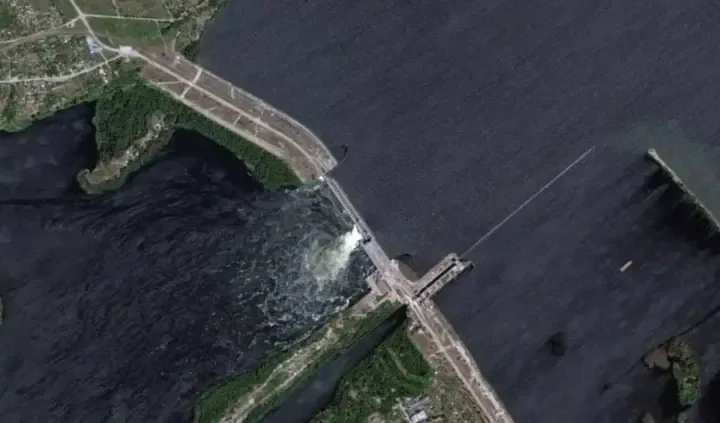
Exactly three years after the Kakhovka hydroelectric power station dam was blown up — and the case is still in the expert examination stage. Borys Indichenko, head of the Specialized Environmental Prosecutor's Office of the Office of the Prosecutor General, explained: some conclusions are already ready, but the key comprehensive expertise that should consolidate all the data is still ongoing. The estimated deadline is the end of 2026.
"I hope that by the end of this year we will be able to move on to writing a suspicion, or perhaps even submitting an indictment"
Borys Indichenko, head of the Specialized Environmental Prosecutor's Office of the Office of the Prosecutor General
What has already been established — and where the limits are
The explosion occurred at 2:50 on June 6, 2023. According to the investigation's version, as presented by Judicial Reporter citing the text of the suspicion, Colonel General of the Russian Armed Forces Oleg Makarevich — commander of the "Dnieper" grouping at that time — as early as November 2022 laid plans for the demolition of the hydroelectric power station in a strategic defensive operation plan: to prevent the advance of Ukrainian forces in the Kherson direction. On the night of June 5-6, 2023, according to the investigation, he coordinated through the headquarters the actions of eight military personnel who, between 2 and 3 a.m., activated the explosive mechanism.
The Security Service of Ukraine announced suspicion against Makarevich in June 2024 — under the article on violation of laws and customs of war combined with intentional murder. In July 2025, Major General Volodymyr Omelianovy — chief of staff of the "Dnieper" grouping, who directly coordinated the actions of units at the site that night — received a separate suspicion.
But these are separate criminal proceedings against specific individuals. The large-scale case concerning the fact of the catastrophe itself and its environmental consequences — the one Indichenko is discussing — is still in the evidence-gathering stage.
Scale: figures that are hard to comprehend
- 16,000 people and approximately 80 settlements were in the disaster zone.
- Water flooded at least 600 sq. km of territory, a wave up to 5 meters high covered the banks from Nová Kakhovka to the mouth of the Dnieper-Bug estuary.
- Direct infrastructure damage was estimated at $2.79 billion, total damage exceeded $11 billion.
- Environmental damage according to the State Environmental Inspection calculations — over 146 billion hryvnias, and according to updated three-year-old data — over 77.8 billion hryvnias in ecological losses alone.
- After Chornobyl — the largest man-made disaster on the territory of Ukraine.
It is precisely because of this scale that investigators conducted several "field missions" to collect samples in areas that are already partially inaccessible or occupied. According to Indichenko, each such mission resembled a "safari" — but without this data, comprehensive expertise is impossible.
Suspicion ≠ verdict, and not even ≠ indictment
It is important to distinguish between levels. Makarevich and Omelianovy are suspected — this is the first procedural step, not a verdict or indictment. Both are in Russia and have been informed of the suspicion in absentia. The prospect of an actual trial depends either on their extradition or on future international mechanisms — neither of which is currently guaranteed.
A separate comprehensive case on environmental crimes — the one the Specialized Environmental Prosecutor's Office is handling — could become a precedent for international law: Truth Hounds specialists pointed out as early as 2023 that the dam explosion bears signs of violating Article 56 of Additional Protocol I to the Geneva Conventions on the protection of objects essential to the survival of the civilian population.
If the comprehensive expertise is completed by the end of 2026 and suspicions are announced — it will become clear whether the Office of the Prosecutor General will build a case that can be transferred to international bodies, or whether it will remain a trial in absentia without an actual court hearing in the foreseeable future.