Why this matters
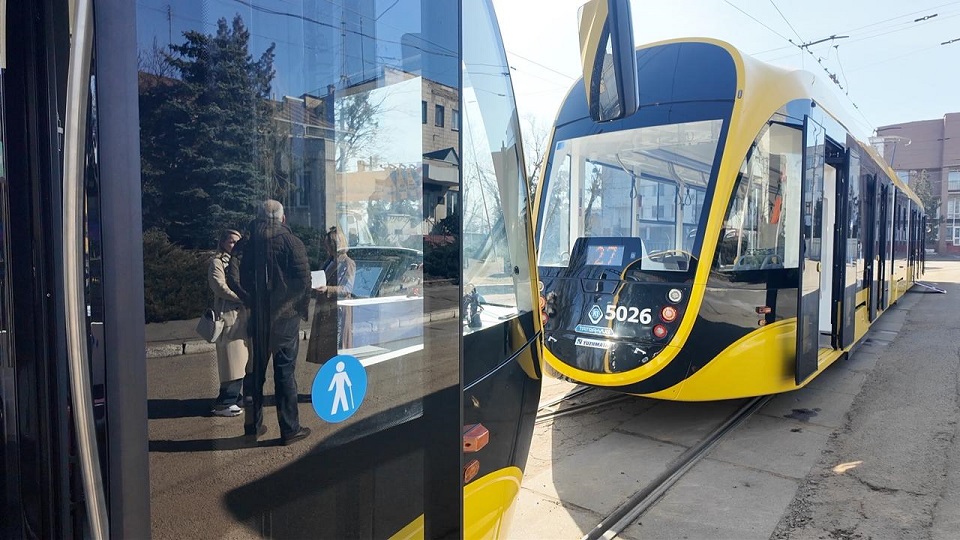
On Friday, March 13, three new trams built by the Odesa-based company Tatra‑Yug entered service on route No. 27, which connects the Darnytskyi, Dniprovskyi and Desnianskyi districts of Kyiv. For Kyiv residents this is not only about comfort inside the car — it is an indicator of the restoration of services on the left bank after a lengthy pause and a signal in favor of local manufacturing.
Official statement
“Even in such difficult times we take care of the comfort of Kyiv residents. Last year the city purchased eight new modern passenger tram cars produced by LLC ‘Tatra‑Yug’. Five of them were already running on the line. Three more went out on the route today,”
— Vitali Klitschko, mayor of Kyiv
What’s inside the car and for whom
The cars feature a 100% low floor, air conditioning and heating, a CCTV system and an automated fare payment system. Eight charging points for gadgets are installed in the cabin. For people with reduced mobility there is a ramp, an information display and a stop‑announcement system; the doors are equipped with visual and audible signals. A single car is designed for over 260 passengers, of which 67 are seated.
Industrial and operational logic
LLC “Tatra‑Yug” has been operating since 1993 and is the successor to the Czechoslovak Tatra school of tram manufacturing. Kyiv has previously ordered trams from the company: in 2021 — 20 units for the left bank, and in November 2024 Kyivpastrans signed a UAH 480 million contract for the supply of five more cars. Today’s deployment of three cars is part of this supply series and a basis for stabilizing service.
Context of service restoration
Electric transport on the left bank was halted on January 10 as a result of one of the massive Russian strikes; after further shelling on January 13, right‑bank services also stopped, which were restored on February 26. Service on the left bank resumed on March 3 after nearly a two‑month pause. These dates serve as a reminder that restoring transport infrastructure takes place under difficult conditions and requires both material‑technical resources and logistical coordination.
What’s next
This is not an epochal change, but a noticeable practical result: restoring routes eases the daily life of thousands of Kyiv residents, supports jobs in Ukrainian industry and strengthens the city’s transport system. The next task is to ensure regular supplies and technical support so that these units become part of a stable network.
Question for the reader: will the current coordination between the city and manufacturers be sufficient to scale this success to other parts of the network and make the recovery long‑lasting?







