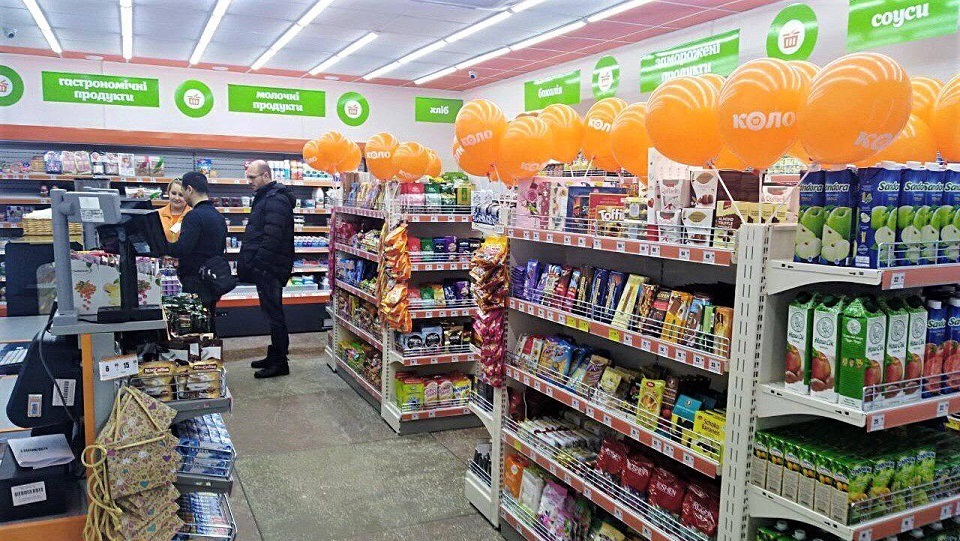
The Antimonopoly Committee on July 16 granted permission to LLC "Omega," the operator of the Varus network, to acquire control over LLC "Aritail," which manages the "Kolo" store chain. The deal will combine two businesses with different logics: a classic supermarket with an area of several hundred square meters and a minimarket of 40–100 m² with 2,000 product items.
Two formats, different philosophy
Varus is a network of 115 supermarkets developed since 2003 by Dnipro businessmen Ruslan Shostak and Valery Kiptyk. According to YouControl data, LLC "Omega's" revenue in 2025 grew by 20% and reached 24.1 billion hrn. In addition to the classic format, the company is developing To Go and online retail through DarkStore in Kyiv.
"Kolo" is a different story. The chain was founded in 2017 as a convenience store: come in quickly, buy essentials, leave. According to open sources, about 250 stores are scattered mainly across residential areas of major cities. LLC "Aritail" is associated with ATB co-founder Hennadiy Butkevych — he is listed as the ultimate beneficial owner of the company in YouControl.
"Kolo" began forming a new retail culture, where the time factor prevails over price.
From company materials for the network's seventh anniversary
Why now
The "near home" format received two systemic boosts. During the pandemic, large stores limited visitor numbers — and minimarkets proved to be a more convenient alternative. After February 24, 2022, the logic remained unchanged: a quick trip to buy groceries near home proved more practical than traveling to a large supermarket amid air raids and fuel shortages.
"Aritail's" revenue in 2025 grew by 23% — to almost 3.3 billion hrn. This means that Varus is buying not a problematic asset, but a growing business, and is paying accordingly — although the deal amount is not disclosed.
What the market gains as a result
For Varus, this is vertical diversification: a large supermarket and a "corner store" cover different purchase scenarios for the same consumer. Similar strategies have long been used in Europe by Carrefour (City format) and Tesco (Express). In Ukraine, before the full-scale invasion, ATB tried to follow this path, but Varus is the first to consolidate it legally through acquisition.
- The application to the AMCU was submitted on June 4, the decision was made on July 16 — standard 42 days without in-depth investigations.
- The EBRD, within a $25 million credit line, has already provided Varus with a second tranche of $10 million — financing for development, not survival.
- Deal details — price, integration timelines, the "Kolo" brand's share — were not disclosed publicly.
The key unknown here is not financial but operational: will "Kolo" retain its own brand and format after integration, or will Varus gradually transition stores under a single sign — and if so, won't it lose exactly what it paid for.