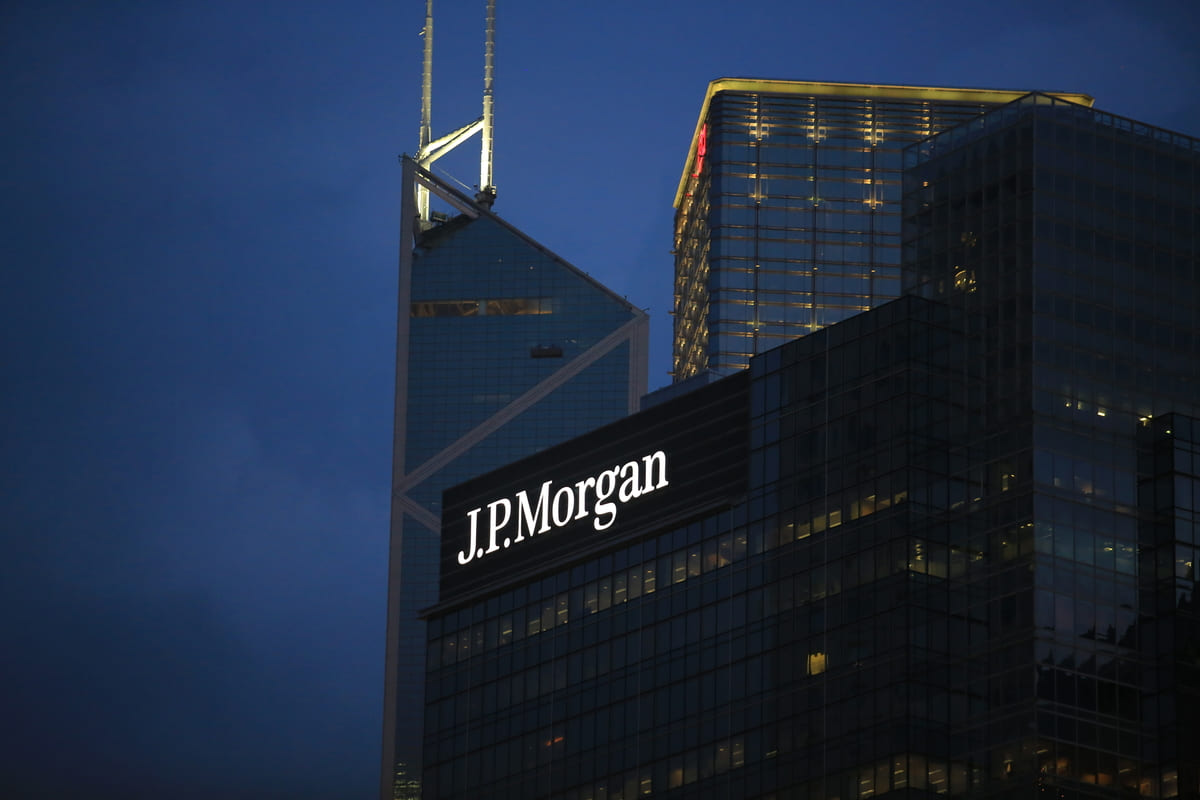
When a bank earns more than any other bank in American history — and does so in a quarter when markets trembled from trade wars — it is no longer just a financial report. It is a statement about who wins from chaos.
Numbers that are hard to comprehend
In the second quarter of 2026, JPMorgan Chase recorded net profit of $21.2 billion — the highest quarterly figure in the history of American banks. Revenue from equity trading surged 86% to $6 billion, and the total income of the Markets division reached $12.1 billion, exceeding the bank's own record set earlier in the year.
Part of the increase was provided by a one-time factor: $4.6 billion in profit from a Visa stock package. Without it, adjusted profit stands at $16.9 billion — still a record. Assets under management reached $5.1 trillion, growing 18% year-over-year, while total client assets stood at $7.7 trillion.
Following the report's publication, the bank's shares hit an all-time high, and market capitalization approached the $935 billion mark. According to Reuters, JPMorgan could become the first bank in the world whose valuation crosses the $1 trillion threshold — alongside Tesla, Meta, and Broadcom.
The Dimon Paradox
Jamie Dimon — the man whose bank just set a profit record — is publicly sounding the alarm about the economy. Back in May at an annual investment forum, he stated that markets and central banks are underestimating the risks from record U.S. budget deficits, tariffs, and international tensions.
"The economy is facing significant disruptions, including geopolitical ones. We hope for the best but are preparing the bank for a wide range of scenarios."
Jamie Dimon, CEO of JPMorgan Chase
This is not déjà vu: in the first quarter of 2025, the bank earned $14.6 billion — and Dimon was also talking about "significant disruptions" then. Back then it sounded like caution. Now, after a record quarter amid trade wars, it sounds more like a description of a business model: volatility is not a risk for JPMorgan, it is income.
What stands behind the record
The profit structure is revealing. The trading division benefits from uncertainty — clients hedge more actively, transaction volumes grow. The investment banking business is fueled by a recovery in M&A following a pause. The retail segment holds up: the card charge-off rate corresponds to the projected indicator of around 3.4% per year — a normal level, not alarming.
At the same time, the bank raised its cost forecast for 2026 to $107.5 billion from $105 billion — and the market reacted by dropping the stock more than 2.5% immediately after the report was released, even before the management call. Rising costs amid record income is a bet that scale will continue to convert into profit.
Today, JPMorgan's market capitalization exceeds the combined value of its three nearest competitors. The bank manages $5 trillion in assets and has equity capital of $375 billion — sizes that make it systemically significant in the sense that its stability and its risks are equally important to the entire financial system.
If JPMorgan truly becomes the first among banks to cross the $1 trillion capitalization threshold, the question will become practical: are regulators in Washington and Brussels ready for one bank to stand alongside the largest technology companies — and at the same time have access to the deposits of millions of households?