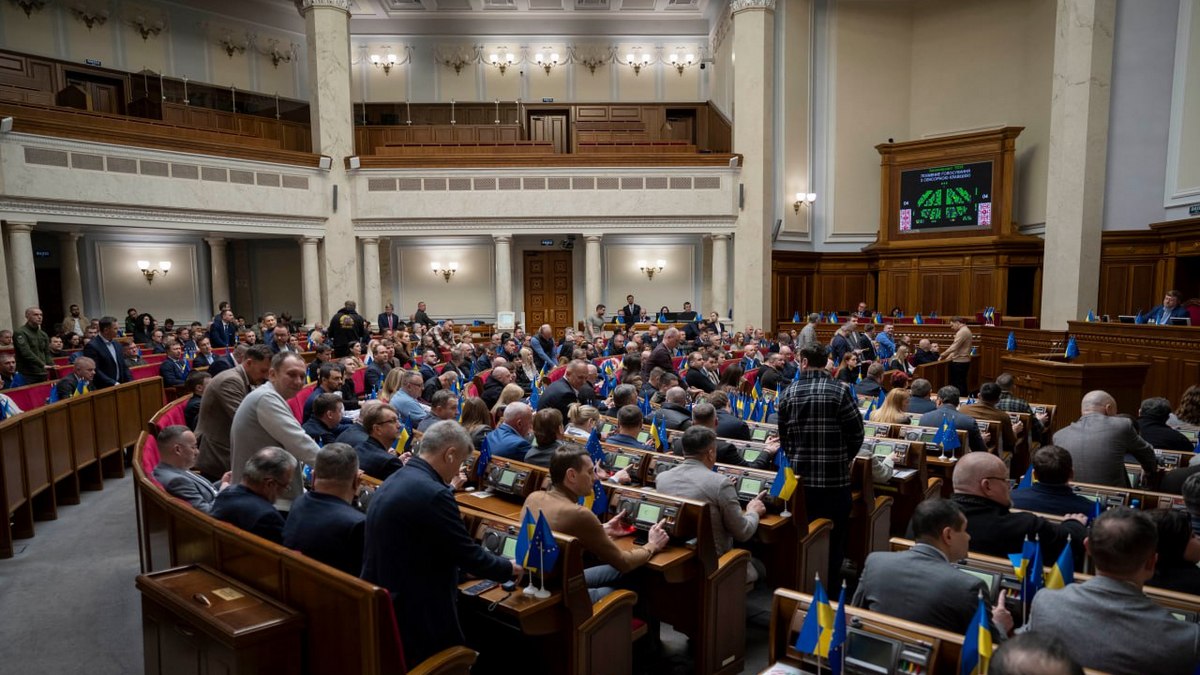
On July 14, the Verkhovna Rada approved the National Security and Defense Council decision from June 9 with 312 votes — and this is not another routine sanctions package. Behind the vote stands a specific financial scheme that Russia has been building for years.
The scheme being closed
The sanctions now extend not only to Russian banks, insurance and financial companies, but also to financial platforms and payment systems where digital financial assets are issued that are used by the Russian Federation. Any operations with virtual assets issued in Russia or backed by the ruble are separately banned — as well as with infrastructure providers that service them.
The main target is the A7 payment system and its A7A5 stablecoin, pegged to the ruble. The scheme is simple and effective: Russian companies channel rubles through the sanctioned Promsvyazbank, buy A7A5, and then instantly exchange them for dollar-denominated USDT on cryptocurrency exchanges (primarily Grinex in Kyrgyzstan) — gaining access to the global market while minimizing blocking risk.
"This involves applying special sectoral sanctions to effectively the entire financial and banking system of the aggressor country"
Fedor Venislavsky, head of the Verkhovna Rada subcommittee on state security and defense innovations
Scale: over $100 billion in less than a year
A7A5 was launched in February 2025 in Kyrgyzstan. According to analytics firm Elliptic, the total transaction volume through the stablecoin exceeded $100 billion in less than a year — a larger supply increase than that of market leaders USDT and USDC. The number of active wallets reached 35,000.
Formally, the token's issuer is the Kyrgyz company Old Vector, which allows the token to be issued outside the Russian Federation, although reserves are kept at Promsvyazbank. The main shareholder of A7 LLC is considered to be Moldovan oligarch Ilan Shor — sentenced in absentia for stealing $1 billion from Moldova's banking system and currently hiding in Moscow.
The United States added Grinex and related wallets to the SDN sanctions list in summer 2025. The reaction was telling: according to the Financial Times, over 80% of A7A5 was quickly destroyed and reissued — to sever ties with the newly sanctioned exchange. More than $6 billion passed through it after the blockade.
- The EU and USA had already introduced sanctions against A7 and Grinex earlier in 2025
- In late September 2025, Russia officially granted A7A5 the status of a digital financial asset — for use in export operations
- A Stablepay virtual card appeared for paying for foreign services, backed by the same token
NBU initiative and synchronization with partners
The expansion of sanctions is an initiative of the National Bank of Ukraine, which has been tracking the evolution of crypto schemes. As Interfax-Ukraine reports, the changes also affect cryptocurrency exchanges, platforms and other infrastructure providers that facilitate operations with ruble stablecoins. Reactions to these measures are already being registered in the policies of the USA, EU and Great Britain.
A practical problem remains: a 50-year sanctions horizon looks convincing on paper, but A7A5 has already demonstrated the ability to instantly restructure after being placed on sanctions lists. If Russia reissues the token through a new jurisdiction — for example, the UAE, where related structures already operate — will Ukraine's sanctions framework be able to keep pace with this update without a mechanism for automatic expansion of the list of sanctioned entities?