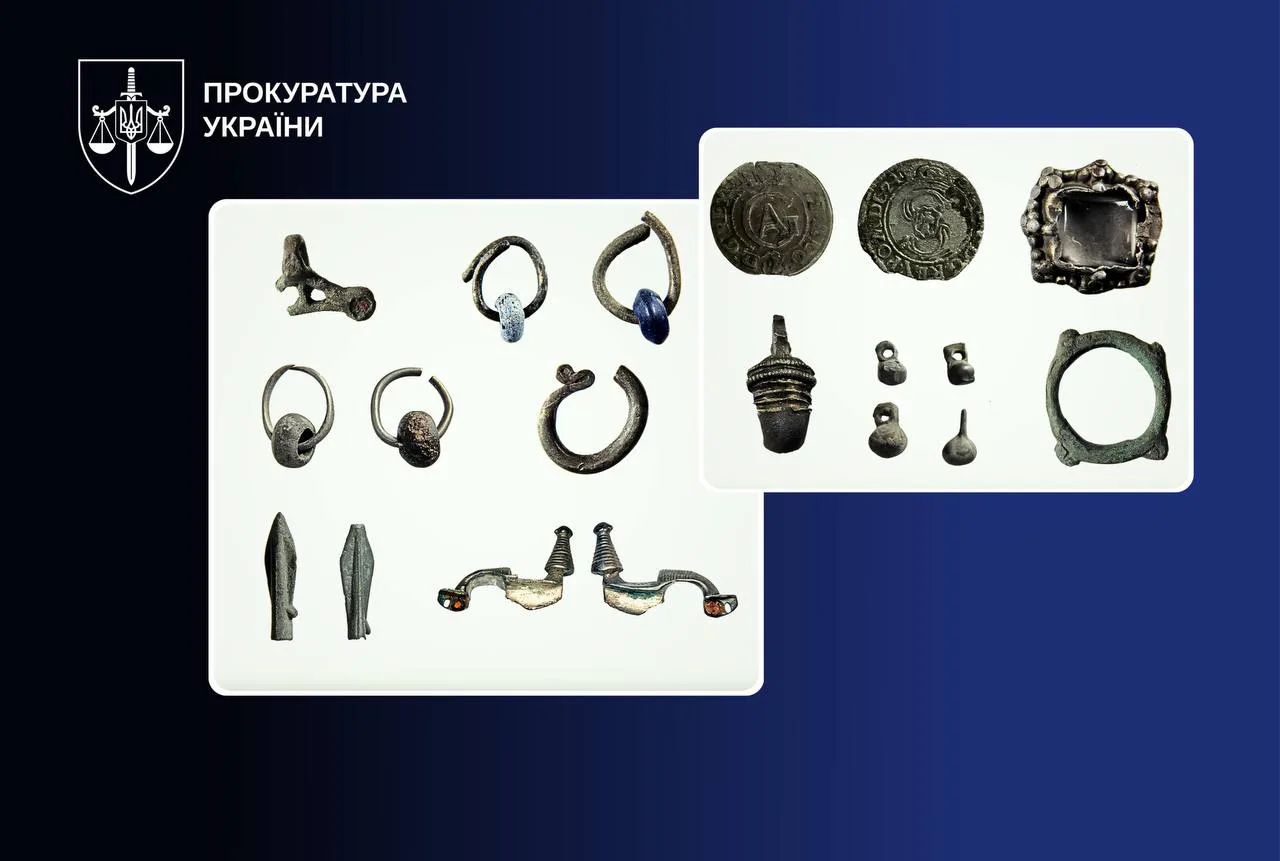
Based on a lawsuit filed by the Office of the Prosecutor General, the Putivl District Court of Sumy Region recognized the state's ownership rights to 892 objects of archaeological and cultural significance. The collection spans more than two thousand years — from the Early Iron Age (8th century BC) to the Kyivan Rus period (13th century AD).
What Was Seized
Among the 892 objects are arrowheads, coins from various epochs, fibulae, crosses, rings and pendants. According to the Prosecutor General's Office classification, the collection encompasses early medieval and Old Rus cultural-historical layers and, according to the department's findings, has exceptional scientific value.
The nature of the collection — numismatics, military equipment, religious and household items — is typical for collections formed through illegal metal detecting: a metal detector allows one to gather precisely this "assortment" over several seasons at the settlements of Poséymia, where Putivl is the center of the densest concentration of archaeological sites.
"Artifacts were held by a private individual and were not voluntarily transferred to the state"
— Office of the Prosecutor General of Ukraine
Civil Lawsuit Instead of Criminal Verdict
An important detail in the formulation: the case was resolved through a civil lawsuit, not within criminal proceedings. This means the court established the unlawful possession of state property, but the question of the owner's criminal liability — under Article 298 of the Criminal Code (illegal archaeological work) or related provisions — was not disclosed in the Prosecutor General's Office public statements.
In accordance with current legislation, objects of archaeological origin in Ukraine cannot be privately owned, sold, or collected by individuals — they are state property as a matter of discovery.
Context: Systemic Practice or Isolated Case
The Putivl case is not an isolated episode. Earlier, with the assistance of the Prosecutor General's Office, over 7,000 artifacts were transferred to the National Museum of the History of Ukraine — the largest replenishment of the state museum fund in years of independence. That collection was discovered during searches in criminal proceedings against the former chairman of the Council of Ministers of the Crimean Autonomous Republic; artifacts were stored in attics and even in electrical boxes.
In parallel, in February 2025, the Verkhovna Rada ratified the Nicosia Convention of the Council of Europe — the first international treaty establishing a mechanism for criminal prosecution of crimes against cultural values, including illegal acquisition and concealment of artifacts.
What's Next
The Prosecutor General's Office did not report which institution would receive the Sumy artifacts or whether criminal proceedings were opened against their owner. The precedent from the Gorbatov case showed that years can pass between the seizure of a collection and an actual criminal verdict.
If the Putivl prosecutors did open proceedings under Article 298 of the Criminal Code, a verdict will become an indicator of whether the ratification of the Nicosia Convention changes anything in practice — or whether civil confiscation remains the only real tool.