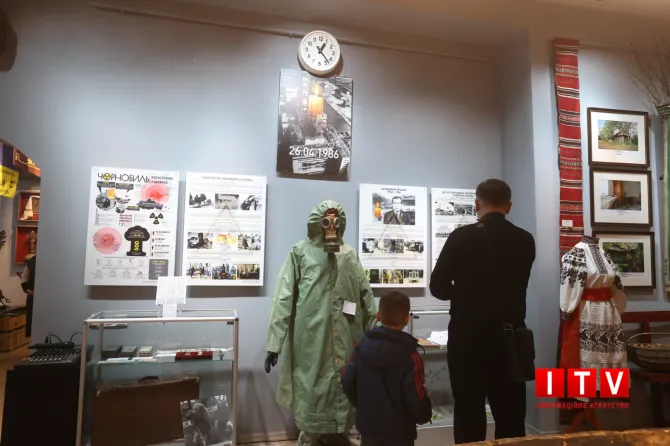
On April 7, an exhibition titled "A World Preserved in Cloth" opened at the Irpin Historical and Local History Museum — a collection of traditional folk clothing and towels from Polissya from the late 19th to early 20th centuries. It was assembled by collector Igor Perevertnuk. Admission is free.
It might seem like just another local history event marking the Chornobyl anniversary. But there is one detail that changes the perspective: most of the items on display come from a region that no longer exists as a living cultural space.
Polissya Before and After
Until 1986, Kyiv Polissya was one of the most archaic corners of Ukraine — swamps, forests, wooden churches, mixed traditions of pagans and Christians. As noted by Ukrayinska Pravda, it was "an archaic region where Soviet propaganda proved powerless against belief in household spirits, forest spirits and mermaids." The 1986 catastrophe accomplished what Soviet authorities could not manage over decades: it devastated settlements and severed the living thread of cultural transmission.
Hundreds of villages were evacuated from the exclusion zone. Some, like Poliske — the former district center — disappeared from the map entirely. According to UNIAN, the level of radiation in the air there exceeded the norm by 100 times within just two weeks after the accident. Some residents returned illegally — thus appearing self-settlers: people whose attachment to the land proved stronger than fear and prohibitions.
What's on Display
The exhibition consists of several sections:
- authentic clothing and towels from Polissya from the late 19th to early 20th centuries from Perevertnuk's collection;
- a section about Chornobyl accident liquidators;
- a narrative about abandoned villages in the exclusion zone and self-settlers who returned home;
- documentation of unique wooden temples of Kyiv Polissya.
In Polissian tradition, a towel is not decoration. It is a sacred object: it welcomed births, saw people off on journeys, and covered the deceased. To preserve a towel meant to preserve the memory of a specific person and a specific place. This is why the exhibition's title works literally.
"Polissya is one of the oldest cultural regions of Ukraine. But the tragedy of 1986 forever changed the life, traditions, and spiritual world of its inhabitants."
From the description of the exhibition "A World Preserved in Cloth"
Irpin — Not by Chance
The city was chosen not only geographically. Irpin itself experienced mass evacuation and destruction — in 2022. An exhibition about people forced to abandon their homes due to a catastrophe opens in a city that knows what it means to return to a burned-out district and find nothing of your past. The organizers do not articulate this context directly — but it is present in the halls.
If the wooden churches of Polissya, documented in the exhibition, still stand in the exclusion zone — the question is practical: is there a plan for their preservation or evacuation before they are completely destroyed through neglect?