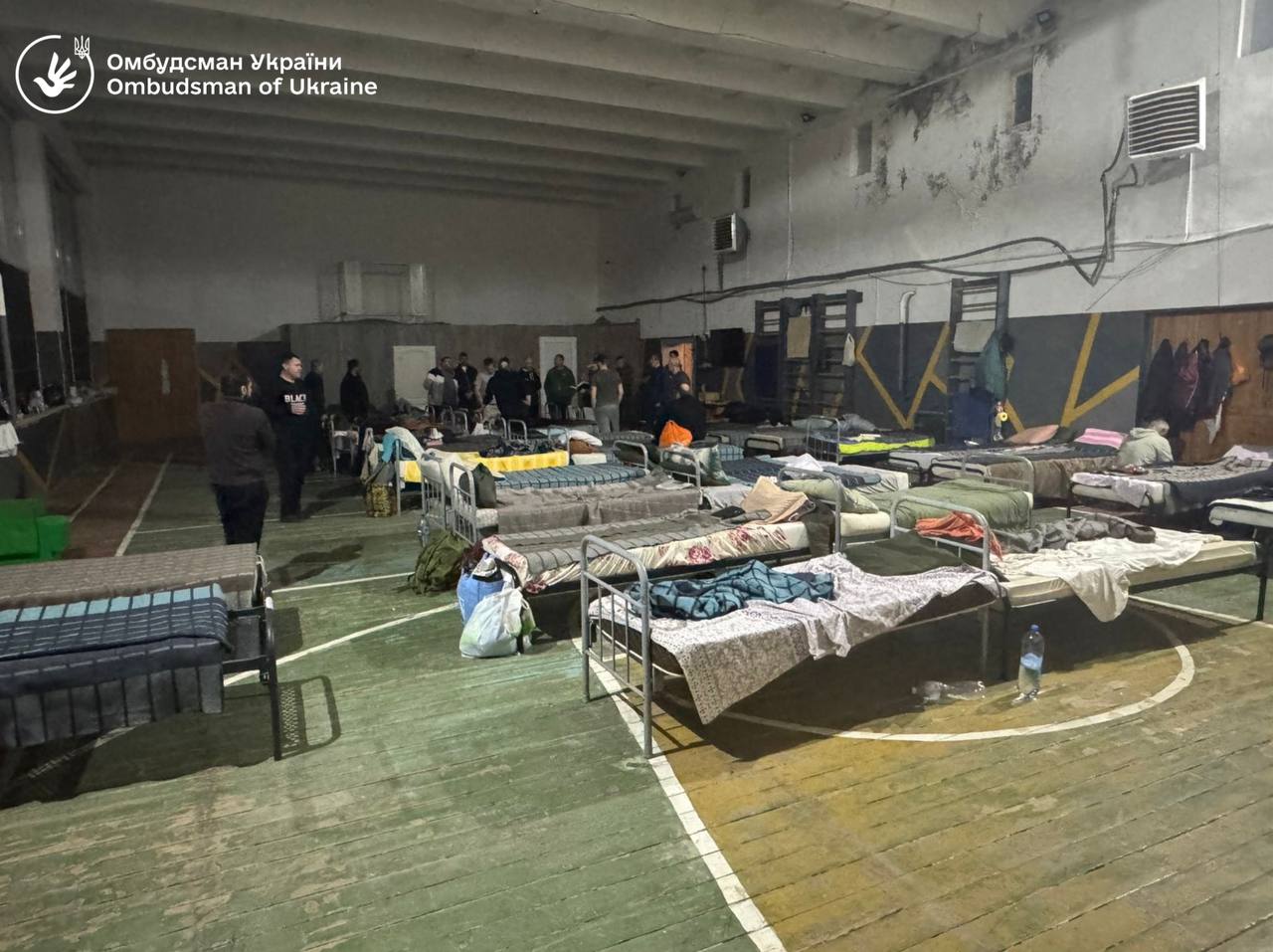
When the Ombudsman's representative Andriy Kryuchkov arrived at the Uzhhorod District TCK on a monitoring visit, officials tried to obstruct the inspection. What was recorded despite the resistance, Dmytro Lubinets called "egregious violations" — and announced a criminal complaint.
What was recorded
People were held in the TCK premises for weeks: detentions lasting 21, 24, 30 and 50 days were confirmed — without any court decision. According to Lubinets, any restriction of liberty without a court decision directly contradicts the Constitution of Ukraine and Article 5 of the European Convention on Human Rights.
In one photo — a veteran with a combatant's ID, which did not save him from being held. In another — a man with a physical disability that, according to the Ombudsman, is "impossible not to notice".
"Only after my Representative intervened was an ambulance called for a man with blood pressure 190 over 100, who had been asking for help for several days. He was hospitalized with a life-threatening condition."
Dmytro Lubinets, Ombudsman of Ukraine
Living conditions: for 40–60 people — 3 mugs and 8 metal plates, people ate in turns from unwashed dishes; one shower and one toilet for several dozen people. Detainees who were not formally registered had their documents and phones confiscated — depriving them of any possibility to contact family or a lawyer.
Legal framework: what this means in legal terms
As a result of the visit, the Ombudsman's Office filed a statement on criminal offenses under Articles 146 (illegal deprivation of liberty), 127 (torture), 344 (interference in the activities of a state official) and 426-1 (exceeding authority by a military service person) of the Criminal Code of Ukraine. This is not just a complaint — it is a formal basis for entry into the Unified Register of Pre-Trial Investigations (URPI) and the start of a pre-trial investigation.
According to the Ombudsman's Office, in January–October 2025 nearly 5,000 complaints about the actions of TCKs were recorded — compared with 3.4 thousand for the whole of 2024. Uzhhorod is not an exception, but a documented example of the trend.
Why the Ombudsman is speaking about this openly
Lubinets directly responded to the argument about "playing into propaganda":
"In reality, it is lawlessness that plays into the hands of the enemy, because legal protection mechanisms are not working, and with each passing day the situation only worsens."
Dmytro Lubinets
At the same time the Ombudsman differentiated positions: he condemned both the actions of the TCKs and the attacks on their employees — acknowledging that mobilization is necessary, but "everything must take place exclusively within the legal framework".
Notably, certain units of the same Uzhhorod TCK — in particular the military law enforcement service — received a positive assessment for their cooperation during the inspection. That is, the problem is not institutional as a whole, but related to specific officials who now face the threat of criminal proceedings.
If law enforcement enters the materials into the Unified Register of Pre-Trial Investigations and the case reaches the stage of formal suspicion — it will become the first publicly documented precedent of criminal liability for TCK leadership. The question is whether the prosecutor's office will open proceedings before specific officials have time to change their place of service.





