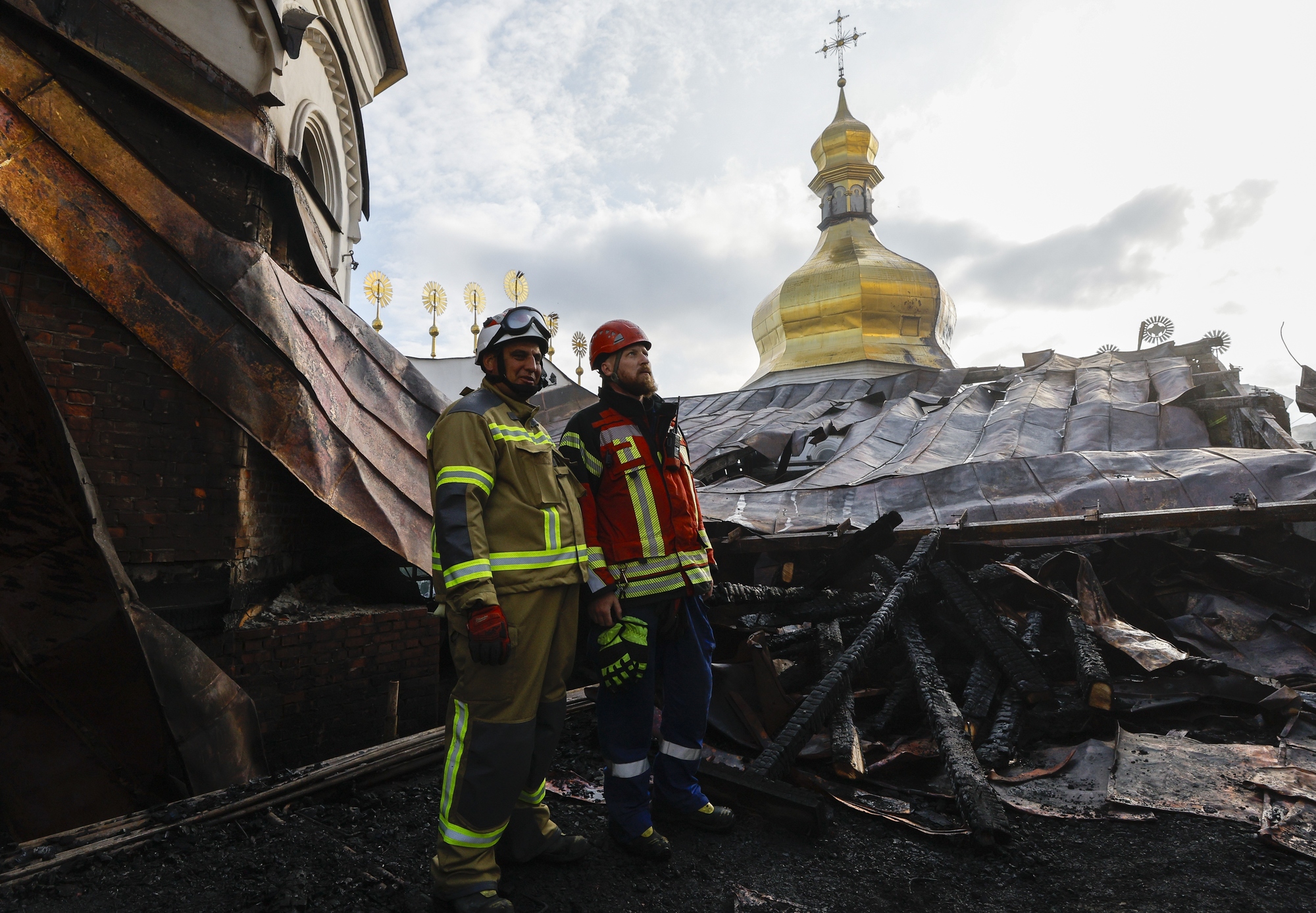
600,000 francs – a sum that does not pretend to rebuild the Assumption Cathedral. Switzerland is not promising complete restoration: the money will go to what engineers call "stabilization" – damage assessment, urgent safety measures, and preparatory work, without which restoration should not be considered at all. This is the practical logic of someone who first stops the roof from leaking, and only then thinks about repairing the entire building.
Those who count and those who speak
Switzerland's decision became known on June 16 at a G7-Ukraine meeting in Evian – that is, literally a day after the strike on the Lavra. The speed of reaction here is more telling than the amount: while the international community was discussing the symbolic significance of the loss of a UNESCO site, the Swiss side already had a specific figure and mechanism – UNESCO would carry out the work together with Ukrainian authorities.
According to Politico, it was specifically photographs of the Lavra in flames that influenced Donald Trump's position during the joint G7 statement. This demonstrates a mechanism that has repeated itself more than once: cultural heritage becomes an argument where military statistics do not work.
Part of larger mathematics
$730,000 – a small figure against the backdrop of 1.5 billion francs that Switzerland allocated for Ukraine for 2025-2028 within the framework of a general cooperation program. These funds cover economic recovery, support for public services, and protection of the civilian population. The Lavra tranche demonstrates how exactly this program works: alongside long-term investments, the country maintains a reserve for rapid response – in spring 2026, energy assistance was provided with the same operational speed during the crisis.
Support for the Lavra on the eve of its 975th anniversary, according to Andriy Sybiha, has special significance precisely now.
What's next
The real question is not how much the complete restoration of the Assumption Cathedral will cost – that amount will certainly be orders of magnitude larger than the Swiss contribution. The question is whether the model of "quick stabilization now, large-scale financing later" will become the standard for other cultural heritage sites damaged over the years of war, or whether the Lavra will remain an exception due to its symbolic status on the UNESCO list.