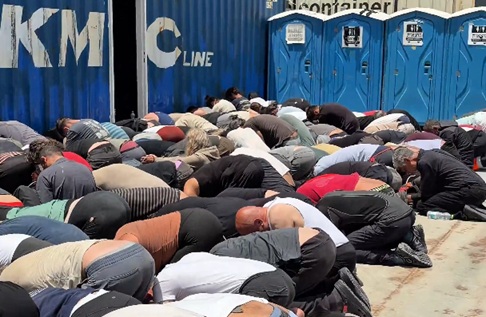
When the Global Sumud flotilla departed from the Turkish port of Marmaris on May 14, Israel was preparing for a standard force scenario: interception, deportation, minimal attention. Everything went according to plan — but not because of the activists' actions.
What Happened at Ashdod Port
In a video posted by Ben-Gvir himself on social media, approximately 430 detainees are visible: people with their hands tied behind their backs stand on their knees, their heads touching the floor — in a temporary detention facility at Ashdod port and on a ship's deck. In a second video, Ben-Gvir says that the activists "came filled with pride, like great heroes," and calls on Prime Minister Netanyahu to allow them to be imprisoned in Israel.
"They came with great pride, like true heroes. Look at them now"
Itamar Ben-Gvir, Israel's Minister of National Security, from video at Ashdod port
Ben-Gvir advised the facility's guards "not to pay attention to their screams" — against the backdrop of female crying heard in the background of the recording.
Six Ambassadors in a Few Hours
The video appeared online in the morning — and by evening, diplomatic protocol began executing in accelerated mode. Canada, France, Italy, Spain, Portugal, and the Netherlands summoned Israeli ambassadors for explanations regarding the treatment of their citizens.
Spanish Prime Minister Pedro Sánchez stated that his government would push for a ban on Ben-Gvir's entry to be extended across the entire EU territory. Irish Foreign Minister Helen McEntee said she was "shocked and appalled" by what she saw and called for the immediate release of the activists.
Canadian Prime Minister Mark Carney called the treatment "disgusting" — and reminded of the context: Canada imposed sanctions against Ben-Gvir last year over his systematic incitement to violence against Palestinian communities.
Public Rebuke from His Own Government
An unexpected turn — the reaction from within the Israeli cabinet itself. Netanyahu partially distanced himself from the incident: while Israel has the right to stop "provocative flotillas of Hamas sympathizers," Ben-Gvir's actions "do not correspond to Israeli values and norms," the prime minister said.
Netanyahu also ordered the activists to be deported "as soon as possible" — effectively rejecting Ben-Gvir's public call to imprison them. But the sharpest criticism came from Foreign Minister Gideon Sa'ar: "You deliberately damaged our state with this shameful show," he wrote to Ben-Gvir on social media, adding: "You are not the face of Israel."
Flotilla as a Mirror
The first boats departed from Barcelona last month: the organizers called the action "civil intervention at a moment of escalating violence and humanitarian crisis." Israel, on the other hand, argued that the flotilla typically carries only a symbolic amount of humanitarian cargo and refuses to transfer it for ground transportation into Gaza.
The paradox of the situation lies in the fact that the video was shot and published by Ben-Gvir himself, calculating on a domestic audience. Instead, he did what no PR campaign of the flotilla could have accomplished: he forced six governments to simultaneously publicly condemn Israel, and his own prime minister — to publicly distance himself from it.
If Spain truly initiates a pan-European entry ban for the current Israeli minister — this will become a precedent that the EU has so far avoided. How far Brussels is willing to go will depend on whether Ben-Gvir remains in the cabinet after the elections that are already gaining momentum in the Knesset.





