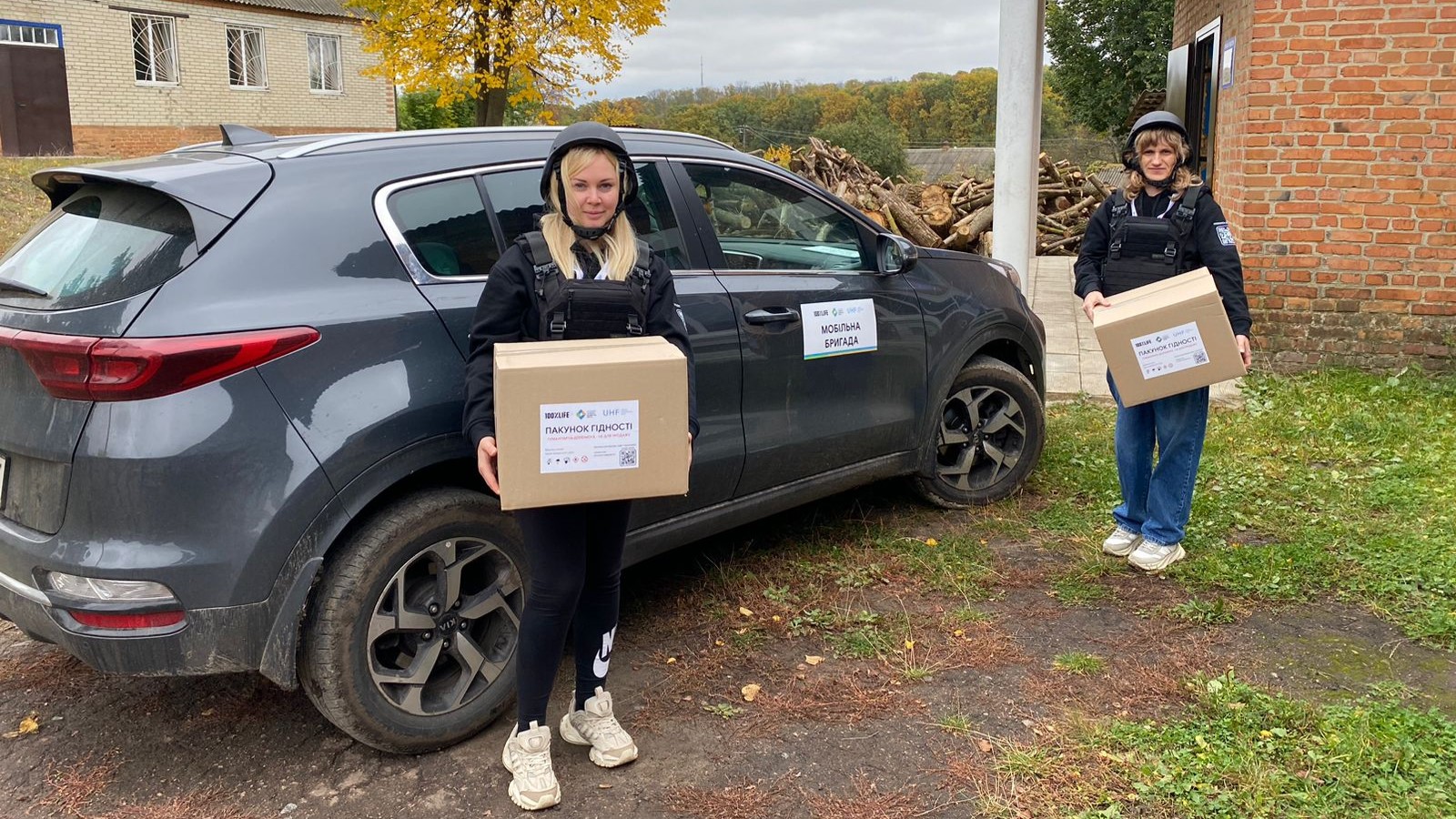
A mobile brigade arrives in a community where medical and social services have almost completely disappeared. The people who did not evacuate are mostly elderly, with chronic illnesses, and psychologically exhausted. These are the people that the teams of the NGO "100% Life" traveled to as part of the "From Vulnerability to Strength: Comprehensive Protection Initiative" project.
Why Not "One-Time Aid"
The project was financed through the Humanitarian Fund for Ukraine (UHF/OCHA Ukraine) and was implemented together with partners — the NGO "Ukrainian Smile" and the NGO "City Sustainable Development Agency". Its fundamental difference from typical humanitarian distributions was the integration of various services into one system: psychological support, case management, cash assistance, and rehabilitation — all in one route for a person, rather than separate queues to different organizations.
"People in front-line communities are waiting for someone to come to them. They are in constant exhaustion, stress, uncertainty."
— NGO "100% Life"
"People in front-line communities need not one-time assistance, but the feeling that they are not left alone with their problems."
— Natalia Balayan, project coordinator, NGO "100% Life"
What Was Done
- Mobile socio-psychological brigades traveled to communities in Sumy and Kharkiv regions — including Bilopolska, Krasnopolska, Yunakivska, Bohodukhivska and others, located directly at the line of contact.
- Psychological support for children and parents: mental health screening using MHPSS methodology was conducted for 9,448 children — 3,371 in Sumy region, 6,077 in Kharkiv region. According to the results: 143 children (1.6%) have a high level of distress, 2,596 (27.5%) — moderate.
- Rehabilitation of children with hearing and vision impairments — including the use of game-based methods on tablets to restore vision.
- Case management and cash assistance for the most vulnerable categories.
Scale and Context
19,000 people received support in total. These are not internally displaced persons in safe cities — these are people who remained or returned to communities where shelling can still be heard. According to OCHA, more than 14.6 million Ukrainians needed humanitarian assistance in 2024. Front-line Sumy and Kharkiv regions are among the most underserved: social infrastructure is destroyed, there is a shortage of specialists, and psychological assistance is still viewed by some residents as "not for me".
It is significant that more than a quarter of the examined children have moderate or high levels of distress — and this is only those who were reached by screening. The actual situation is likely broader.
What's Next
The project is completed. Mobile brigades no longer travel on this route — unless funding is continued. The question is not rhetorical: will any part of the built support system be preserved after the grant cycle ends — or will communities once again be left without specialists until the next project?







