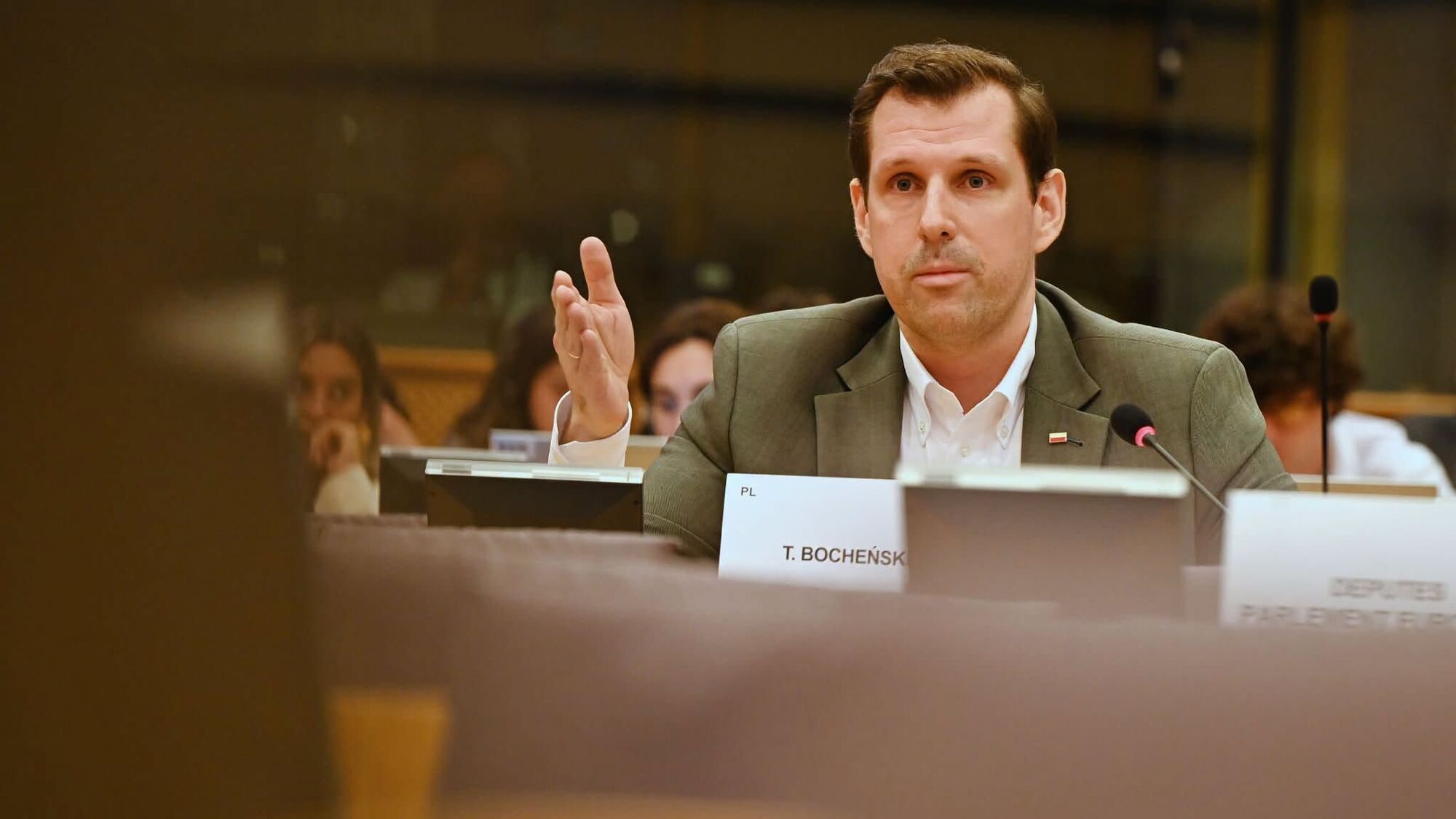
When Tobiasz Bocheński speaks about deporting "Ukrainian men of draft age who are not working legally," it's worth parsing the word "legally" itself. Because we're not talking about the unemployed as such — we're talking about those who work in the shadows, without official registration. And in Polish reality, this concerns a large share of migrant workers, including Ukrainians, who for years have filled gaps in construction, agriculture, or logistics precisely through cash-based schemes.
Who actually gets hit
The PiS proposal is technically not about those who don't work at all — there are relatively few such Ukrainian men in Poland, because it's hard to survive in an expensive country without work. It's about people in the gray zone: uncontracted side jobs, seasonal employment, unregistered self-employment. This group is most vulnerable precisely because it has no paper trail that would prove "legality."
Moreover, Ukrainians working illegally often do so not by choice to avoid the system, but because employers deliberately offer cash payment — it's more profitable for business, not for the worker. So the deportation risk in PiS logic falls on someone who is already in a weaker position in labor relations.
The real conflict: labor market versus political control
The second layer of the proposal is the idea that work permits would be issued not by the market and not by agencies, but directly by the government. This is no longer about Ukraine in general, but about an attempt to take control of labor migration regulation out of business hands. Polish entrepreneurs, especially in construction and agriculture, have depended for years on Ukrainian labor — and they, not Ukrainians, will become the main opponents of such a reform if PiS actually tries to implement it.
"The decision to grant permission to work... will be a government decision, and it is a political decision, for which every government will have to take responsibility," — Tobiasz Bocheński.
The argument about the front as a cover
The thesis that deportation "will help Ukraine fight" is logically weak: a person who is forcibly pushed out of Poland without a job and savings doesn't automatically go to the draft office — they can just as easily try to find a way to leave for another EU country while temporary protection is still in effect. The real effect of such policy — not a mobilization reserve for Ukraine, but a redistribution of migrant workers between neighboring countries that are still more lenient in their approaches.
What this means practically right now
Elections are in autumn 2027, and for now this is a pre-election statement, not a law. But the signal matters for those who are currently working in Poland without an official contract: if the trend toward stricter migration rules continues — and Denmark and Czechia are already moving in this direction — legalizing employment becomes not a bureaucratic formality, but a question of whether you'll stay in the country at all.
The question for the next two years: will the Polish labor market, dependent on Ukrainian hands, manage to produce a counter-argument before PiS turns its pre-election thesis into a real legislative bill?