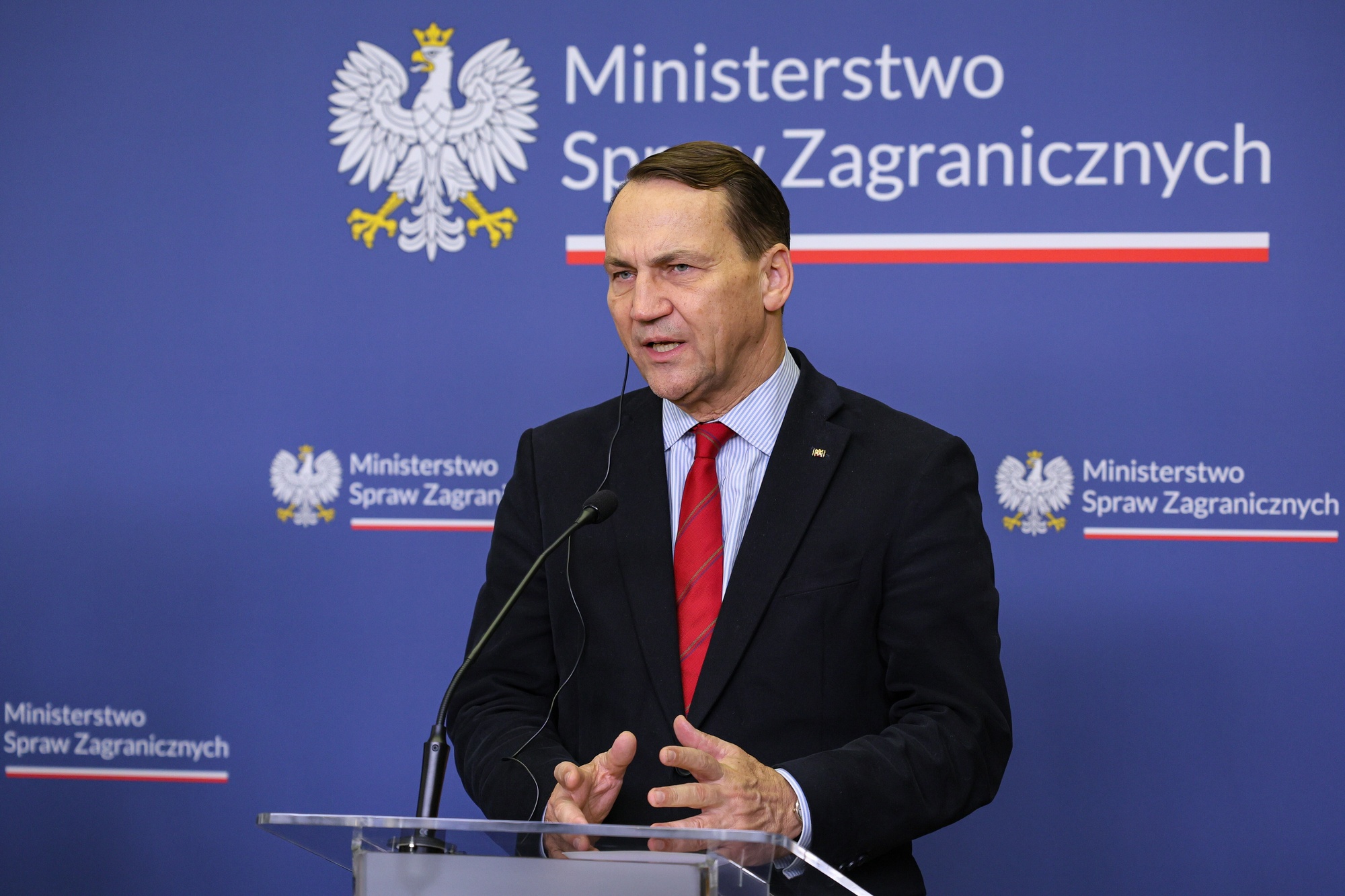
Polish Foreign Minister Radoslaw Sikorski has clearly distanced himself from the idea of accelerated EU membership for Ukraine in a live broadcast on RMF24: "This will not happen." Warsaw supports Kyiv's European integration — but exclusively through fulfilling the conditions that Poland itself once underwent.
An argument from personal history
Poland submitted its EU membership application in 1994, began official negotiations in 1998, and became a member only in May 2004 — ten years after the application. During this time, the country had to harmonize its legislation with acquis communautaire in dozens of areas and pass assessment under the Copenhagen Criteria: democracy, rule of law, market economy, and ability to fulfill membership obligations.
Sikorski uses this precedent as a framework for evaluating Ukraine. According to him, Kyiv has not yet adopted all the laws necessary to advance the accession process — and this, he emphasized, is not criticism but a factual statement from an ally.
"It is not true that Ukraine has adopted all the laws necessary to advance the process of joining the EU. We understand the reasons. You have a war, some deputies have left the country, some have resigned, but the laws are not being adopted."
Radoslaw Sikorski, Polish Foreign Minister
Corruption as the main roadblock
Separately, Sikorski warned: if Ukraine tolerates corruption, it will not join the EU. This is not mere rhetoric: in the summer of 2025, the anti-corruption issue nearly cost Kyiv several months of negotiation progress.
On July 22, the Verkhovna Rada voted for draft law No. 12414, which stripped the NABU and SAP of their independence and transferred new powers to the Prosecutor General. The European Commission called this "a step backward." After protests in dozens of cities, Zelensky submitted and signed a new law No. 13533 within a week, restoring the powers of anti-corruption bodies. However, the episode itself remained in the memory of Brussels officials as a signal of the fragility of reforms.
Enlargement Commissioner Marta Kos subsequently publicly listed the minimum steps she expects from Kyiv: the appointment of the head of the Bureau of Economic Security, the return of international experts to the High Qualification Commission of Judges, the appointment of four Constitutional Court judges who passed international selection. None of these points require the end of the war — only political will.
The Visegrád factor and the change in the Hungarian link
Alongside his statement on the EU, Sikorski revealed another diplomatic vector: following parliamentary elections in Hungary, where Peter Madar defeated Orban, the Polish side has already held telephone negotiations with Hungary's expected new foreign minister Anita Orban and invited her to Warsaw. The goal is to restore the functioning of the Visegrád Group (V4), which has been effectively paralyzed since Orban's turnaround.
This is significant: it was Hungary that for years blocked the opening of negotiation chapters with Ukraine in the EU Council. If the new Budapest truly lifts its veto — the technical process could accelerate regardless of any "special tracks."
What the figures say
Analysts at Capital Economics estimate the most realistic date for Ukraine's EU accession as the mid-to-late 2030s. Sikorski named a similar timeframe: the beginning of the next decade. Meanwhile, the reconstruction of the country, according to assessments by the World Bank and the European Commission as of the end of 2025, requires nearly 588 billion dollars — three times Ukraine's projected 2025 GDP. Part of these funds is tied precisely to progress in reforms and accession negotiations: without closed chapters — without tranches.
For the average Ukrainian, this means a simple dependency: each year of delayed reforms is a year without full access to the single market, without investor protection under EU standards, without capital flows that could finance reconstruction. Poland after joining in 2004 received hundreds of billions of euros from structural funds — and transformed from one of the poorest member states into one of the continent's most dynamic economies.
If the Verkhovna Rada adopts all priority laws from Marta Kos's list by the end of 2026 — will Brussels agree to review the pace of closing negotiation chapters without waiting for the active phase of the war to end?





