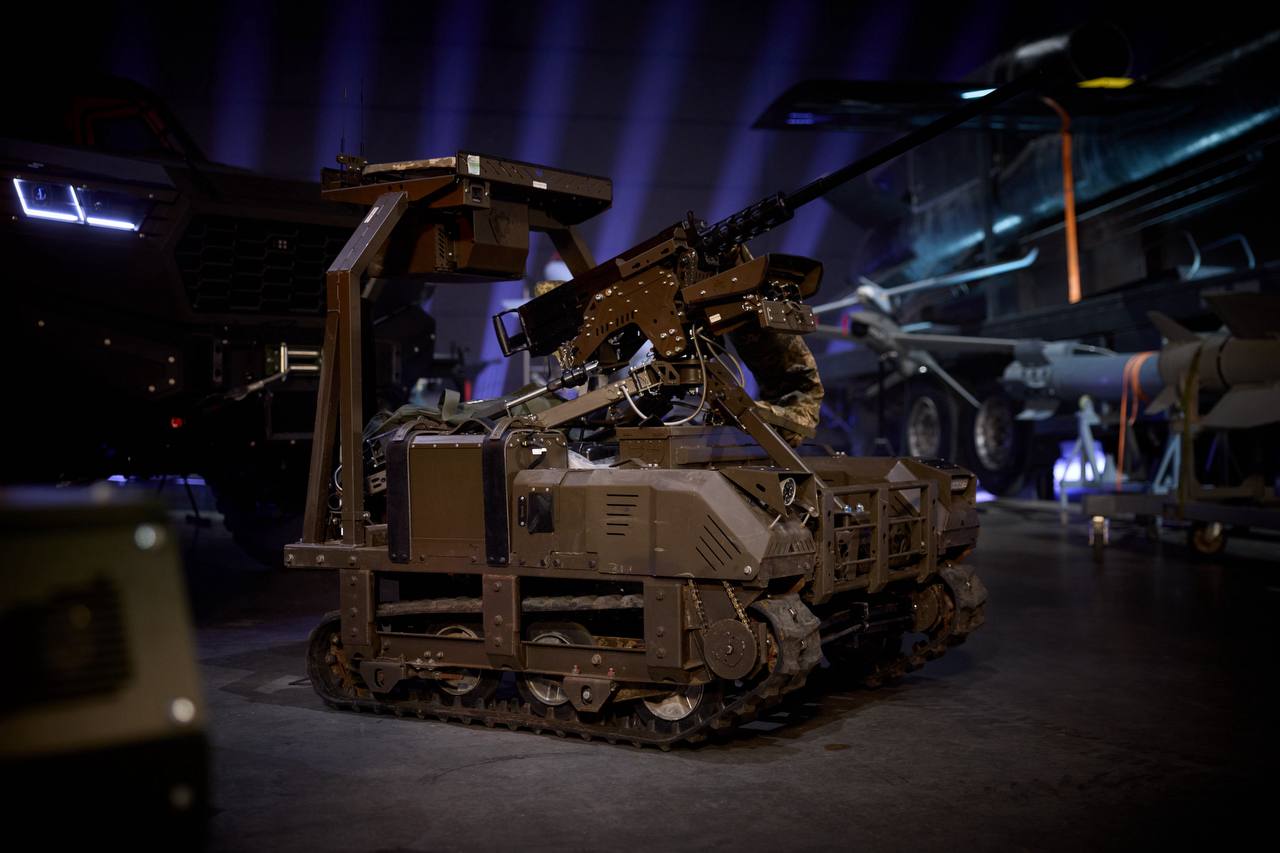
On the night of April 13, President Zelensky wrote in Telegram what would have sounded like science fiction a year ago: Ukrainian ground robotic systems (GRS) and drones captured an enemy position without a single infantryman on the battlefield.
"For the first time in the history of this war, an enemy position was taken exclusively by unmanned platforms — GRS and drones. The occupiers surrendered, and this operation was completed without infantry participation and without losses on our side."
President Zelensky, Telegram, April 13, 2025
Details are minimal. Zelensky did not name the direction, brigade, or date of the operation. However, Glavkom journalists reconstructed the picture from open sources: Russian fortifications were attacked by FPV drones and suicide GRS. When another robot approached the destroyed bunker, the occupiers hung a piece of cardboard with the inscription "We want to surrender." Those who survived were independently guided by drones to positions where they were taken prisoner.
This is not the first time — but the first time officially
The precedent itself is not entirely new. The 3rd Separate Assault Brigade had previously reported the first surrender of Russians to ground drones in the modern war — the operation was conducted in the Kharkiv region with the participation of FPV and GRS. At that time, the brigade stated: "For the first time in history: Russian soldiers surrendered to ground drones." However, this was a brigade-level statement. Now — the first confirmation from the Supreme Commander that the operation has been repeated and developed as a method, not an exception.
According to representatives of the brigade that participated in the previous similar operation, this is the first confirmed successful assault in the modern war using exclusively unmanned platforms. Positions that "twice resisted neighboring units" were taken by the robots of the "Troika."
Why now and who benefits
The context is arithmetic. As noted by Kyiv Independent, Russia mobilizes 40–45 thousand people per month, Ukraine — 25–27 thousand. Infantry shortage is not hypothetical but operational: every person saved in an assault is a direct response to the staffing crisis. Robotization here is not hype but a compensatory strategy.
Zelensky himself outlined the scale: GRS "Ratel," "Termite," "Ardal," "Lynx," "Serpent," "Protector," "Volya," and others completed over 22,000 missions on the front in just three months. Essentially — tens of thousands of cases where equipment went into the most dangerous zone instead of people.
- First combat mission of GRS — December 2024, "Hartiya" brigade, Kharkiv region
- First surrender without infantry — 3rd Assault Brigade, Kharkiv region, date not disclosed
- First confirmation at presidential level — April 13, 2025
- 55 Ukrainian GRS codified according to NATO standards as of April 2025, according to Brave1
According to the commander of unmanned systems of the 12th "Azov" brigade under the pseudonym "Bud," which he provided to Foreign Policy: "It is hopeless to take an armored vehicle and simply send it to evacuate infantry positions — you will be destroyed on the way, one hundred percent". GRS fill exactly this gap.
What remains behind the scenes
Zelensky deliberately did not name the place and time of the operation — standard practice during active combat. But the lack of details also means the absence of verification: it is not yet possible to independently confirm the fact of position capture. GRS operators are obligated under international humanitarian law to remain "human in the loop" — the decision to open fire is made by a person, not an algorithm. This is both protection against accusations and a technical limitation at the same time.
If Kyiv is indeed transitioning to systematic use of GRS in assaults — the question is not whether the technology will work. The question is whether Ukrainian GRS production can catch up with front-line demand before Russia learns to destroy them en masse: so far the count is 2,000 units for 2024 against the requested 40,000 for 2025.





