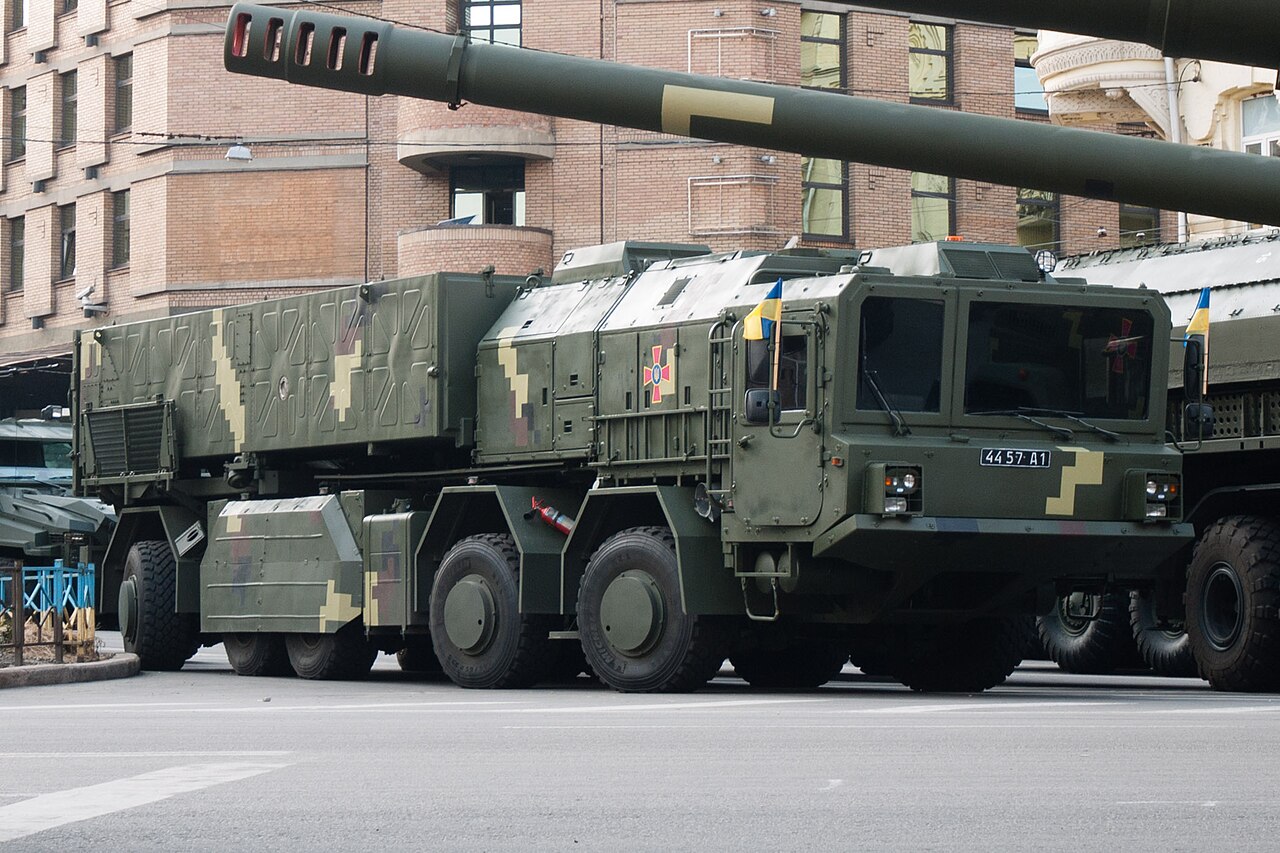
In early April 2026, defense industry circles began discussing the possibility of freezing the mass production program for the Sapsan ballistic missile. There is no official decision yet — but the fact of the discussion itself is telling: the missile, which began active development in the summer of 2022, has still not reached the production pace demanded by the front.
In parallel — a different picture emerges. Private defense company Fire Point not only exists within the framework of state programs: it is approaching formal inclusion of its own ballistic missile FP-7 into the list of Armed Forces of Ukraine weapons. According to the company's chief designer Denis Shtileman, all formal procedures should be completed by the end of this year.
"Ukraine fundamentally needs to have its own ballistic missiles in order not to depend on the political decisions of partners"
Denis Shtileman, chief designer at Fire Point — BBC Ukraine
FP-7 is a missile created on the basis of the 48N6 air defense guided missile from the S-400 air defense system with a modernized hull and new electronics. Range — up to 300 km, accuracy — 14 meters circular error probable, warhead — 150 kg, maximum flight speed — 1,500 m/s. In February 2026, the first video of successful tests appeared.
Where Sapsan Got Stuck
Sapsan — developed by Pivdenne Design Bureau and Pivdenmash — underwent its first combat application in May 2025: it then destroyed a Russian command post at a distance of about 300 km. In December 2025, Zelensky confirmed that the missile is already in use. But between isolated launches and mass production lies a chasm.
Among the reasons constraining scaling are the conditions at Pivdenmash. The enterprise in Dnipro was hit by an Oreshnik strike on November 21, 2024, and as of early 2026, the front line has advanced to within 70 km of it. According to NV, experts question the real production capacity of the enterprise — particularly regarding rocket engines and access to solid rocket fuel based on ammonium perchlorate.
It is precisely in this context that the idea emerges, which sources connected to the missile program told about in a material by CDAKR director Valentyn Badrak on LIGA.net: to redirect funding from state enterprises to private manufacturers capable of deploying serial production faster.
Not "Private Contractors vs. the State" — But a Question of Pace
The weakness of the state sector here lies not in the competence of designers, but in infrastructure vulnerability and bureaucratic inertia. Sapsan with a 480 kg warhead is a significantly more powerful weapon than the American PrSM for HIMARS with a 91 kg warhead. But a powerful missile produced slowly loses out to a less powerful one produced quickly.
Fire Point is not the only private structure in this segment. But its trajectory is telling: from prototype to certification completion — in just several years of active development, without the heavy legacy of Soviet production logic.
- Sapsan: range up to 500 km, warhead 480 kg — developer Pivdenne Design Bureau / manufacturer Pivdenmash
- FP-7: range up to 300 km, warhead 150 kg — developer and manufacturer Fire Point
- Both missiles are ballistic, ground-based, intended for strikes on deep targets
Coordination of the Sapsan program has been led since July 2024 by Deputy Defense Minister Anatoly Klochko — the center of gravity shifted from the Ministry of Strategic Industries to the Defense Ministry. According to Badrak, this was the correct management decision. But management restructuring does not replace production capacity.
If resources are indeed redirected to private contractors, and Sapsan moves into limited production mode — the question is not which missile is technically better, but which one Ukraine will be able to produce in sufficient quantities before front-line demand becomes critical. The answer to this depends not on designers, but on whether the state will manage to make a decision on resource redistribution before Pivdenmash loses the rest of its production capacity.





