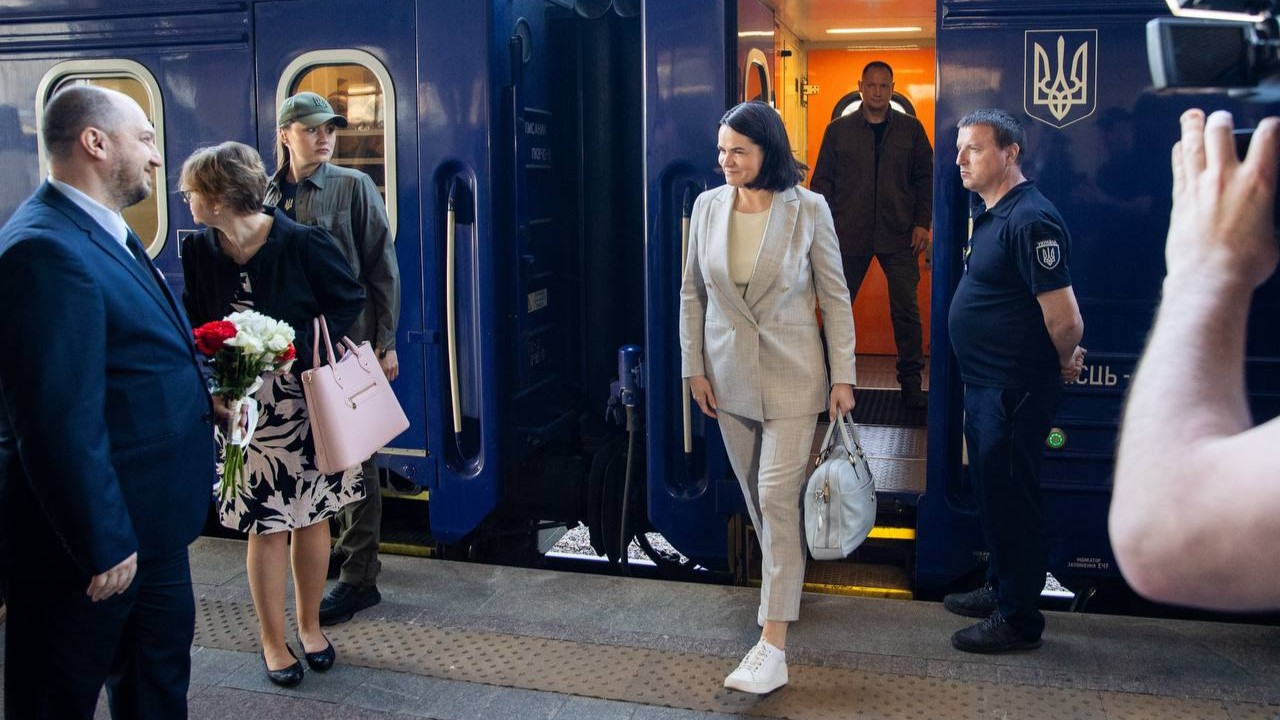
On May 25, Sviatlana Tsikhanouskaya arrived in Kyiv by train — for the first time as an official representative of the Belarusian democratic opposition. Four years into a full-scale war in which Belarus has served as a springboard for Russian invasion, this visit comes late. But its substance goes beyond symbolic handshakes.
Mission — literally
The central event of the visit is the opening of the Mission of Democratic Forces of Belarus in Ukraine, a permanent representation in Kyiv. This is neither an embassy nor an NGO in the conventional sense: the structure claims the role of a political interface between the opposition in exile and Ukrainian authorities.
In parallel, Tsikhanouskaya's office has made a specific demand of Kyiv — to appoint a special representative on relations with democratic Belarus. Ukraine's Foreign Ministry has already taken a step in this direction: according to Yevropeiska Pravda, the ministry appointed a person responsible for contacts with the Belarusian opposition before Tsikhanouskaya's arrival, and Foreign Minister Dmytro Kuleba met with her earlier.
Agenda: Belarusians in the army and volunteer status
Beyond the geopolitical framework, the program includes quite practical matters. According to Tsikhanouskaya's office, one of the key topics is the status of Belarusian volunteers and their family members in Ukraine: legal protection, documents, social guarantees for those fighting as part of the Armed Forces of Ukraine.
"Among the topics are the status and prospects of Belarusians in Ukraine, primarily Belarusian volunteers and their family members, opening of the mission, development of permanent political dialogue and appointment of a special representative"
— Tsikhanouskaya's office, comment to Yevropeiska Pravda
Meetings: Zelenskyy, Kuleba, Verkhovna Rada, EU diplomats
The negotiation program includes President Zelenskyy, Foreign Minister Kuleba, the leadership of the Verkhovna Rada, and diplomats from the European Union. The presence of EU representatives in this list is a detail that shows: the conversation about Belarus is not being conducted solely in a bilateral Kyiv-Vilnius format, but with an eye toward broader international coordination.
Why now
Tsikhanouskaya met with Zelenskyy earlier in Vilnius — but a visit to Kyiv during active warfare carries different weight. Belarus continues to provide Russia with territory, logistics, and infrastructure. Lukashenko did not send his own troops, but his complicity in the 2022 invasion is documented. For the opposition in exile, physical presence in Kyiv is a way to show: democratic Belarus is not neutral, and after a possible regime change will claim the role of a partner, not a defendant.
If Kyiv truly appoints a special representative and grants the mission a clear legal status — this will become the first institutional recognition of the opposition by a state that has the strongest grounds to be demanding toward Minsk. If it remains at the level of protocol photos — for the fourth year in a row nothing will change for the thousands of Belarusians fighting under the Ukrainian flag without any legal protection.





