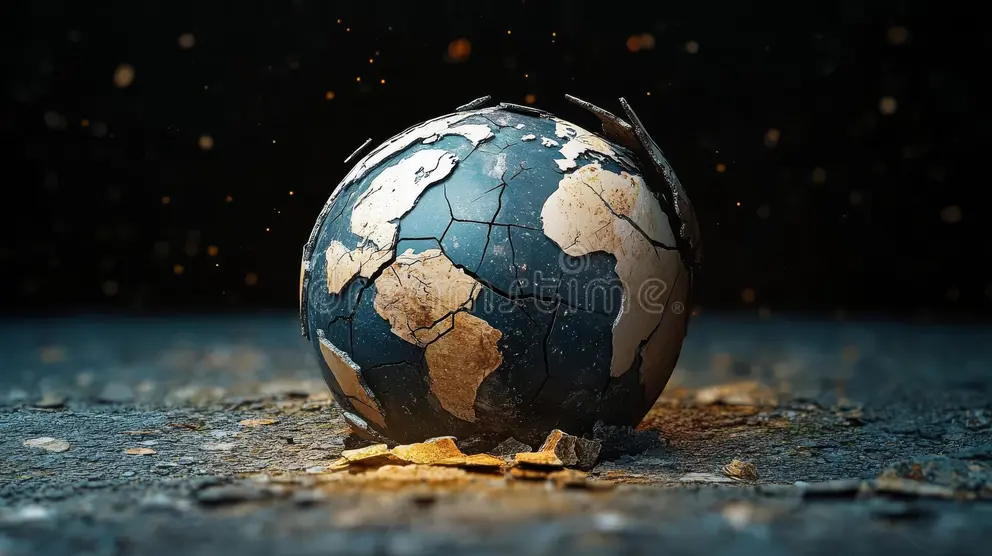
And if we are talking about the breaking of an entire historical era, the actual “moment of rupture” is rather difficult to track. Epochal breaks happen quickly, but not instantaneously. So if you read somewhere that since some recent date or event there exists a “new world in which we woke up” — that can only mean the author slept for too long.
Strip of chaos
Today we are witnessing the process of the rupture of the world order — the relative order that existed in the world from the end of the Cold War, that is, from the collapse of the USSR. And we cannot fail to see that this process did not begin with Russia’s invasion in 2022 or 2014, nor with Russia’s aggression against Georgia, nor with some speech by Putin, and not even with the “Chechen wars.”
Looking more broadly — all the blood that has been shed in the world since the collapse of the USSR is evidence that a world order after the Third World (the Cold War) was never really established.
In 1991 the world entered a strip of chaos and remains in it to this day. What is being destroyed now are only the remnants of the “world of rules” developed after World War II.
Anyone who wants to study this strip more deeply — its causes and consequences, and specific important “turning points” — risks drowning in a sea of facts, assessments, and interpretations. Because we are still in chaos. But we know that chaos is always succeeded by some kind of order. Some kind. So what exactly will it be? Will this new world order become an even greater evil? Will it carry within it the seeds of even greater future chaos that will torment the world of our children or grandchildren?
What can we do? How can we influence it? Which way should we row?
The content of the processes
We must finally learn to manage our attention. Don’t scroll the news feed and focus all your attention on where, what and why something is happening. Think a little about the ultimate meaning and direction of events. After all, in the historical process there are no senseless events and phenomena that lead to nothing.
Cold War: 1945–1991
The content and direction of events in world history from 1945–1991 were determined by the “rivalry of two systems” and the clumsy attempts of the Soviet leadership to play some game on the global geopolitical chessboard against the “collective West.” In practice it was like a simultaneous chess session staged by Ostap Bender in the Vasuki chess club: he lost all the games on all the boards and barely escaped a physical reprisal.
At the same time, in this period the system of international law and the corresponding institutions were actively being built up. This process was actively aided by the fact that humanity as a whole was fairly frightened by the prospects of nuclear Armageddon and the concept of guaranteed mutual nuclear destruction.
Strip of chaos: 1991–present
It is harder to determine the content and direction of world events from 1991 to the present, because the world still has not crossed the strip of chaos. One can note the global finishing blows, the dismantling of the system of international relations, of international law, and even of the principles on which that law rests (for example, the Helsinki Act of 1977).
There is also a gradual slide of international institutions into full, tragicomic, “very concerned” ineffectiveness.
Opposing tendencies
As always, opposing tendencies operate within strips of chaos, and the struggle between them determines the eventual result of this chaos — namely, what the world and the new order in it will be like.
The world of the law of force
This will be a world in which the main rule will be “vae vists,” or “woe to the vanquished.” In it a powerful state will have the right to intervene by force — up to military intervention — if certain interests, ambitions, or even whims of the ruling strata and individuals who make the relevant decisions demand it. It will be a world where military aggression is a continuation of politics by non-political means. A world whose agenda is determined by “realities on the ground,” namely pseudo-referendums, gauleiters, occupation administrations, repression against dissenters, and constant “special military operations” here and there.
It will be a world of agreements imposed by force. Agreements that the side that has power, or believes it has power, will revise to its advantage when it deems it expedient. The only factor restraining the powerful will be greater force — or the threat of the use of such force. This will be a very dangerous and generally very depressing world, with more hunger and poverty, more environmental degradation, while the planet’s precious resources are wasted on an endless arms race.
It is toward such a future that authoritarian leaders, regimes and business elites — whose interests situationally coincide in an era of chaos — are pushing us. Russia — the last land empire, pumped up with foolish money, free resources, and its own propaganda — has once again “gone back to its old ways” — namely, to “gathering lands.” Support from China, which is playing its own game, authoritarian tendencies in the United States, the traditional short-sightedness of a significant part of Western elites who chase the illusory prospect of “sustainable business” with Moscow, right- and left-wing sentiments in Europe fanned by Moscow’s money — all this globally works toward a new order of the “law of force.” The driver of all this disgrace is the final stage of Moscow’s imperial cycle.
The world of the force of law
But there are healthy forces in the world as well. Despite enormous controversy and the absence of a reliable international legal framework, Saddam Hussein’s regime was punished for the occupation of Kuwait, Serbia — for the genocide of Bosnian Muslims and Kosovar Albanians. Assad’s regime suffered collapse. It seems they finally dealt with the Venezuelan dictator.
Order must be established in the world. Bloody dictators and criminals must be removed from power and tried for their crimes. The idea is that mass crimes and serious violations of rights and freedoms cannot remain unpunished, and therefore external actors can and should intervene. Unfortunately, talk about legally defining the boundaries of “humanitarian intervention” did not go any further.
It could not have gone further — because there is neither a platform nor a format in the world to seriously discuss such issues, let alone adopt systemic decisions that would have consequences.
Ukraine’s role
Of course, we can take some comfort in the fact that recently Russia’s odious allies have diminished a bit (minus Assad, minus Maduro). But Ukraine seeks the just punishment of Moscow for the crime of aggression. And justice should be based not only on clearly delineated rights, but also on international-legal mechanisms for punishing such violations.
Since such mechanisms do not yet exist, and coalitions of the determined, willing and concerned are clearly not going to go to war for Ukraine, we must continue the fight. We do not want the world of the future, in which our children and grandchildren will live, to be a world of the “law of force.” In this sense Ukraine is fighting not only for its existence, but for the global prospect of the “force of law.”
People often say that a military victory for Ukraine is impossible. But without it the world of the “force of law” will not come about. Then everything will be forgiven to Moscow, and that should not be. Therefore the military-political collapse of Russia is a necessary condition for avoiding the worst global scenarios of the future. And the struggle of Ukrainians and other freedom-loving peoples who seek to rid themselves of Moscow’s imperial yoke — for example, the peoples of the Caucasus — is of key importance for the future of the entire world. We are obliged to promote global awareness of the idea that the end of the last imperial cycle of the last land empire is in the interests of all humanity.
PS
An old Soviet-era joke about the notion of “the last one”:
Rabinovich, why weren’t you at the last party meeting?
Oh, if I had known they were really the last ones, I would have certainly come!





