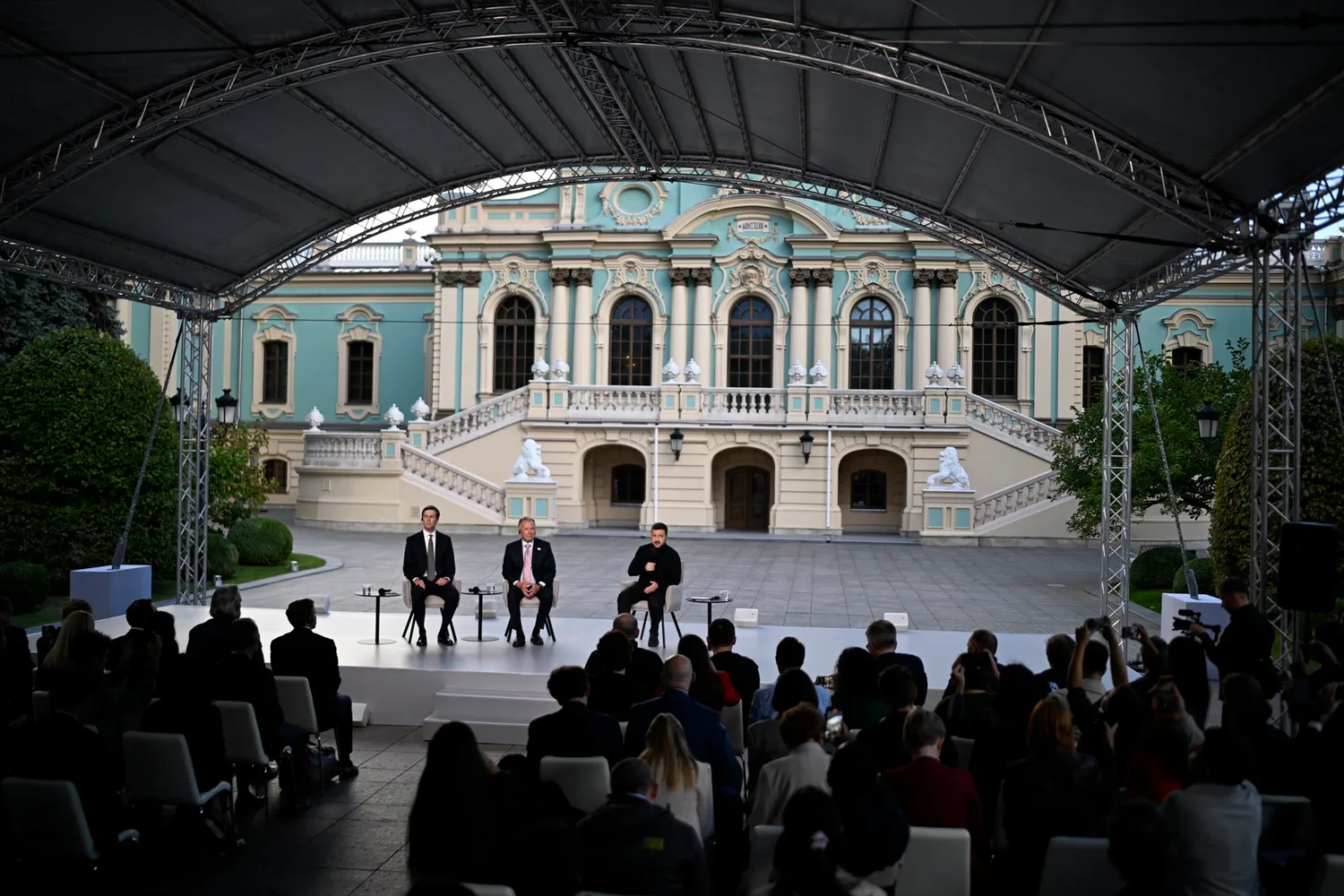
Millions of Ukrainians are preparing for winter for the third time, when a missile or "Shahed" drone could turn off the lights for several days. Against this backdrop, President Volodymyr Zelensky said in an interview with Axios that he wants to manage to agree on at least a partial de-escalation before the cold weather — and that there is a specific window for this: September and October.
What exactly did Zelensky say
Zelensky said that he received information from U.S. special envoys that Russians are ready for negotiations, noting that Ukraine wants to use September-October to restart the diplomatic process. According to him, the U.S. envoys traveled to Moscow and Kyiv mainly to "unblock" the diplomatic process, but also brought some new ideas with them.
The president did not reveal details, but clarified the directions: some of the discussions concerned potential de-escalation steps by Russia and Ukraine before and during winter. Specific details were mentioned only in one phrase: "There are ideas about energy and grain, about electricity and about oil and gas. We have different interests, Russia and us."
This formulation — "different interests" — is the key to why a declaration of willingness to talk does not yet mean a readiness to agree on anything concrete.
Two goals, not one agreement
Zelensky divided the task into two levels. He called the first goal a resumption of negotiations, and the second — an attempt to make the coming winter different from the previous ones, when Russian attacks on Ukraine's energy infrastructure had escalated the war. In other words, this is not about a peace agreement, but about an attempt to agree on at least limited, tactical steps — possibly following the model of previous partial agreements on energy that have been repeatedly violated by both sides during the war.
The president himself formulates this cautiously, without promises of results: "We have September, October to find any way to talk. Without dialogue we will have no results. I think that President Trump can find a way to really start the negotiation process before the cold winter."
The American side speaks of progress — but what kind
Parallel to Zelensky's interview, U.S. President's Special Representative Steve Witkoff reported on the results of his visits to Moscow and Kyiv. According to him, American negotiators achieved "substantial progress," including on coordinating a schedule for additional trilateral talks.
The discussion is precisely about the schedule of meetings — not about the content of a future agreement and not about any signed commitments by the parties.
Zelensky, for his part, proposed a venue: a session of the UN General Assembly in New York at the end of September as a possible place for continued talks.
What is missing from this statement for now
Despite the president's cautious language, three things are absent from the public description of the process, without which "de-escalation" remains a word rather than a mechanism:
- No specific steps are named with dates, volumes, or targets — only directions like "energy," "grain," "oil and gas."
- There is no mention of a verification mechanism — who and how will document violations if the parties agree, for example, not to strike electrical grids.
- There is no confirmation from the Russian side in its own words — all information about "readiness" comes through American intermediaries.
This does not mean the process is fictitious. But it does mean that between the statement "ready to talk" and the commitment "we will not strike substations in December" — there is a great distance that still needs to be covered in the next rounds.
Skepticism against a backdrop of optimism
Not all participants in the discussion share Witkoff's optimism. Even before the latest statements, Ukrainian political scientists had already noted that U.S. contacts with Kyiv and Moscow had thawed the negotiation process itself, but no breakthroughs on substance had been recorded yet. This is consistent with the caution of Zelensky himself, who speaks not of an agreement but only of a "way to talk" — a formulation that leaves open the question of whether Russia will agree to anything more than a pause in rhetoric.
What will verify this statement
The coming weeks will provide an answer to a simple question: will there be at least one documented, verifiable step after the "September-October window" — for example, a pause in strikes on energy facilities for a certain period — or will the conversation again remain at the level of diplomatic formulations about "progress" and "new ideas." If a trilateral meeting is indeed announced in the coming days, as Witkoff promised, this will be the first measurable test of whether Zelensky's September statement had something more behind it than hope.