US Presidential Special Envoys Steve Wittkoff and Jared Kushner managed to visit the Kremlin and Kyiv within three days, shake hands with Putin and Zelenskyy, make several statements in each capital — and bring back no document that could be called an agreement. Alexey Buryachenko, president of the International Institute for Security Studies, in a comment to UNN calls this a "thaw" in a process that has been stalled for half a year. A thaw is not a breakthrough. It is the difference between "nothing is happening" and "something is moving again," and it is costly to confuse these two states when it comes to war.
What actually happened on September 5-6
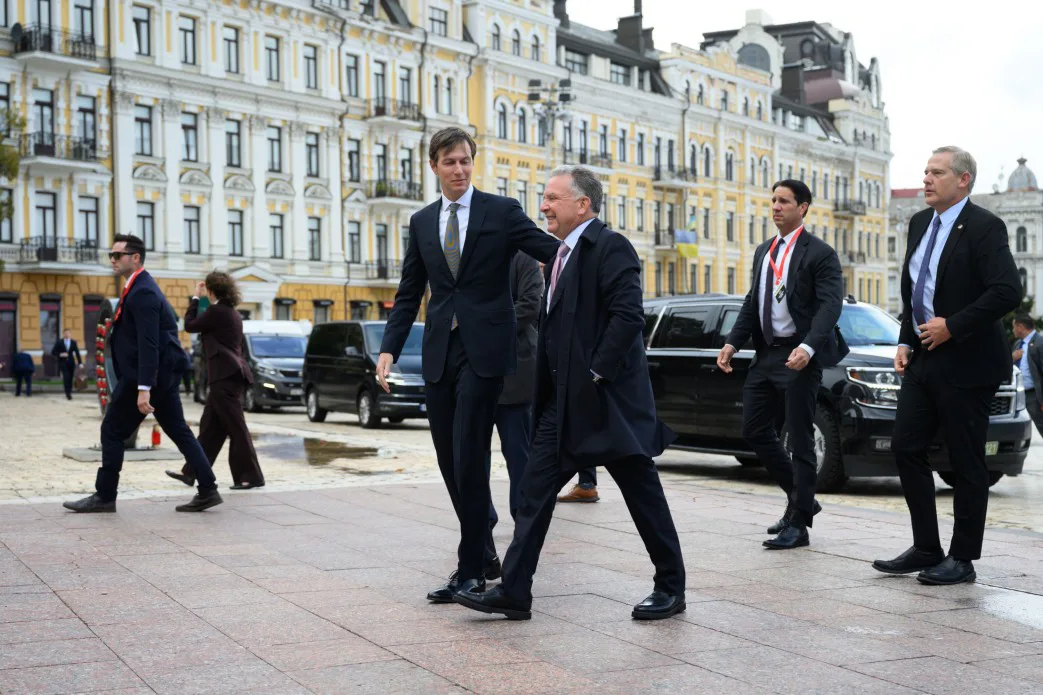
On September 5, Wittkoff and Kushner spent over three hours at a meeting in the Kremlin. Wittkoff and Kushner met with Putin in the Kremlin; negotiations lasted more than three hours. In Moscow, the discussion was joined by Putin's advisor Yuri Ushakov and Kirill Dmitriev; according to Ushakov, the discussion concerned the war, economic issues, and potential joint US-Russia projects. The next day, the delegation came to Kyiv for the first time — this was their first trip to Ukraine since they took on a leading role in the US administration's efforts to end the war. Negotiations in the capital took place in three sessions; first, Wittkoff and Kushner met with the Ukrainian side, and later representatives of Great Britain, France, and Germany joined the discussion.
No formal result — neither a ceasefire agreement nor a framework agreement — emerged from the summit. The most concrete thing stated publicly: the main US task is to bring Ukraine and Russia's positions closer together, narrow the circle of disagreements, and establish communication between the parties. Kushner himself proposed resuming a tripartite negotiation format between the US, Ukraine, and Russia. This is a declaration of intent to continue talking, not a commitment to anything concrete.
A mechanism that doesn't exist
Buryachenko draws attention to a key detail: the American envoys are not the architects of the strategy.
Wittkoff and Kushner are not architects of the negotiation process. They are representatives of Donald Trump executing his orders. They came, delivered, listened, made certain statements, conducted communication. The architect of the negotiation process is Marco Rubio, and it is this person, in agreement with Trump, who will determine further negotiation strategies.
This means that any "good conversation" in Kyiv or Moscow does not create an enforcement mechanism: there is no institution fixing agreements, there are no deadlines, there are no penalties for non-compliance. The tripartite format proposed by Kushner is a procedure for talking, not a guarantee of results. Even a temporary ceasefire, which was discussed during the visit, depends entirely on the political will of the parties to continue ignoring violations, not on any signed mechanism.
How the parties are reacting
Zelenskyy thanked the American envoys after the meetings and emphasized that he is grateful to the representatives of the US President for visiting Kyiv, noting that several rounds of talks have already taken place, and the main thing is to achieve peace that is worthy, reliable, and lasting for Ukraine. The tone is notably positive, but without specifics regarding conditions.
Moscow also spoke cautiously and cordially, without concessions. The Russian side called the negotiations constructive and useful, but did not report agreement on a ceasefire or other key decisions, again insisting on accounting for its so-called "root causes of the conflict." In other words, the rhetorical temperature rose, but the position on territories and Ukraine's status did not. According to Buryachenko's assessment, this is not coincidental:
With high probability, Ukraine will enter winter in a state of war. Based on at least the public rhetoric we have heard, the United States does not yet plan to pressure Putin and the Russian Federation sufficiently. Without additional pressure — both European and American — there is no reason to expect that Putin will simply agree to terms unfavorable to him.
European national security advisors from Britain, France, and Germany did not accidentally join only parts of the meetings in Kyiv. Buryachenko explains this presence as Brussels' direct fear of being left out of agreements:
It is now extremely important for Europeans to be in the context of these negotiations, to be integrated both in the process itself and, most importantly, in any agreements that could hypothetically be reached through US mediation. For Europeans, it is important that Ukraine does not accidentally agree to conditions that the Americans brought, because if European interests are not integrated into such an agreement, Russia could then switch to threats specifically against Europe.
Four different goals under one "peace" banner
The political analyst breaks down the process participants by their real, not declared, interests:
- The US — political points for Trump before the midterm congressional elections in November, not peace as an end in itself
- Russia — ending the war exclusively on its own terms, without abandoning its "root causes"
- Europe — a guarantee that any agreement will not leave the continent facing a strengthened Russia
- Ukraine — the only party that needs actual peace, not a tactical victory
Each actor in this negotiation process came to implement their specific priorities and goals. Peace is only the surface goal. The United States needs to strengthen Trump's position and, accordingly, the Republican Party before the elections. Europeans need Russia not to attack them after reaching an agreement. Russia needs the war to end on its terms, and essentially Ukraine is the only country that simply needs peace.
It is precisely this divergence of goals — not a lack of good will by individual negotiators — that is the real reason why the "thaw" in dialogue is unlikely to quickly turn into an agreement.
What this means in the coming months
Buryachenko reminds us of two real constraints on pressure: Washington wants to reach an agreement before winter and is therefore looking for a formula that both Moscow and Kyiv would accept. However, the American sanctions bill is unlikely to be passed before the elections, and it will be difficult for Europe to quickly agree on a new package of restrictions. In this configuration, the only real tool for pressuring Russia remains Ukrainian long-range strikes — not diplomacy, but military capability.
If by the end of October none of the participants — neither Washington nor Brussels — announces specific sanctions or military steps with implementation deadlines, this will mean that the "minimum" plan (simply keep dialogue alive) has definitively beaten the "maximum" plan (end the war before the elections), and Ukraine will indeed enter winter without an agreement — but also without a formal collapse of negotiations that anyone could be held accountable for.