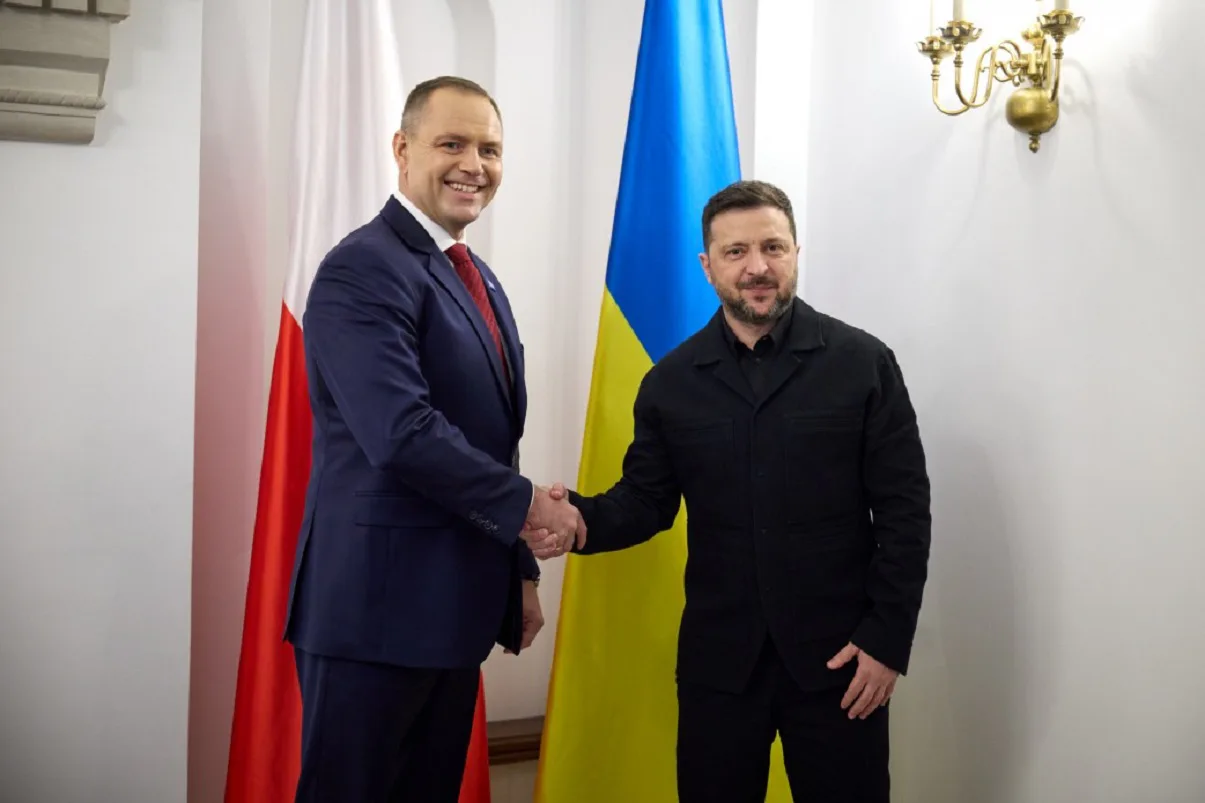
Presidents of Ukraine and Poland Volodymyr Zelenskyy and Karol Nawrocki held bilateral negotiations on the sidelines of the NATO summit in Ankara, lasting more than an hour. This is the first full-fledged meeting between the two leaders since relations between the countries entered their sharpest conflict in years in spring 2025.
What caused the crisis
The starting point was Zelenskyy's May decree awarding the Separate Special Operations Center "North" the honorary name "In the Name of UPA Heroes." Warsaw reacted harshly: Polish President Nawrocki stripped Zelenskyy of the Order of the White Eagle, and the next day the award was returned to Warsaw by "Nova Poshta" courier service. Zelenskyy did not attend the Ukraine Recovery Conference in Gdańsk in early July.
In this context, the Ankara meeting appeared to be an attempt to stop escalation rather than a planned bilateral dialogue.
What was discussed — and where the wall stands
According to Zelenskyy, the talks covered three blocks: security, economics, and historical issues.
"Of course, it's security, and we understand that here we have one enemy — Russia. Then — economics. We held what I believe was a successful conference in Gdańsk on the recovery and reconstruction of Ukraine. Polish business is interested. We are open to our Polish partners. We also discussed historical issues. In my opinion, we need to be constructive and delicate so as not to destroy the important, friendly, neighborly relations between Ukraine and Poland."
Volodymyr Zelenskyy, to journalists after the meeting
Nawrocki, for his part, assessed the conversation more restrainedly. He confirmed that he raised the issue of UPA heroization and acknowledged: no agreement on historical issues was reached. "We didn't go there with the hope that we would solve all issues," he said at a press conference, adding that he reiterated Poland's position on the UPA.
Gdańsk: €10 billion — but not quite investments
Zelenskyy called the recovery conference in Gdańsk successful, citing the interest of Polish business. Formally, there is reason to do so: Ukraine signed approximately 160 agreements totaling over €10 billion. Polish construction groups Budimex, Polimex-Mostostal, and AMW Sinevia are already forming consortiums to participate in Ukrainian infrastructure tenders.
However, economist Oleg Pendzin warns against too optimistic an interpretation of the figures. The €10 billion includes €3.2 billion in EU macro-financial assistance under a credit program for €90 billion — that is, money that was already planned. "So talking about some investment breakthrough — definitely not," he notes. According to Pendzin, the key constraint for private capital remains the security situation: "There are no direct investment agreements because the key issue is security."
This does not diminish the URC format itself, but means that real Polish business will come to Ukraine not after the conference, but after the security situation changes.
Parallel diplomacy
While the presidents met in Ankara, Ukrainian Foreign Minister Andrii Sybiha proposed to his Polish counterpart Radosław Sikorski in Warsaw on July 3 an anti-crisis package: consultations between the foreign ministries, a meeting of historian-experts, and involvement of religious leaders in bilateral dialogue. According to Sybiha, "significant progress" has been made in addressing sensitive issues over the past year and a half — although the public conflict over the UPA casts doubt on this.
The leaders agreed to continue dialogue and maintain close contacts. President's Office Chief Kyrylo Budanov stated that the peak of escalation between Ukraine and Poland is still ahead.
If Warsaw ties further unblocking of bilateral relations to the formal cancellation of the UPA decree — the issue shifts from diplomatic to domestic politics: is Kyiv ready to back down from a decision supported by a significant portion of Ukrainian society?







