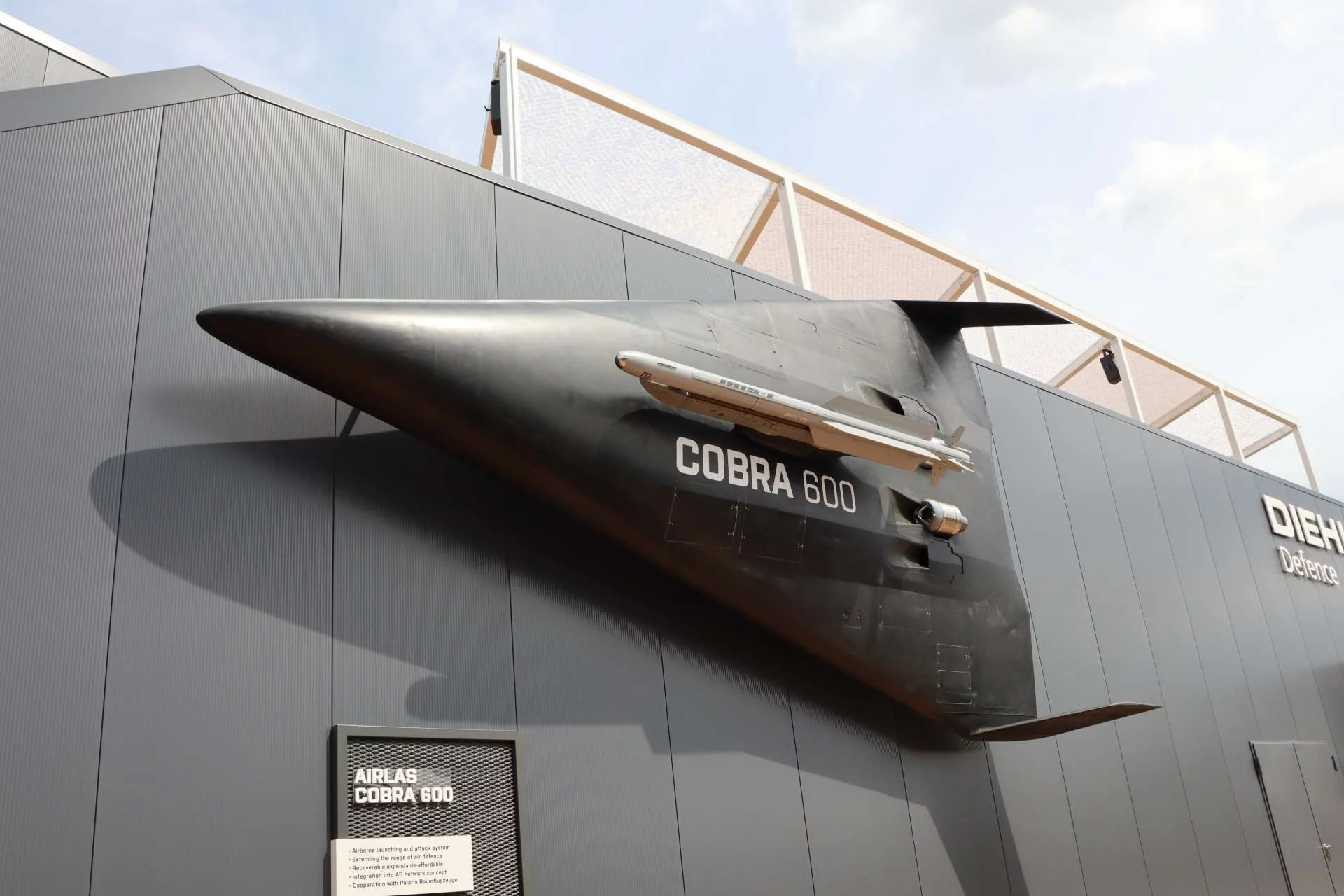
German company Diehl Defence presented the Cobra 600 jet-powered drone at the ILA Berlin Air Show 2026 — a platform developed specifically for launching IRIS-T missiles. The system's declared operating range is up to 400 kilometers from the operator.
The concept is simple yet radical: instead of keeping a launcher within range of enemy missiles, Cobra 600 relocates the firing moment deep into a covered zone or above the line of contact. IRIS-T in its basic SLS configuration has a range of up to 12 km, SLM — up to 40 km. Cobra 600 transforms this missile into a weapon whose launch point itself becomes a mobile and difficult-to-strike target.
For countries building layered air defense systems — such as Ukraine or NATO's eastern flank states — this means the ability to protect objects deep within their territory without deploying ground-based systems near them. Alternatively, keep the launcher in relative safety while striking targets above the frontline.
Diehl Defence has not disclosed detailed technical specifications of Cobra 600: takeoff weight, flight endurance, navigation systems, and electronic warfare protection remain classified. This is typical practice for platforms between the concept stage and series production — but this is where the main uncertainty arises.
An unmanned air defense missile carrier is not just a technical solution, but also a doctrinal choice. Who makes the firing decision if the drone operates autonomously in a radio silence zone? What are the rules of engagement for a platform carrying a missile with an active homing warhead? Diehl Defence has not publicly addressed these questions.
Cobra 600 is currently just an exhibition piece. But if the system reaches series production and integration with existing IRIS-T SLM complexes, which are already in service with Ukraine and several NATO countries, Europe's air defense architecture will gain a new structural element — and new questions about command and control that currently have no public answers.
Are the customers — particularly the Bundeswehr and NATO partners — ready to formulate clear rules of engagement for an autonomous missile carrier before the platform exits the test cycle?