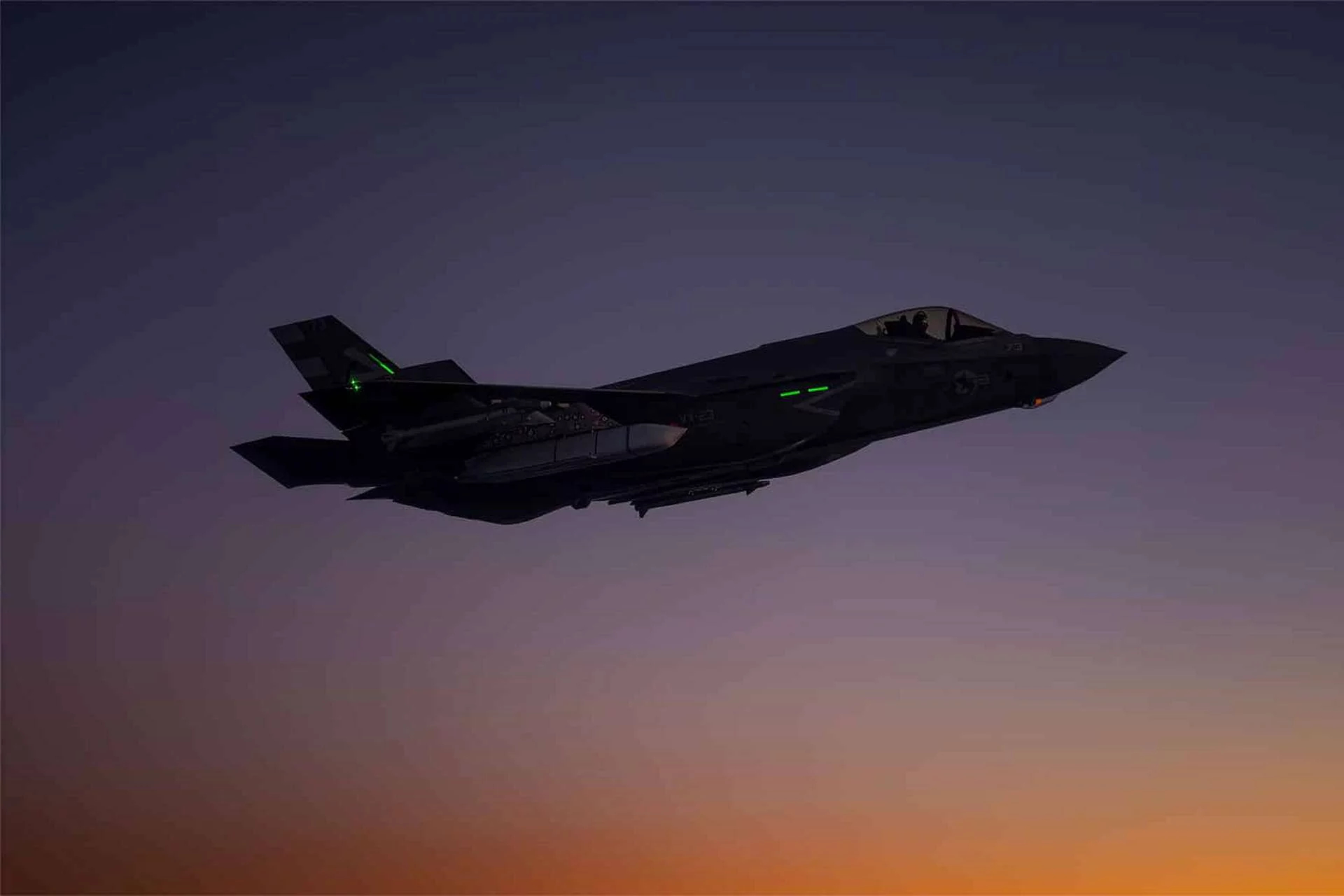
On September 10, 2024, an F-35C conducted its first flight over Naval Air Station Patuxent River in Maryland carrying two AGM-158C LRASM missiles on internal wing pylons—plus two inert AIM-9X missiles on wingtip stations. These were the first "captive carry" tests: verification of how the missile behaves on the airframe in various flight modes, without separation and firing.
Why externally mounted, not in the weapons bay
LRASM physically does not fit inside the F-35's internal weapons bay—the missile, approximately 4.3 meters long, was developed for external mounting on platforms like the B-1B and F/A-18. For the F-35, this means a specific tactical compromise: external carriage partially negates the low observability that the entire program was built around. As The Aviationist notes, the configuration—two LRASM on the pylons closest to the fuselage—is the same one later applied to the F-35B during March 2025 tests.
According to Lockheed Martin, LRASM integration is part of the Block 4 modernization package—along with the JASSM missile (AGM-158B). Both systems are externally mounted. The question of internal carriage remains open: the company has not confirmed whether such modifications are being considered for future versions.
What is LRASM and why does the F-35C need it
AGM-158C is an anti-ship missile featuring stealth characteristics, autonomous target acquisition, and the ability to operate in electronic warfare conditions. According to open-source data, its range is over 370 kilometers, with some estimates reaching 925 kilometers (by analogy with the baseline JASSM-ER). The missile flies at medium altitude, then transitions to "sea skimming" mode—extremely low altitude over water—to complicate interception by ship-based air defense systems.
"LRASM is designed to destroy surface targets in complex electronic warfare conditions and saturated air defense environments."
Lockheed Martin, press release, March 2025
F-35C is the only Joint Strike Fighter variant designed to operate from U.S. Navy aircraft carriers. Its integration with LRASM directly addresses scenarios in the Pacific: as Army Recognition notes, the development is part of the response to growing capabilities of the Chinese Navy's surface fleet.
Where the program stands
The September F-35C flight tests represent the first of several phases. Subsequent phases involve missile separation from the aircraft in flight and live fire tests. In March 2025, the F-35B completed its first phase. Neither variant has yet reached the live firing stage.
- September 2024 — F-35C: first captive carry flights (September 9–10, Patuxent River)
- March 2025 — F-35B: first captive carry flight, confirmed by Lockheed Martin
- Next phase — separation and firing: date not announced
Captive carry is merely confirmation of structural compatibility. At least two more test phases remain before operational readiness, after which data proceeds to certification.
The key question for the program: if external carriage remains the only option, will the F-35C be deployed with LRASM in scenarios where stealth is critical—or will the missile become a second-echelon tool, used after air defenses are suppressed by other means?