Most people buy a charger, plug everything into it, and forget about it. DJI went further — its Power 140W GaN doesn't just divide current between ports, it decides who charges faster.
What's inside
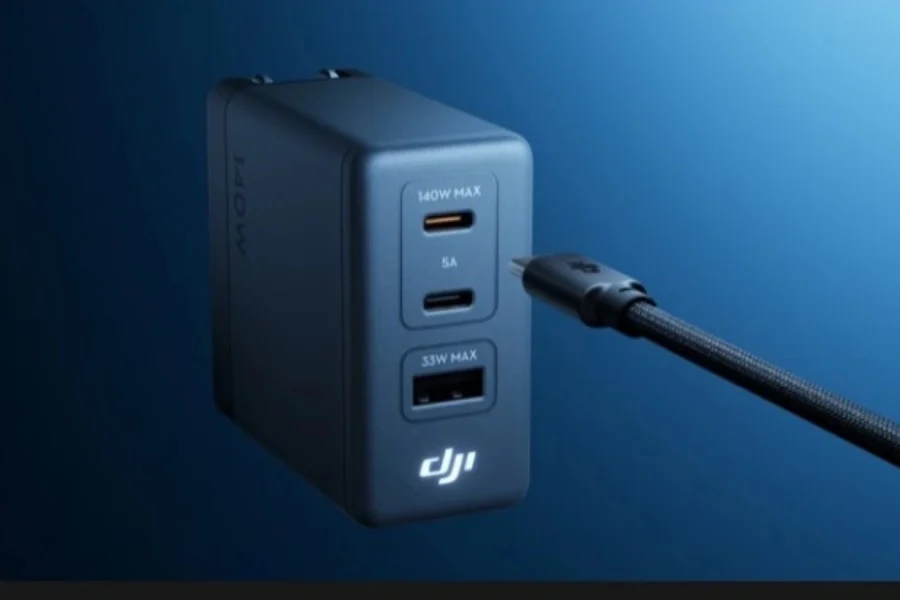
This is the first high-power GaN charger in the DJI Power lineup. Two USB-C ports support the Power Delivery 3.1 standard and each can deliver up to 140W — enough for a MacBook Pro 16" or compatible Lenovo or ASUS notebooks. The third USB-A port delivers up to 33W and is designed for headphones, older smartphones, or peripherals. According to Gizmochina, the housing with GaN semiconductor measures just 68.3 × 32.2 × 64 mm and weighs 245 grams — more compact than most 65-watt chargers on the market.
Dynamic distribution: how it works in practice
When multiple devices are connected to the device, the charger automatically recalculates power limits between ports. The key thing is that this happens without interrupting charging when a new device is connected or disconnected. None of the active ports "restart."
Priority in the queue goes to devices from the DJI ecosystem — drones, cameras, brand accessories.
DJI, technical description of Power 140W GaN
This is not a neutral function. If you connect a DJI drone and a third-party laptop simultaneously — the drone gets more watts. For a pilot with a flight an hour away, this is convenient. For a designer rendering a project on a third-party brand laptop nearby — less obvious.
Package and price
Along with the charger, DJI sells a USB-C cable with a built-in digital display showing real-time power consumption. The cable supports up to 240W and data transmission via USB 2.0. The charger's price is 209 yuan (around $30 / ~1250 UAH), which for a 140-watt GaN charger with priority distribution is a competitive offer.
Where the catch is
DJI is primarily a drone company, not a charger manufacturer. The Power 140W GaN looks like a way to keep users within the ecosystem: it's convenient to carry one charger for everything, but it's deliberately optimized for its own products. The announcement coincides with the expansion of the DJI Power lineup — at the beginning of 2025, the company already showed the Power 1000 V2 with two 140-watt USB-C ports for stationary use.
The question isn't whether you should get this charger if you have a DJI drone. The question is whether this priority logic will remain transparent when the Power lineup expands to charging stations for cars or offices — where there may be no DJI devices of "its own" at all.