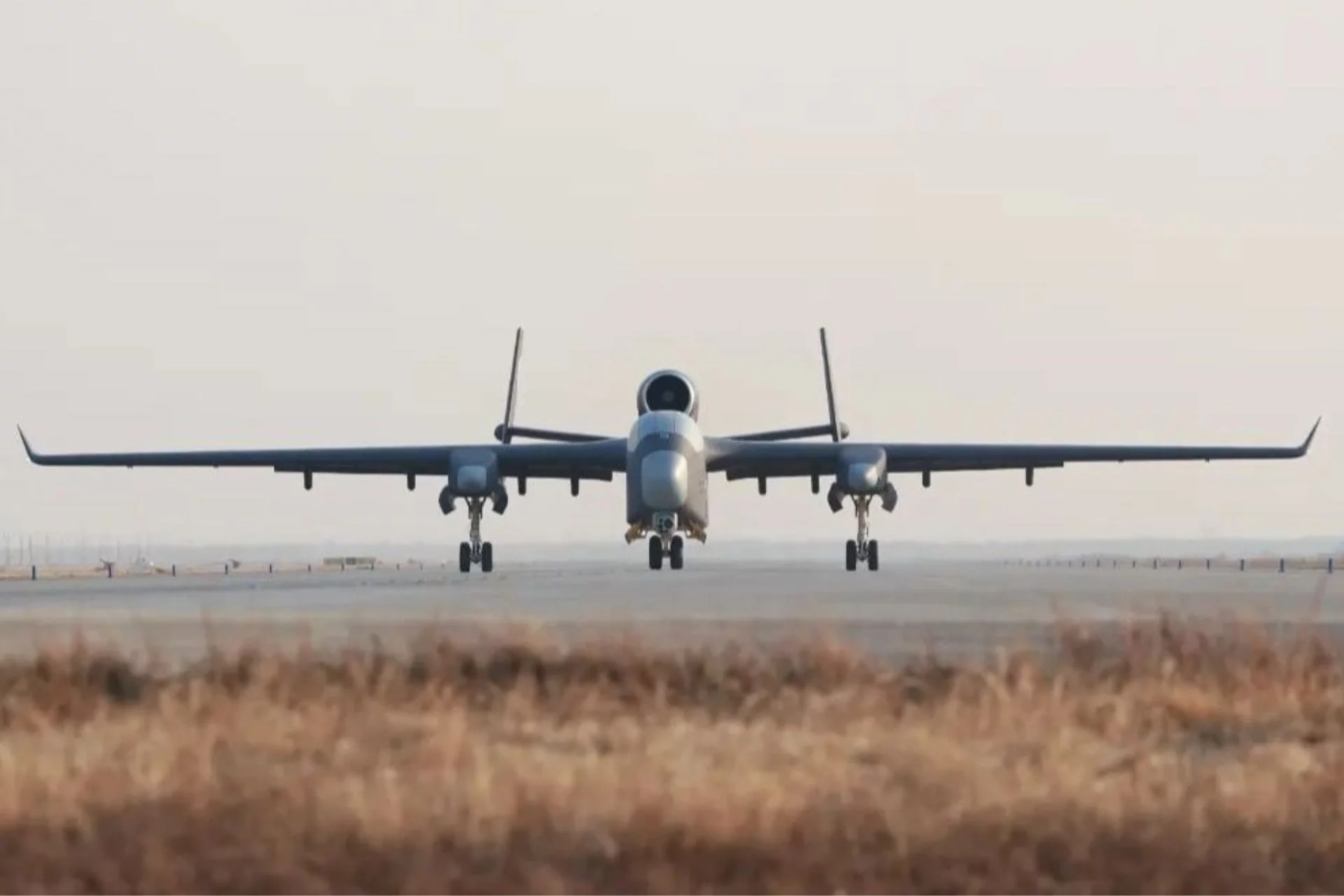
On December 11, 2025, a drone took off over Pucheng County in Shaanxi Province that Chinese state media dubbed an "aerial aircraft carrier." Jiutian — a development of China's Aviation Industry Corporation (AVIC) — made its first flight following its debut at the Zhuhai air show in November 2024.
What is this machine
According to specifications released by AVIC and Chinese state media, Jiutian has a length of 16.35 meters and a wingspan of 25 meters. Maximum takeoff weight is 16 tons, payload capacity is up to 6 tons. Cruising speed is approximately 700 km/h, ferry range is 7,000 kilometers, flight duration is 12 hours. For comparison: this is greater than the distance from Beijing to Guam.
The construction is modular. At the Zhuhai air show, the payload module was labeled "Isomerism Hive Module" — an awkward machine translation of a Chinese term that AVIC later clarified: it refers to launching a swarm of drones in flight. Under the wings are eight hardpoints for air-to-ground and air-to-air missiles, including the PL-15.
Television scenario — not advertising, but doctrine
In May 2025, CCTV aired a conceptual video: several Jiutian aircraft dropping hundreds of quadcopters and winged strike drones that coordinate attacks against a U.S. Navy carrier strike group, clearing the path for anti-ship ballistic missiles.
"Jiutian can threaten critical infrastructure on Guam and beyond — if deployed from bases in mainland China or support points in the South China Sea."
Asia Times, analysis from December 15, 2025
The logic is simple: small drones lack the range to reach Guam independently. Jiutian solves this problem — it becomes a mobile airfield that brings the swarm closer to its target.
A lesson from Ukraine that Beijing studied carefully
Analysts from Asia Times directly reference Operation "Web" — a Ukrainian attack in summer 2025, during which drones secretly transported to Russian territory destroyed a significant portion of the strategic bomber fleet. This very precedent demonstrates the vulnerability of aircraft on the ground to swarms — whether they are stationed at a Russian airbase or at the American Diego Garcia base.
What was practiced over fields near Avdiivka with cheap FPV drones — hunting personnel, destroying fortifications, counter-drone missions — Jiutian transfers to a strategic dimension: the same saturation logic, but with intercontinental bomber range.
Civil dashboard as cover
Officially, AVIC positions Jiutian as a "multi-purpose platform": cargo delivery to remote areas, restoring communications after disasters, monitoring forest fires, maritime patrol. This is not hypocrisy — the modular design truly allows for quick reconfiguration of the aircraft. But that same modularity means the line between civilian and combat use blurs at the level of a single cargo compartment.
The Chinese government is promoting the concept of a "low-altitude economy" — large-scale development of unmanned aviation. Jiutian fits into both narratives simultaneously, complicating any export control from Beijing's partners.
Where the line between demonstration and combat capability lies
The first flight is not adoption into service. Jiutian underwent flight tests with a single aircraft (airframe №004, the same one demonstrated in Zhuhai). Until series production, working out swarm tactics, and real integration with control systems — years of work lie ahead.
However, the pace of China's unmanned program provides no grounds for complacency: exactly one year passed from first demonstration to first flight.
If the United States does not accelerate its own swarm countermeasure programs — particularly laser and microwave weapons for Guam — Jiutian will transform from a technology demonstrator into an operational threat before any Pentagon analytical report manages to capture it.